You’re the Duke! You’re the Duke!

Because I play so many board games, sometimes this funny thing happens where I’ll experience a game and its source material out of order. Last night, for example, I watched my first episode of The Mandalorian as research for Corey Konieczka’s latest adventure title. This is always an interesting process. Rather than approaching the game with my own assumptions about what a proper adaptation might entail, everything is flipped on its head as my feelings toward the source material are filtered through the lens of the of the adaptation. I’m peering through the telescope in reverse.
A few weeks back, I watched Escape from New York for the first time. The reason? That same evening, I’d conducted my inaugural play of Kevin Wilson’s version of John Carpenter’s cult classic. My main takeaway was that the film, like the game, is sublime trash. But here’s the kicker: I think I prefer the game.

Navigating roadblocks, mooks, and the mean streets.
The President of the United States has been captured by the gangs of New York. Also, New York has been converted to a massive prison island, awash in piss and gibbering maniacs. AND IN THE GAME, HARDY HAR. Ahem. By now, the setup for Snake Plissken’s infiltration of Manhattan has reached sufficient cultural penetration that I knew the gist before either playing the game or watching the movie. Get in, get the President, get out.
Wilson largely preserves that formula. Starting in the center of Manhattan Island, Snake and a few untrustworthy companions have a limited number of turns to find a few key items — the President, a tape containing some super-duper secret information, an escape route across one of the island’s booby-trapped bridges — or die trying.
Or — and this is crucial — everybody has the option to betray their pals and escape on their own.
Wilson’s adaptation is a throwback in two senses. In the first sense, it’s a nostalgic trip through a much-loved film, one that’s proved uncannily enduring and influential, from William Gibson’s Neuromancer to Hideo Kojima’s whole brand. In the usual fashion of cardboard adaptations, playing this game is a tour of various sights, characters, and story beats from the film. There’s an event card that gradually adds prisoners to the top of the World Trade Center; once they hit a critical mass, they will topple Snake’s infiltration vehicle from its rooftop to the streets below. There are trashcan lids used as shields, cars as improvised battering rams, and firearms with ill-recommended scopes mounted on them.
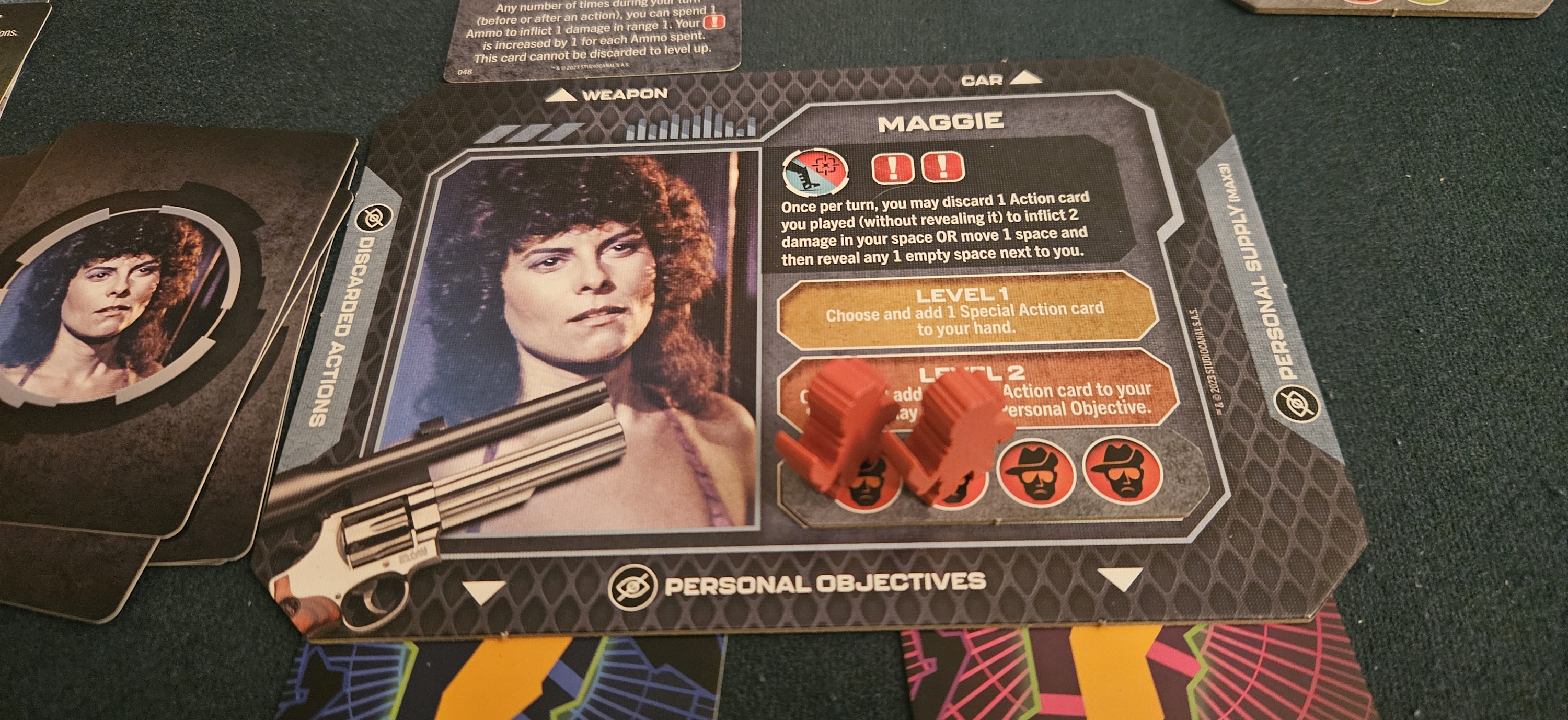
Characters carry items, brandish weapons, level up, manage cards…
More than that, Wilson captures the behaviors and tics of Carpenter’s characters. In one sense, the movie feels primed for gamification: it’s staffed by four principal characters, each with their own cool lines, weapons, and means of bypassing the obstacles standing in their way, and none of them really trust the others.
That last point is key. Too many board game adaptations focus on aesthetic over intention, familiar faces over feel. Escape from New York does both. Each character has their own repertoire of action cards that produce distinct behaviors within the game world. Snake Plissken is a stealthy close-combat commando who can either creep around enemy forces or engage them directly. Maggie tends to murder her problems at range. Brain tricks his enemies into moving elsewhere rather than confronting them head-on. And Cabbie… well, Cabbie has a cab that he drives all over the place, apparently leaning on the horn entire time.
But in addition to these personality traits, nobody really believes that they’re part of a team. Sure, it’s possible, if only barely, to scrape together the President and the necessary items, reach a bridge, and pass through its defenses before the timer runs out. But why go to all that trouble? When the game begins, everybody receives two hidden personal objectives. To escape on their own, both must be accomplished. On their own, this is slightly easier than assembling the moving jigsaw that is the game’s cooperative objective. Now, whenever one of your teammates moves off in an unexpected direction, you aren’t merely doubting their strategy. You’re questioning their loyalties.
This outright solves the quarterbacking problem, not to mention produces some nice table-talk. Players regularly cast aspersions on one another’s intentions. Certain cards let you swipe items from your teammates; this masterstroke makes it possible to, say, deprive a friend of the item they need to escape the island on their own. That’s a straightforward enough move, eliminating temptation so as to bring wandering feet back into the fold. But if you’re a jerk, you could instead kidnap the President out from under a teammate’s nose, preventing them from assembling at the nearby bridge for evacuation.
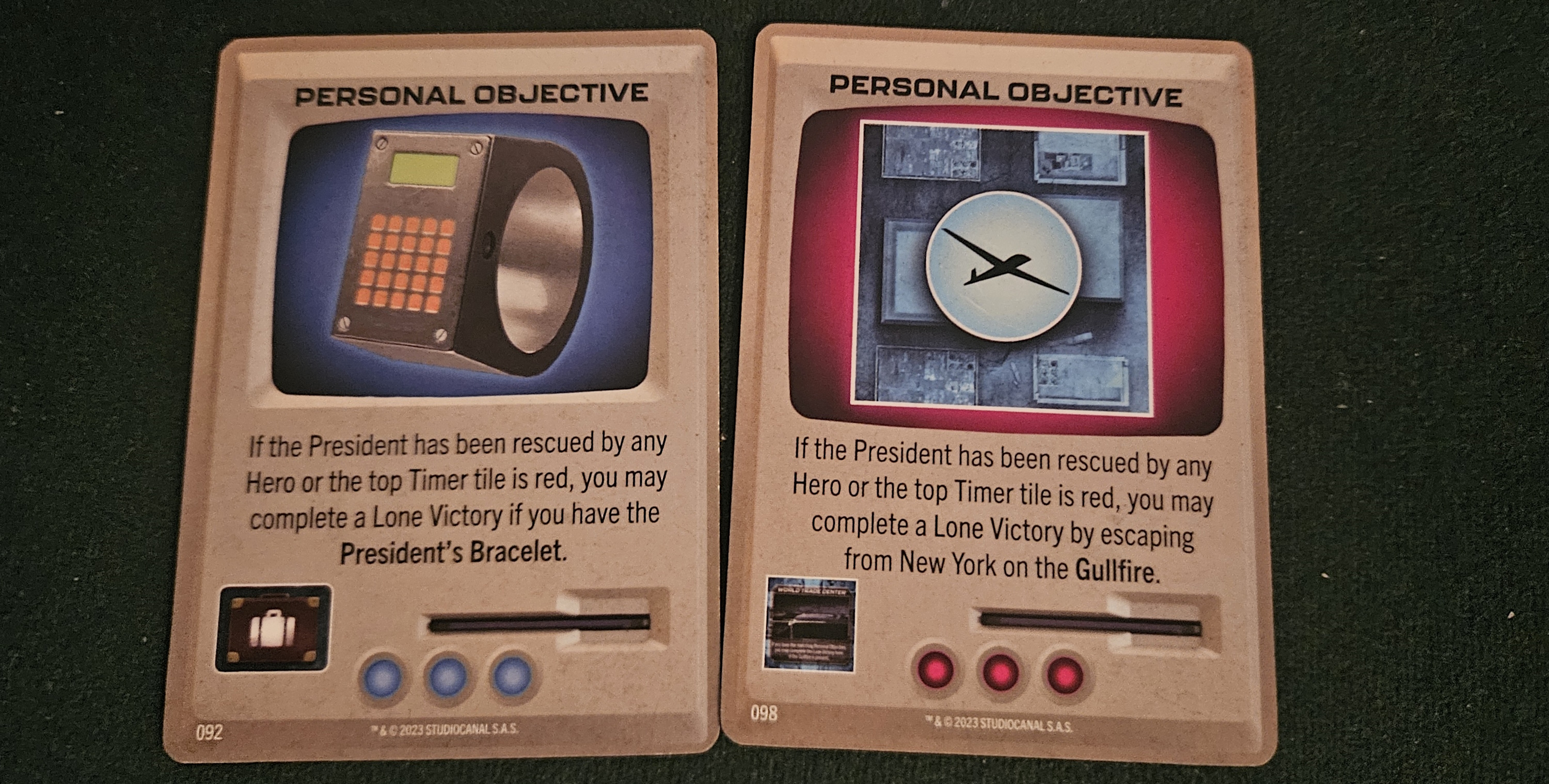
Work as a team or pursue your personal objective? That is the question.
While Wilson faithfully produces a throwback that hearkens to the aesthetics and feel of John Carpenter’s original, this is also a throwback in a second sense. Namely, that Escape from New York feels like a relic from ten years ago, an overstuffed Ameritrash design that doesn’t know when to stop tossing ingredients into the blender and thumbs its nose at hoity-toity terms like “elegance” and “restraint.”
The biggest example comes in the form of the game’s event system. Or should I say, its three event systems.
First up is the timer deck, one of the game’s soundest ideas. This is the ticking time bomb implanted in your neck; when the deck runs dry it’s kaboom for your arteries. But rather than ticking down every single turn, the timer is connected to your forward momentum and the game’s abstraction of your life points. I mentioned the cards that dictate your character’s actions. Each turn sees you using two of these to sneak, run, fight, or whatever else, and then setting them aside until you opt to take a breather. This lets you restore your entire hand of cards, but also forces you to reveal a card from the timer deck. This presses your cards to pull double-duty. When you take an action, you discard a card. When you take a hit, you discard a card. Eventually, your character will be so worn out that they’ll be forced to decrease the timer. It’s a clever way to handle stamina and health at the same time, preventing players from being eliminated prematurely but also hastening the game’s conclusion. Could we call it elegant? Sure, but only if we want to offend Snake’s sensibilities.
Naturally, these timer cards have events that trigger when you reveal them. Pretty normal, right? But this is only the first of three methods the game uses to govern enemy responses to your activities. There’s also an actual event deck, a bunch of cards that only trigger when you enter designated spaces. Frankly, the game could have done without these; they rarely trigger and their effects are muted.
The New York deck, along with a corresponding board, is more robust. Basically, almost every action makes noise. Little by little, this pushes up a track. Eventually these points will be spent to activate cards from the New York deck. Maybe some wandering mooks come to investigate. Maybe you spark a massive ambush that shreds your hand of cards in a single spasm. Eventually, tougher cards are added to this deck. Even the wimpiest enemy thug gets tougher, more dangerous, and breaks out ranged weaponry rather than chasing you with baseball bats. Enemy bosses appear to hound you through the streets. Meanwhile, the backside of each New York card also pulls enemies toward your position and potentially adds roadblocks to prevent easy traversal.
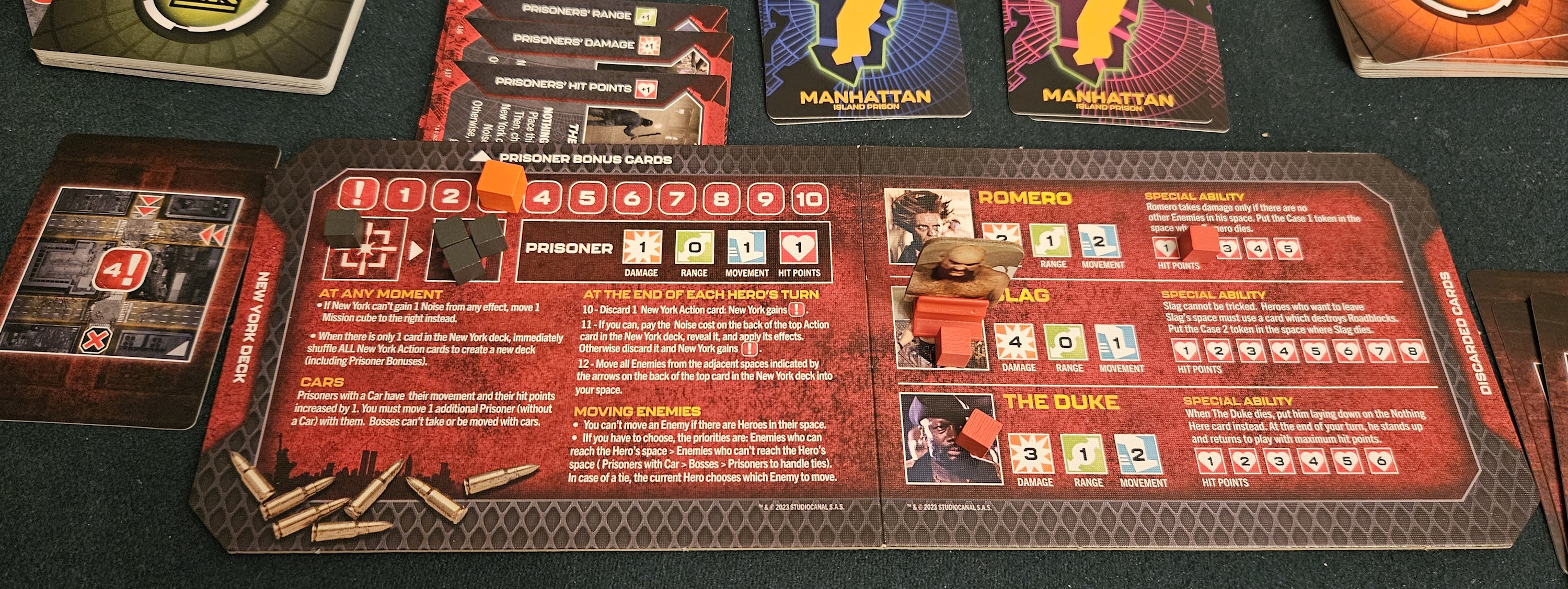
New York gets mean as more noise is generated.
It’s a mess. A glorious mess, but a mess nonetheless. Between your own actions and the response from all these decks, there are twelve steps per turn. Tiny steps, most of which don’t trigger on any given turn, but still. Even messier, there are edge cases to consider. Despite the game’s best efforts at thoughtful iconography and a clear layout, it isn’t long before New York’s streets have become a hodgepodge of blocked intersections, enemies with various movement and attack ranges, and escape routes both viable and busted. I dread drawing the card that sees enemy foot soldiers, cars, and bosses converging on somebody’s position. I’m still not sure I wholly understand all the particulars.
That said, this game is a riot. As adaptations go, it’s a clear labor of love. Exploring the map is wonderful, a combination of multiple card types, sometimes with their own rules. There are so many verbs to play with. Players sometimes slink through the city, doing their best to keep quiet and scout around every corner. Other times they bum-rush into danger, guns blazing, bats swinging, and wheels burning rubber. There are opportunities to be tricky, moments to flee as fast as your feet will carry you, and breadcrumbs of opportunism that will have team players contemplate betrayal most foul. It nails the oddball tone of the movie. Nails it like a baseball bat with nails hammered through the barrel.
Which is why I suspect Wilson’s insistence on cramming everything into the box stemmed from an affection for the source material. The funny thing is that his efforts at compression apparently failed — there are already two expansions! Neither one is necessary, but then again neither was half of the stuff he packed into this box. Still, if you want to host activate negotiations with the cops while you’re running their boss’s errands, or let a fifth player take control of New York directly, that stuff exists. Don’t ask me whether it’s any good. I haven’t touched it. When there’s already so much to play with in the base box, I simply don’t see the need.
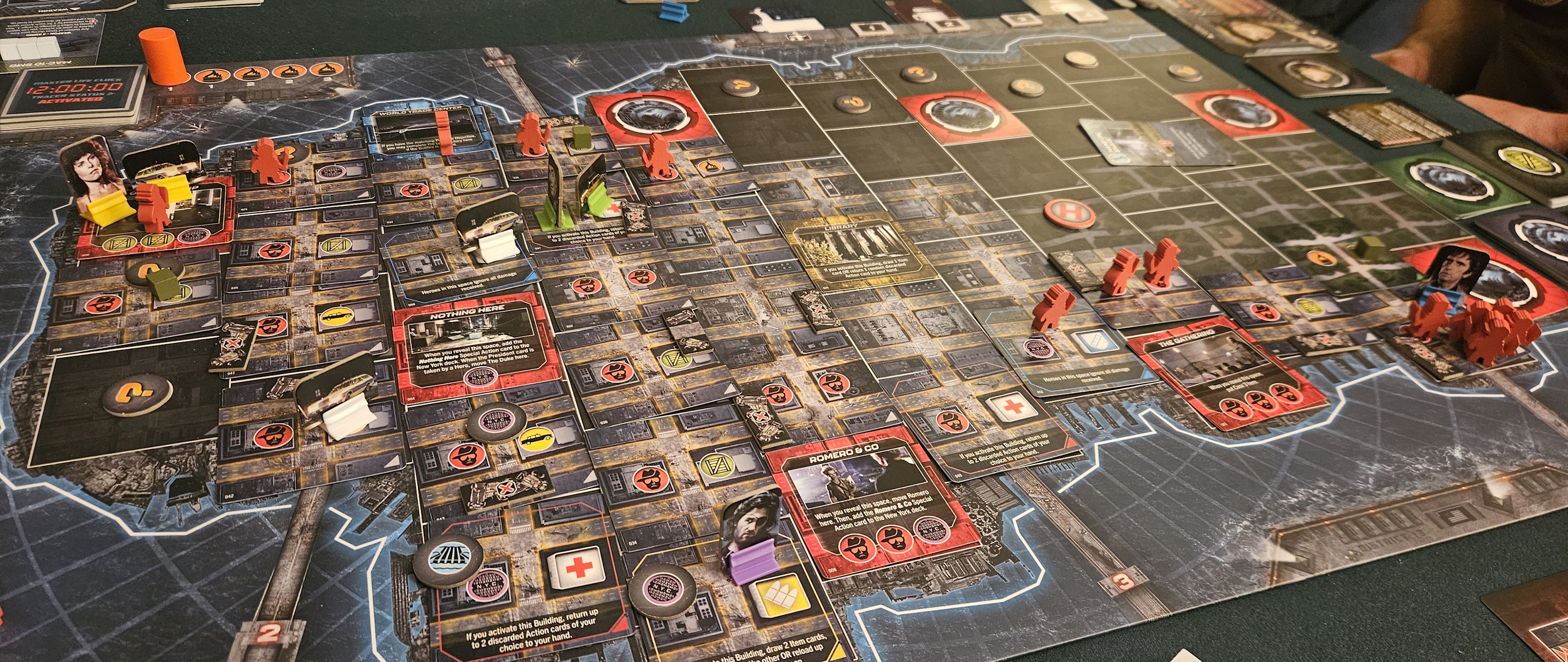
The sprawl.
It’s a delight to see such enthusiasm. While playing Escape from New York, I’ve also been tackling Wilson’s Kinfire Delve, a game that could not be more different from this one. It’s elegant. It’s smooth. Every detail has its place. There are not three separate decks that do more or less the same thing.
But of Wilson’s bipolar design modes, this is the one that gets me the most excited. It’s bombastic, packed with detail, and shows way too much chest hair. It’s also one hell of a good time, a merger of nostalgia, old-timey design, and just enough modern expertise to keep it from getting too bloated. Here’s the word: Escape from New York is pure trash. Button me up for a dumpster dive.
(If what I’m doing at Space-Biff! is valuable to you in some way, please consider dropping by my Patreon campaign or Ko-fi.)
A complimentary copy was provided.
Posted on July 25, 2024, in Board Game and tagged Board Games, Escape from New York, Pendragon Game Studio. Bookmark the permalink. 17 Comments.

 SPACE-BIFF!
when I read the title, I was thinking, “please God, let this be an Escape from New York game!”
Continue reading…
and it was!!!
You never know another person’s movie lexicon, but for just watching it for the first time…you’re doing it right!
Haha, thanks!
This looks sick!! Do you know how to get a copy?
I believe it’s in “coming very soon” mode. Maybe Gen Con?
(By the way, I see your username, haha)
are you aware of the older game, released soon after the movie? Much less state-of-the-art to be sure, but an interesting contrast.
I know it exists, but I haven’t played it. A comparison piece would definitely be worthwhile…
But maybe for someone else.
What a wonderful surprise. I’ve had a hard day of traveling and just settled into a somewhat less than ideal hotel bed. Looked on my phone and was elated to discover a Space-Biff review of a game I backed and am eagerly awaiting. To make it even better, it sounds like the game is exactly what I was hoping for. Thank you for reviewing this! Excellent as always!
Glad to be a bright spot in an otherwise tough day! Hopefully tomorrow will be better. And either way, you’ve got this game coming — and it’s really good.
Wow, this sounds like a really fun game. Co-op game aren’t usually my thing, but this seems like a real genre bender and I’d play it in an instant. Thanks for the great review. Also, Escape From New York was one of my favorite movies when I was a kid. I saw it in the theaters when it first came out and have rewatched it many times (DVD, Blu-ray, now streaming…) and enjoy it every time I watch it. Did you know John Carpenter co-wrote, directed, and co-composed the music for that movie? He was a one man show. Very similar to Ti West who wrote, directed, and edited the “X” trilogy starring Mia Goth (X, Pearl, and MaXXXine) which are all excellent horror movies. I just saw MaXXXine 2 weeks ago – it had a very similar vibe to the old John Carpenter movies, especially Halloween. Sorry, my second most loved hobby after board gaming is watching and talking about movies.
I’d heard that about Carpenter composing! What a guy.
I haven’t seen MaXXXine yet, but I liked Pearl quite a bit.
Hey Dan, have you seen Carpenter’s version of The Thing? Or played the board game based on it by the same company that made EFNY? I’d love to hear your opinions on those if you ever get a chance.
I have watched The Thing; it’s fantastic. I haven’t played Pendragon’s version of it, unfortunately. Back when it released, I was talking to someone from their distributor about getting a review copy, but that fell through for some reason.
Pingback: The Man DeLorean | SPACE-BIFF!
Pingback: Some Rando Viking | SPACE-BIFF!
Pingback: Best Week 2024! Adapted! | SPACE-BIFF!
Pingback: Kinfire Homeowners Association | SPACE-BIFF!