See Shells She Sells

In an age when so many board games are designed as ludic dogpiles, heaping as many mechanisms and tracks onto a board as humanly possible, it’s little oddities like Seaside that prove the inverse. You can do so much with a single idea.
Here, Bryan Burgoyne’s idea is simple. On your turn you draw a tile. Each face shows a different action. You select one, either tossing the tile into the sea or claiming it for your stretch of beach. Barring a few specifics, you could start playing right now.
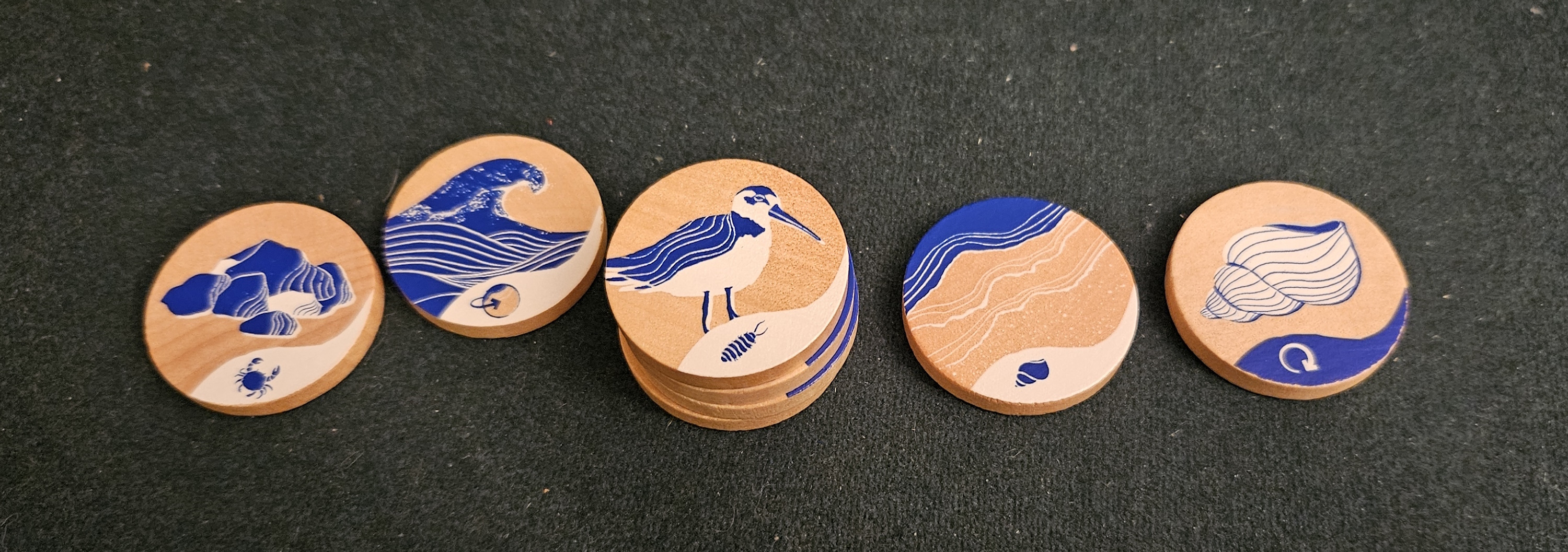
Check out those tiles.
Even those specifics don’t add much to the description. There are seven faces in all. Three of them are more or less identical. Should you draw and choose a crab, an isopod, or a seashell, you toss the token into the sea and then pull from the bag again. Breezy.
The four other tokens are more involved but not by much, each offering a different method for claiming tokens from the sea to your seaside. Beaches are the simplest. Once played, you can claim as many shells as you now have beaches. See? Nothing to it. Rocks are a little tougher, but not because of their rules. Whenever you place an even-numbered rock — your second rock, your fourth — you claim every crab in the sea and one from an opponent’s shore. Again, easy, although this time with a bit more oomph. More risk, bigger payout. The last of the gathering tiles is the sandpiper. This guy gobbles up as many isopods as you want, up to the maximum in the sea. The trick is that these isopods are stacked underneath your sandpiper, and you can only have stacks of a single height. If one stack outdoes the others, all of them are discarded except for the highest stack.
There’s one more tile, the wave, which flips one of your beaches to its opposite side and resolves it. This can lead to little splurges of activity, especially when a wave reveals a wave which reveals an isopod which lets you draw again. They don’t sound like much, but waves are the game’s gesture at shooting the moon, or thereabouts. When the bag empties and the game concludes, it’s the player with the most waves that claims all the remaining tiles in the sea.
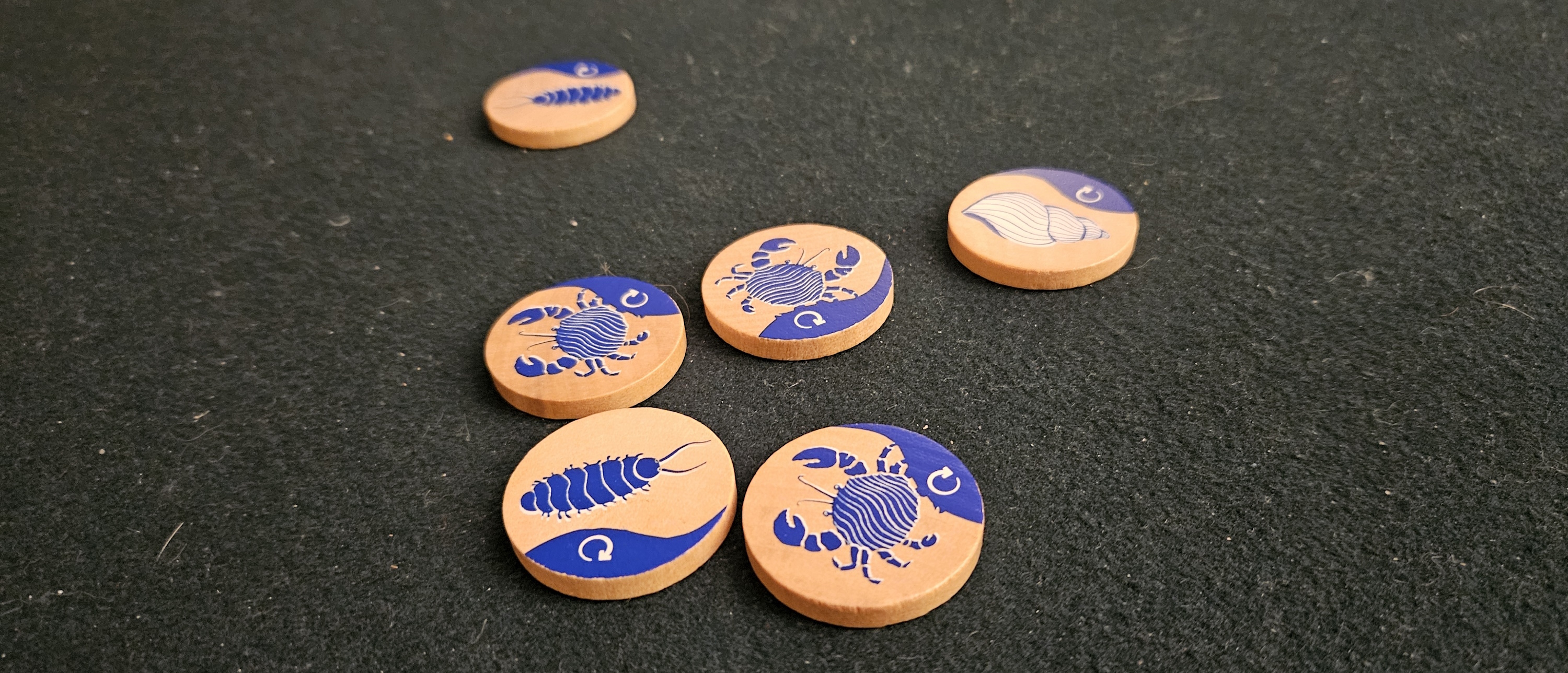
The sea will claim us all. But not yet.
The appeal of Seaside lies entirely in its rhythm. As you might expect, most turns consist of pulling tile after tile, opting for the ones that fill up the sea, until you happen upon something that will gobble up enough tiles to make it worth your while. This is inherently risky, albeit risky in a cozy way. Maybe even a serene way, although that might be overselling it. Every pull risks filling up the sea for somebody else. Especially when you get one of those unlucky draws that refuses to throw something into the sea, instead showing two faces that can only be placed on your seaside.
There’s some strategy, a need for players to search out little opportunities while fishing for certain long-term investments, but let’s not kid ourselves. This is a mood game, an after-picnic affair, a fact exemplified by the durable bag and hardy tiles. I have my suspicions that the paint might wane in the face of actual weathering, but it seems like an excellent choice for family campouts or day excursions.
In that light, simplicity is nothing but a note in the game’s favor. My ten-year-old insists that the sandpipers are protecting the isopods. My five-year-old clacks the tiles and invents games of her own, contests that operate according to more labyrinthine rules than Burgoyne’s. Both can play it, more or less.
At the same time, I can’t help but wish for the slightest bit of extra friction, the proverbial sand that would become the pearl. Seaside isn’t merely cozy; it’s sleepy. Which is a fine thing for a picnic in the sun, spread out atop a blanket, but still limits the game to a certain niche.
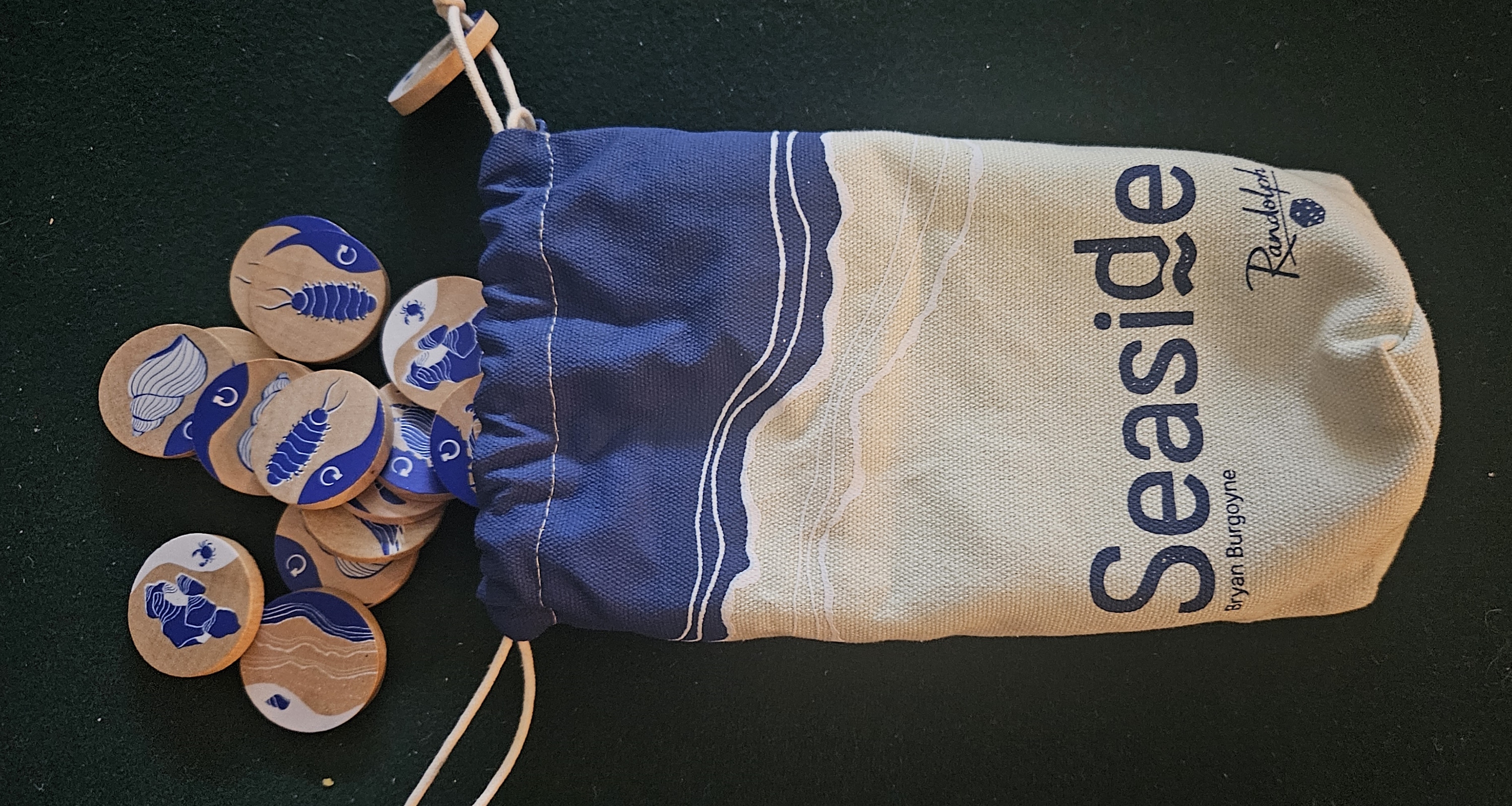
I do appreciate complete packages like this.
Either way, this is one more proof that a single idea can do a lot more than meets the eye. Seaside embraces the beach life. Its limbs are heavy and warm. Its strategies are straightforward but sufficiently attention-getting that its fifteen minutes are well spent. I would rather play this than certain of its over-stuffed peers.
(If what I’m doing at Space-Biff! is valuable to you in some way, please consider dropping by my Patreon campaign or Ko-fi.)
A complimentary copy was provided.
Posted on July 15, 2024, in Board Game and tagged Board Games, Hachette, Seaside. Bookmark the permalink. 5 Comments.

 SPACE-BIFF!
That sort of light, flowing rhythm makes me think of Jaipur, which also feels low-intensity in a good way, but can be unsatisfying. I do love the camel mechanism in Jaipur — I wonder if the isopods feel a bit like that.
Sort of besides de point, but I searched for Burgoyne and could not find on the wiki page how his rules were labyrinthine. I am curious and would like to learn more about him, do you have a link about what you are referring to ?
His rules aren’t labyrinthine. My daughter’s are.
Ah, I guess I do not understand the sentence or the referring to Burgoyne. English is not my first language and I’m not using it daily so. Anyway, thank you for the answer, I enjoy your reviews a lot (or a least the parts I think I understand ;))
No trouble! It was a fraught sentence.