Those Dying Generations at Their Song

Playing Defenders of the Wild, a poem comes to mind: “Sailing to Byzantium,” William Butler Yeats’ lament of old age and concern over whether anything remains after this life. I considered recording a recitation to embed in this article, but you’d be better off hearing it from Dermot Crowley.

These creatures wouldn’t normally get along.
Maybe that sounds funny. How many board games turn one’s attention to Irish poets? Too few.
I don’t think it’s happenstance. Above the table, Defenders of the Wild is saturated with autumnal colors. Setting up the game, someone inevitably remarks that it looks like Catan, what with the hex-frame that rings the board. Yet Catan never looked so solemn. The marshes of this land are rimed with first frost. The mountains wear a shawl of cold mist. The brighter colors, those of the fields and forests, are bright only because they are the visage of nature in its hibernation-throes. The grass gone yellow. The trees bleeding color into leaves that will fall at the slightest stir. What awaits on the other side? The stillness of a winter grave? Rebirth?
Or something worse? The ceaseless tilling of unthinking ploughs. Gasoline permeating the air. Clattering, clambering robots, articulated for mobility but hideous in their movements, patrolling a landscape that will never again hear birdsong.
When Yeats writes that “Whatever is begotten, born, and dies,” I feel old. I think of the windshield after a long drive in my parents’ car, smeared orange and green. I think of my windshield two months ago after we took our own children to Denver. Clean. Unspotted. Biodiversity disappearing right before my eyes. Not in the distant rainforest, where I can cluck about how they should know better. Here, in the heartland of my own country.

The cooks are warriors, the loaves their swords.
As games about standing firm in the face of a dying world, Defenders of the Wild is timely in much the same way as Daybreak, although T.L. Simons and Henry Audubon take a different approach than the one embraced by Matto Menapace and Matt Leacock. There’s the obvious contrast: where Daybreak planted its feet in the real, casting the United States, Europe, China, and the Majority World as its protagonists, Defenders of the Wild adopts an approach redolent of Cole Wehrle’s Root, cloaking its commentary behind the veil of fable.
Both games are about cooperation. In Daybreak, it was international rivals. In Defenders of the Wild, your heroes are creatures of air and land, those that crawl and gallop, predators and prey. My favorite card is a wolf medic. He’s emblematic of the game at large. Grinning wildly, his bone-saw perched across one shoulder like a greatsword, he’s having the time of his life. When the revolution is finished, he’ll be the one amputationist to emerge nourished rather than shell-shocked.
This emphasis on individuals also marks a greater departure from Daybreak. Where that game focused on nations and institutions and inventions, a grand project of global cooperation, Defenders of the Wild is about the small folk. This comes across in the way cards are played. In Daybreak, cards were instruments of corporations and governments, and piled together until they produced unstoppable momentum. Here, every card is a single person. Playing it means that person will take one or two actions, putting themselves at risk. An ox reshoulders his yoke to pull supplies through the woods. A bluejay guides those who once hunted her along hidden paths. A badger brews her precious herbs for the good of all. A fox takes up the banner and grows into a leader.
Daybreak is about change coming from the top. Defenders of the Wild is about change forcing its way up from beneath the soil.
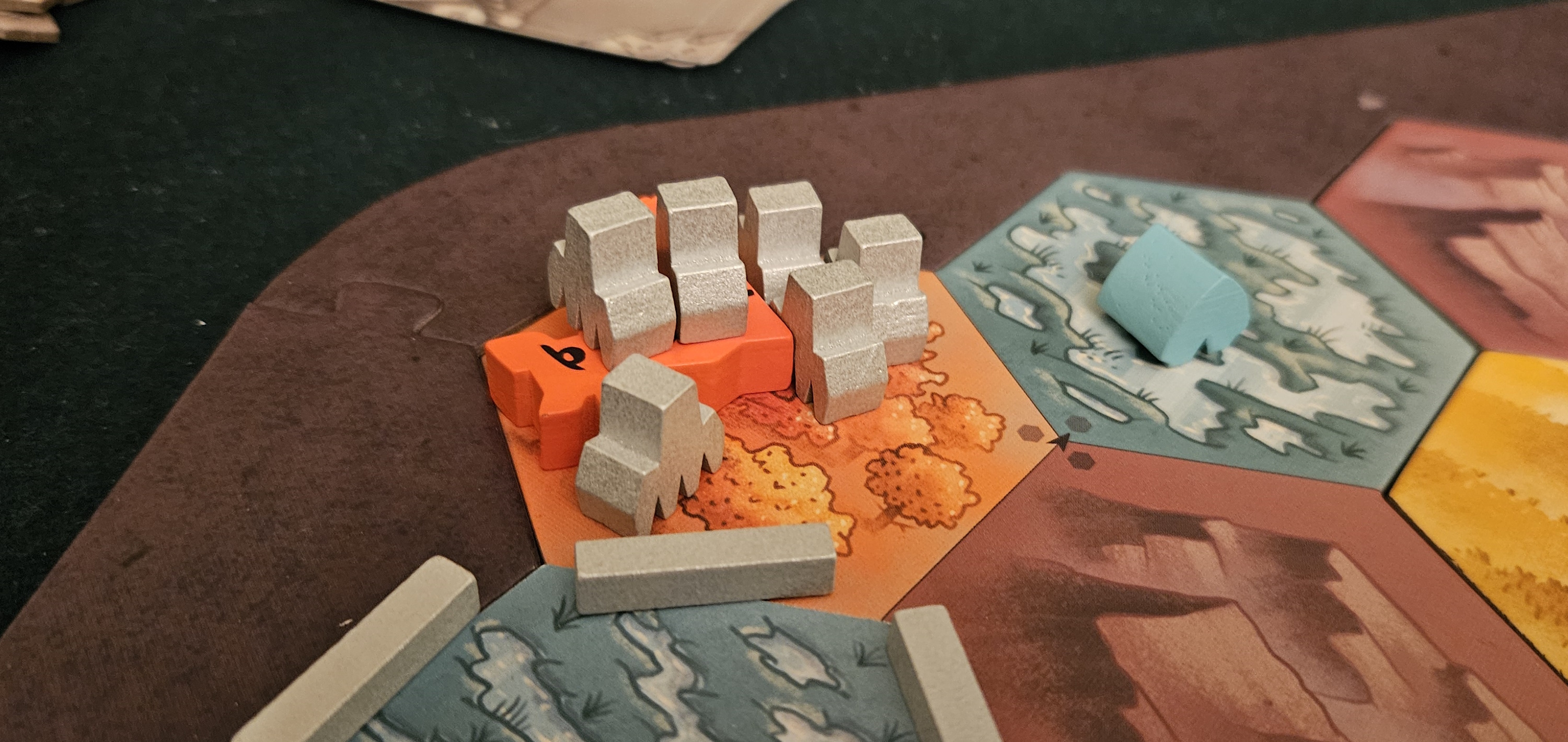
Imagine a robot stamping on a pig — for ever.
It’s appropriate that a game about trashing the system — in some readings of its fable, a system that encourages so-called artificial intelligences to slurp up our fresh water and drain our power grids — should happen to feature such a robust automated rival. Your enemy here is a literal machine, a stand-in for every corporation or government that prioritized growth over health.
Simons and Audubon’s rival may be soulless, but that doesn’t mean it isn’t engineered for self-preservation. Its operations are dead simple, but each one marks the landscape in new ways. Towering engines zipper across forests and marshes in their effort to enclose and pave the wilderness. Factories pour effluent into the rivers, gradually burning toxic scars into the soil. Mechanized police, incapable of recognizing that they will soon be rendered obsolete by the very entity they champion, clatter across hilltops to harry the innocent.
Squint and the machine looks uncomfortably like the activities we’ve undertaken in a hundred board games. Those walls are Catan’s roads. Those mechs are the armies we sent to suppress dissenters and barbarians. Those factories are the cities and mines and sawmills we inflicted on empty tracts of wilderness. Listen to me. “Empty.” They were never empty. There was never such a thing as terra incognita. Only the places and people we decided didn’t count as important enough to deserve protection.
This isn’t the first time we’ve seen a board game counteract its own received traditions. Only last month, John du Bois delivered Striking Flint, a game that inverted the worker placement genre by having your workers sit down to prevent labor rather than enacting it. Defenders of the Wild does something similar. Like Spirit Island, but even more concrete. You are the robber pawn of Catan. You are the barbarians in every civilization game. You are the people lost in the creases of the maps drawn by empires.
And you’re not going to take it anymore.

Casualties are hard-felt.
Maybe it’s a surprise that this is such a simple game. For the most part, your actions are straightforward. Attacking a mech removes it from the map. Cleaning up pollution does the same. Breaching a wall puts a little blast marker next to it, signaling that you can now pass through the opening. (Not to mention that like everything else in this game it’s adorable.) The toughest action in terms of prerequisites is founding a camp. This requires your furries to have gained enough support through the aforementioned actions. The hardest action, rules-wise, is movement, as it’s possible for your creatures to move along habitat corridors. Until the machines stamp a wall across them, that is.
Along the way, Simons and Audubon are clear-eyed about the risks of activism and revolution. Every action is forcibly modified when enemies are near, whether hunters in your space or snipers in a nearby factory. Even the most basic and harmless activity, picking up litter, can result in a bullet hole if the resultant damage die doesn’t roll your way. Absorb too many hits and a card is claimed from your hand as a casualty, bringing the cause one step closer to fatal demoralization.
It’s a sobering note even in a fable, calling to mind the Woodland Alliance’s uprisings in Root, which were vicious and indiscriminate enough that they were only partially softened by the setting. The fable here is more focused — some might call it one-sided — with its emphasis on mutual aid, direct action, and the perils of putting oneself on the line. Some will complain that the machines are too impersonal, that they’re given less of a voice than Root’s villains… but they’re also reducing the woodland to asphalt one parcel at a time. Make of that what you will.
Regardless, Defenders of the Wild is uncompromising as a call to action. Despite the included difficulty options, failure is possible when somebody putters around the edges of the map rather than diving into the thick of it. It’s all so very human. Even when the alternative is annihilation, many of us would rather not think about the wood chipper rolling across the meadow. But it’s coming. We can feel the rumble in the earth.

Getting lucky with those walls!
Perhaps, though, it isn’t too late to alter that course. In one last essential parallel to Daybreak, there’s a stubborn streak of optimism running through this game. The walls can be blasted open. The machines can be rusted from within. The factory parks can be turned over again to nature. They will be forever changed, but may become new again. The fable teaches us that the dragon can be slain. As Yeats put it when his poem turned from despair to hope, “Once out of nature I shall never take / my bodily form from any natural thing, / but such a form as Grecian goldsmiths make / of hammered gold and gold enameling.”
(If what I’m doing at Space-Biff! is valuable to you in some way, please consider dropping by my Patreon campaign or Ko-fi.)
A complimentary copy was provided.
Posted on July 10, 2024, in Board Game and tagged Board Games, Defenders of the Wild, Outlandish Games. Bookmark the permalink. 25 Comments.

 SPACE-BIFF!
Your text was once again fantastic. Only one question remains, did you like it?
The crucial omission! Yes, I like it a lot. I don’t usually get lost talking about a game unless I harbor great affection for it.
Thank you, this is what I expected but you know what they say about assumptions… Fantastic text, made the wait even harder to receive my copy.
Yeah, I regret not being clear in stating that I like the game. So it goes.
This was a well-written piece that I actually found moving in its eloquence – thank you for writing it.
Thanks for reading!
Your initial review of Defenders of the Wild when the KS launched suggested that the difficulty was a bit of an issue. Too easy at times, too hard at others. Do you think the final product addressed this? I noticed they have a bit more variability now with the difficulty at setup. I always appreciate your thoughts!
Happy to help!
Short answer: Yes.
Long answer: Yes. They added a set of tougher robot cards that you can mix into the base deck. Want a stiffer challenge? Replace two regular cards with two difficult cards. Want to endure some real abuse? Replace the whole deck. The robots can still weave around instead of building factories. That’s the nature of random draws. But a string of weak draws matters a lot less when the robots are fielding cards that let their engines move farther each turn, inflict damage with mechs, or churn out factories and pollution at the same time.
The other big addition has to do with player factions. I didn’t have a complaint with the original four teams, but I love how they’ve added a slight bit of customization. Now you pick a leader at the start of each game. This determines the makeup of about half your deck, giving you little bonuses that will feature more prominently but depriving you of other advantages. It goes a long way to producing a new challenge each session.
Hey wait — we could have heard your recitation of Sailing to Byzantium? Give it up, man!
Nah, you don’t want that. I have a face for radio. And a voice for print.
Awww. Well, I appreciate the heck out of your prose. So by all means stick to print.
That’s very kind of you to say, thank you!
That was a great review, really curious about the final version. One of my worries when looking at the campaign of this game and a couple of playthroughs was that there is not really any escalation for the player – or am I missing something? Do you feel more capable as the game goes on or does it get repetitive? Like, following the comparison to daybreak, one of the big things is building up your tableau and having a bigger impact per action.
Thanks for writing!
I would describe it as a tidal shift rather than constant escalation. Picking up items provides new opportunities, such as using maps to escape danger or fireworks to defeat mechs without getting hit back. As you establish more camps, you will draw more cards; this provides further opportunities to use abilities situationally AND you can spend your excess cards for additional actions. It isn’t comparable to the engine-building of Daybreak, but there is a sense of developing your resistance over time. The hiccup is that you can flub the momentum and wind up with a depleted hand until you build another camp. It’s an interesting dynamic, but it doesn’t map easily onto the usual engine-building dynamic.
Thank you for a great review, yet again. Your text was like a poem in itself.Such an enjoyment to read.
I somehow had completely passed this game and had to look it up.
For all of you interested, seems like a late pledge is still possible, but it
closes tomorrow, on the 12th of July.
Thanks for the kind words, Rainwing.
And thanks for sharing that info with our readers! I wasn’t aware of that deadline until after I’d published the review. Alas.
WOW…Very insightful and thought provoking read! Well written (not that I am authority on writing skills😆). I don’t usually care to read much, but I was immediately pulled in, immersed, and enjoying the read. Makes me all the more excited to get my KS copy:) Thanks for the read.
Thanks for the kind words, Sam! Glad to hear you enjoyed it.
Your windshield lament strikes home. I’ve noticed that too in the last 30 years.
Heck, 17 years ago I went to a Family Reunion in Kansas in early July, the air was thick with fireflies, a novelty for a west-coaster.
When we went back a few years ago for another family reunion, and there was maybe one or two fireflies.
i don’t know the life or season of fireflies, so maybe that week or two difference in summer meant they were at the end of their season, but asking around about the fireflies, no one seemed to notice their absence at all.
Thanks, Dan, for finding space to speak about the subtle, unnoticeable and drastic changes to our environment.
Thanks for reading!
Time flies, we have yet to get this one on table. Dan, based on your experience, would you recommend playing this two handed when playing with two players?
You can if you like, but I don’t think it’s necessary to do so. It works perfectly fine at 2p as far as I’m concerned.
Pingback: Biomoseying Along | SPACE-BIFF!
Pingback: Best Week 2024! Better Together! | SPACE-BIFF!
Pingback: Frank in the Woodland | SPACE-BIFF!