Arbor Daze

After a disaster left much of the land uninhabitable, eco-pilgrims journey to faraway territories to restore both their village’s habitats and the creatures that once dwelled there. Dani Garcia’s Arborea joins the recent run of ecologically conscious board games; this time, its fantasy setting provides a colorful, almost trippy backdrop to the action. It’s conservation on acid, the Half-Earth Project on mushrooms.
If only it had embraced the trip.

Villagers on pilgrimage.
The centerpiece mechanism of Arborea is the pilgrimage. Part action-selection, part shared workspace, these are the tracks that everybody at the table relies upon to move their pilgrims to those far-off lands. The process, nigh unintelligible in the rulebook, soon becomes a natural shorthand for the passage of time and distance, not to mention a series of interlocking components and incentives that must be carefully assessed, manipulated, and cursed at.
There are four of the things, each attached to two separate pilgrimage trails, interwoven paths that resemble roots or nervous fasciculi. These tracks are cardboard boardwalks, narrow strips that tick forward space by space until they deposit those pilgrims at their desired trailhead. From there, pilgrims trace a route back home, stopping at each icon in turn to gather — everything. Resources, which can be spent by anyone, but which also have a tendency to dry up at the most inopportune moment. Spirit, your own personal measure of how often you can deploy an extra pilgrim or push one of those routes forward an extra space. Extra villagers, trained and sent out into the world. Cards. Creatures. Favors with the local patron guardians.
Before long, these tracks become symbols for Arborea at large. It’s a clever system. It’s also a fiddly system, a taskmaster that demands updating multiple times per turn. And a fickle taskmaster at that, capriciously doling out significant benefits that can multiply your score across one of four categories. Perhaps it would help if it were easier to move. Not only within the game — that, too — but as a physical plaything. The board is embossed, slightly recessed to hold the tracks in place, but this micrometer depression is so shallow that it’s impossible to discern without running your finger along its surface. Certainly it’s too slight to prevent the tracks from sliding around. The icons on the pilgrimage trails, meanwhile, are as small as the graphic design will permit without requiring a magnifying glass. These details combine to make it both fascinating and confounding. Early in the game, it’s a puzzle to be worked through. Once grasped, it becomes your means of interacting with the world. By the end of the session, it’s a chore that must be completed before Arborea gets to the good stuff.
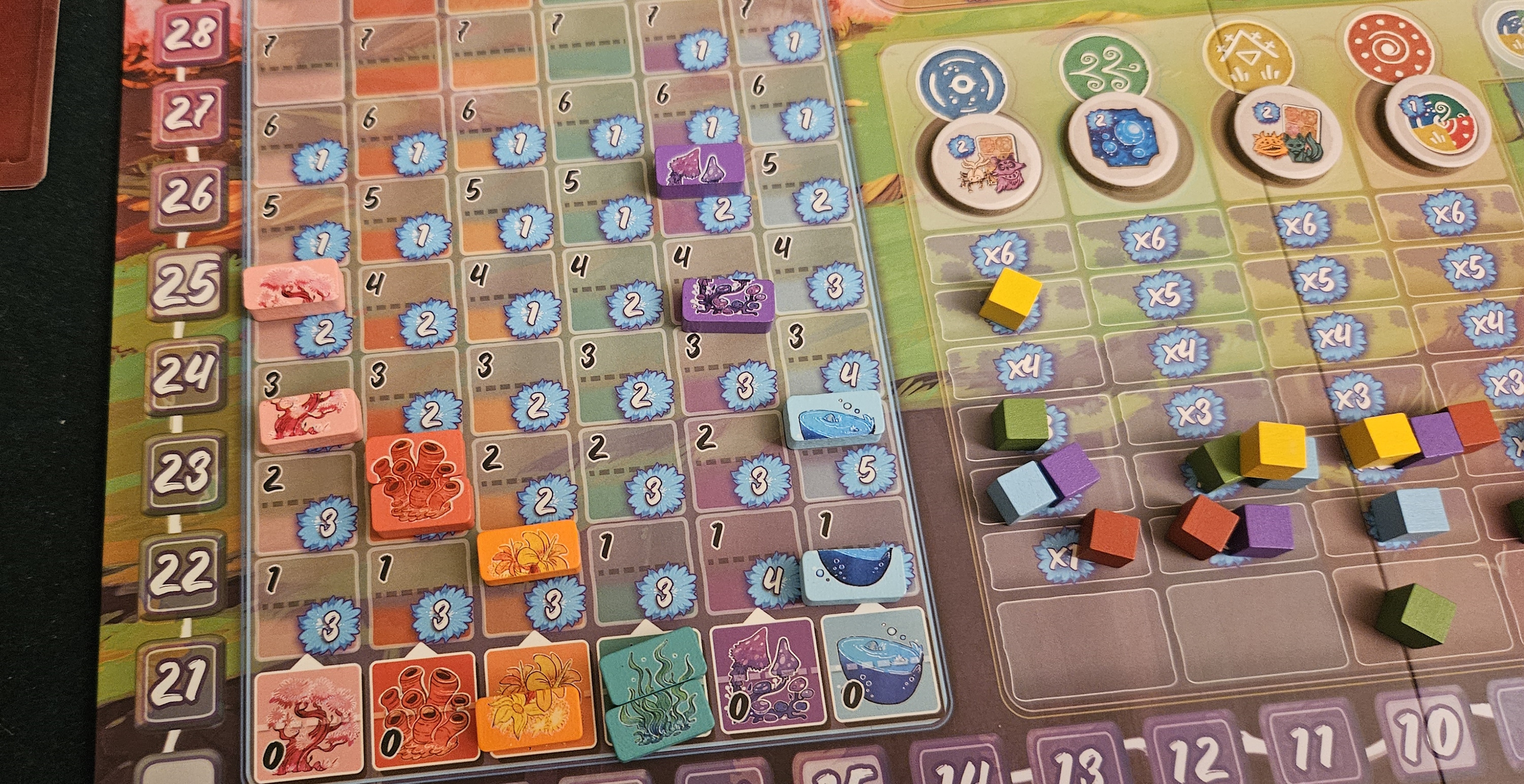
Gathering resources and improving victory conditions.
To be fair, that good stuff is captivating. Take, for example, the game’s resources. There are six of the things, biomes that will heal the land. Coral, forests, flowers, that sort of thing, with life-giving water functioning as the rarest of the bunch and filling in when the others are in short supply. Moving up one of these tracks increases its availability for everyone at the table; anything you don’t spend is awarded as points when your turn ends. The inverse is also true. Inevitably, your plans will be upended when somebody spends that patch of fungus out from under you.
While those moments are often infuriating, they’re also the best part of Arborea. In its finest moments, Arborea functions as a gamified Tragedy of the Commons — a philosophical hoax used to privatize common land, resources, waterways, and nowadays creativity itself, so that some baron or another can make off like a bandit under the pretense of “proper management.” (Hardy har.) In Arborea, these resources are sufficient for everybody and incredibly profitable when generated for the common good rather than only produced when useful for your own enterprises. Reaching that point, however, requires an alien mindset, one that doesn’t mesh well with our commerce addictions.
They are, after all, incredibly precious. Spending resources lets you improve the land around your village, flipping cards that represent the now-replenished land. Nicely, the rewards for doing so are tangible: if a card requires three fungus and a weed, that means its completed side will reveal some combination of those exact biomes. These cards gradually pile together, a placement minigame that allows you to produce vibrant forests, watering holes, coral gardens, and everything else.
Better yet, those biomes soon become home to reintroduced creatures. These represent another shared commons. In the course of their pilgrimages, your villagers will add various fauna to a shared store. These can then be acquired and arranged on all those cards you’ve been flipping. In one of the game’s smartest moves, their reintroduction is holistic; rather than waiting until the end of the game to assign them to their proper places, it’s necessary to introduce these creatures to your cards as soon as possible. Even if the cards don’t quite show the best possible conditions, hoarding creatures in pens soon becomes a net negative, a bottleneck that threatens to subtract points and may prevent creatures from being reintroduced at all. Instead, they should be repopulated both thoughtfully and swiftly, their habitats perhaps adjusted later as time and resources permit.
Of the game’s many scoring conditions, these are by far the most interesting. Most creatures thrive under obvious conditions, most of them color-coded. Purple wiseowls enjoy purple mushrooms, pink mushfrogs hang out in the pink forests, and so forth. But there are other, more knotty considerations. Spiderants prefer being adjacent to differing habitats. Grimsters and tailcats, in addition to preferring their color-coded biomes, also chow down on mushfrogs and antlerworms that sit along horizontal lines. Water doubles the score of any nearby creatures. Rewilding Arborea’s landscape is satisfying, a tangle of incentives that cinch into an imperfect but nevertheless complete knot.

Assembling a thriving ecosystem is a delight.
Had Arborea stopped there, it might have been a wonderful title. Engaging with the game’s commons, producing resources that others will claim, and wrestling with those who take more than they share — these represent Arborea at its best. There’s a complete game in there, one where players must pursue their village’s interests while also stewarding the resources and creatures that everybody needs to thrive.
Instead, this is one more nu-Euro that can write but cannot edit. I mentioned that the pilgrimage system, with its fiddly tracks and eye-squinting icons, is a metaphor for the entire game. There’s simply too much stuff in here. For instance, it’s not only possible to journey across eight separate pilgrimage routes, but also give gifts to the sages who oversee them. Later, when traveling those routes, you can earn further bonuses for each gift given. It’s the mathematical cruft that dominates this sort of game, the sense that everything needs to get bigger, to grow more optimized. Except this flies in the face of how one interacts with all those pilgrimage sites, not to mention how one reads the game’s setting. If anything, reconstituting a damaged ecosystem may well require the global village to become less optimized. In chasing that logarithmic line, Arborea can’t decide what it’s really about.
At a more mechanical level, the game’s incentives get screwy when assessing its non-biome victory conditions. There are four of the things, randomized each game, and they represent a serious wellspring of scoring potential. Moving up those tracks multiplies your score in the corresponding category, introducing huge swings that dwarf the game’s core puzzle of pairing creatures with habitats. To be sure, sometimes these objectives intersect with that puzzle. But not always. Even when they do, there’s a peculiar disconnect between your holistic aims and the particulars demanded by the scoring objectives. A thriving ecosystem demands many creatures, but these goals often award points for having a specific pair.
That’s all rather granular. The point is that Arborea can’t help but overwhelm its best and most topical ideas under an avalanche of unnecessary details. At root, this is a game about feeding into and consuming from a village commons. But it’s also about the track manipulation of its pilgrimages, the track manipulation of its scoring objectives, and the track manipulation of its sage gifts. That’s too many damn tracks with too many damn icons printed too damn small. The Kickstarter Exclusive Edition comes with even more stuff. Don’t worry about it. This is a game that needs its fat trimmed, not extra love handles.
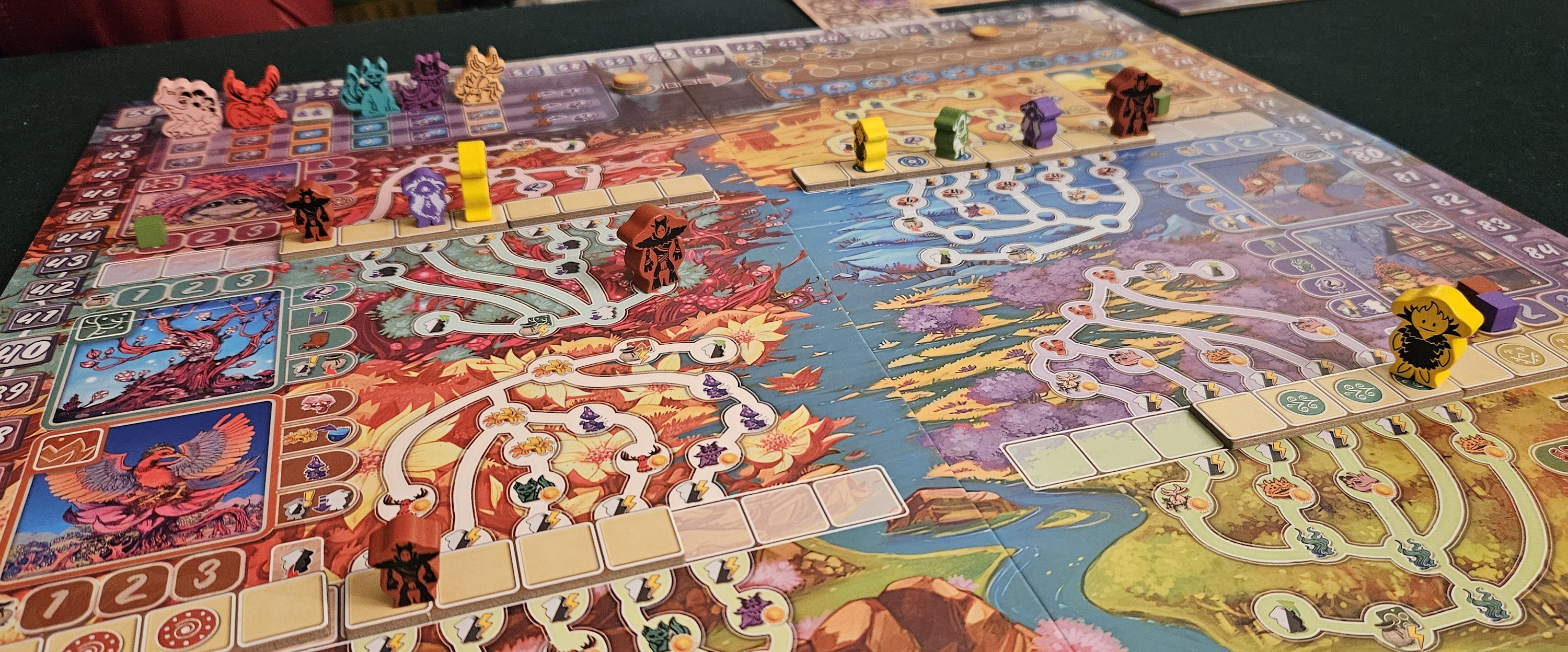
The icons could have been significantly larger.
Somewhere under all that rubble there’s an excellent game in Arborea, one that centers both player interaction and the fraught but essential concept of the village commons. That game likely would have been more experimental, less interested in a half-dozen scoring vectors, a little more accepting of the psychedelic vibrancy of the artwork. It’s a shame we didn’t get to see it.
(If what I’m doing at Space-Biff! is valuable to you in some way, please consider dropping by my Patreon campaign or Ko-fi.)
A complimentary copy was provided.
Posted on May 14, 2024, in Board Game and tagged Alley Cat Games, Arborea, Board Games. Bookmark the permalink. 6 Comments.

 SPACE-BIFF!
I completely agree about the four additional scoring conditions that can really upend the game at final scoring. And the beautiful production is marred a bit by the small icons. I find the core puzzle satisfying enough to keep me coming back though, largely due to the interactivity you have on other people’s turns. Deciding how you might use someone else’s generated resources and whether to hop off a track they’ve moved keep things interesting, this is true even in solo, which is impressive. A lovely game and I hope his follow-up, Barcelona, is as strong if a bit more streamlined.
I will say, I enjoyed this one well enough that I’m happy to explore anything else he designs.
I’m hoping Dani Garcia ends up the reverse Fabiano Lopiano. I found that Fabiano’s fist game wasn’t favourite of his, it had a creative central hook around an otherwise familiar framework that isn’t overly complicated but it is interesting and interactive; but with each subsequent game he added a little bit more and the a little bit more after that until that central hook is no longer central but buried amongst several mini games that are each boiled down to being less interesting than they could’ve been if they were the main focus of a whole game rather than a sidetrack (not to mention the added teach time and detracted intuitiveness each time you want to play). In other words, he started out promising as someone who could inject some newer euro ideas/mechanics into a more classic euro feel, but ended up just making more new style euros that get lost amongst the throngs of games with endless tracks that are apparently really fun for people that enjoy a spreadsheet in their spare time. With Dani I’m seeing that each subsequent release gets closer to the game I want (but still isn’t there yet) so maybe he will go the other direction and have more faith in his better ideas than he can make a game that’s simpler because the hook is good on its own and doesn’t need to drown it in other mechanisms to win over fans. I was very tempted to back this, but it didn’t quite clinch it for me, it has eye-catching colours and art and then makes terrible use of it by making something that is so busy it causes eye strain (I felt similarly to Bitoku) and the tracks idea just seems like a more fiddly version of T’zolkin but without the novelty gears (which, it turns out, is more practical and less of a gimmick than everyone’s given it credit for, not only does it look cool but it’s highly functional and makes a breeze of the admin that would otherwise be a mess of tracks you have to manually update each round)
That’s a good contrast. I contemplated mentioning Sankore, for instance, which has some cool ideas rattling around its box, but burdens them with so many frustrations that it’s a chore to play. We believe in you, Dani!
The tragedy of the commons is not a philosophical hoax. It is a convincing explanation why all attempts at socialism have failed. You might have confounded it with another common hoax: privatising natural monopolies such as conduct bound infrastructure (rails, water supply etc.) and calling that “market economy”.
China has entered the chat.