Smooth Jazz
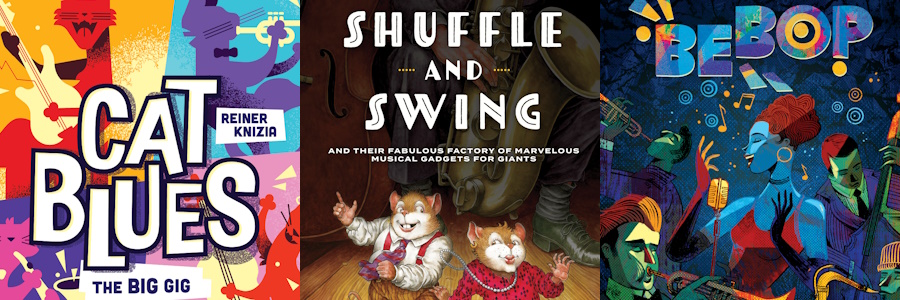
Another year, another Bitewing Games crowdfunding campaign. This time around, there are three titles on offer, unified by a jazzy setting that may or may not come through in print. Rather than drag this out into an entire festival, today we’re hosting a three-part set that will emphasize the highs and lows of all three pieces.
Spoiler: One of them is amazing.

How much is this set worth to you?
Cat Blues: The Big Gig
Designed by Reiner Knizia
The Big Gig is a remaster of 1998’s Cat Blues, also known as Katzenjammer Blues, a minor Knizia diminished in part by the publisher’s decision to bump the player count from a maximum of four to six people — a catastrophic decision, all told, given the tight margins this game operates under.
Like some of Knizia’s finest offerings, this is an auction game that’s straightforward to learn and play, but clever enough to reward experience. At its rawest, your goal is to build sets of four matching cards called quartets. These literal and thematic “sets,” in the musical ensemble sense, are then exchanged for points and bonus tokens. The big hurdle is that the same cards you use to build sets also function as currency. It’s like bidding on rare coins with a retailer that will only accept other rare coins.
As auction games go, there aren’t too many whiskers to consider. Cards are dealt from a central deck until either two matching numbers or a wildcard appears. Then the bidding commences via a staircase-style system in which quantity is amplified by the variety of cards you’re willing to part with — matches are stronger than differing numbers. In many cases, there’s a zero-sum feeling to the bids, as players swap two cards for two better cards, or dump three mismatched cards for four that have a better chance of winning future auctions.
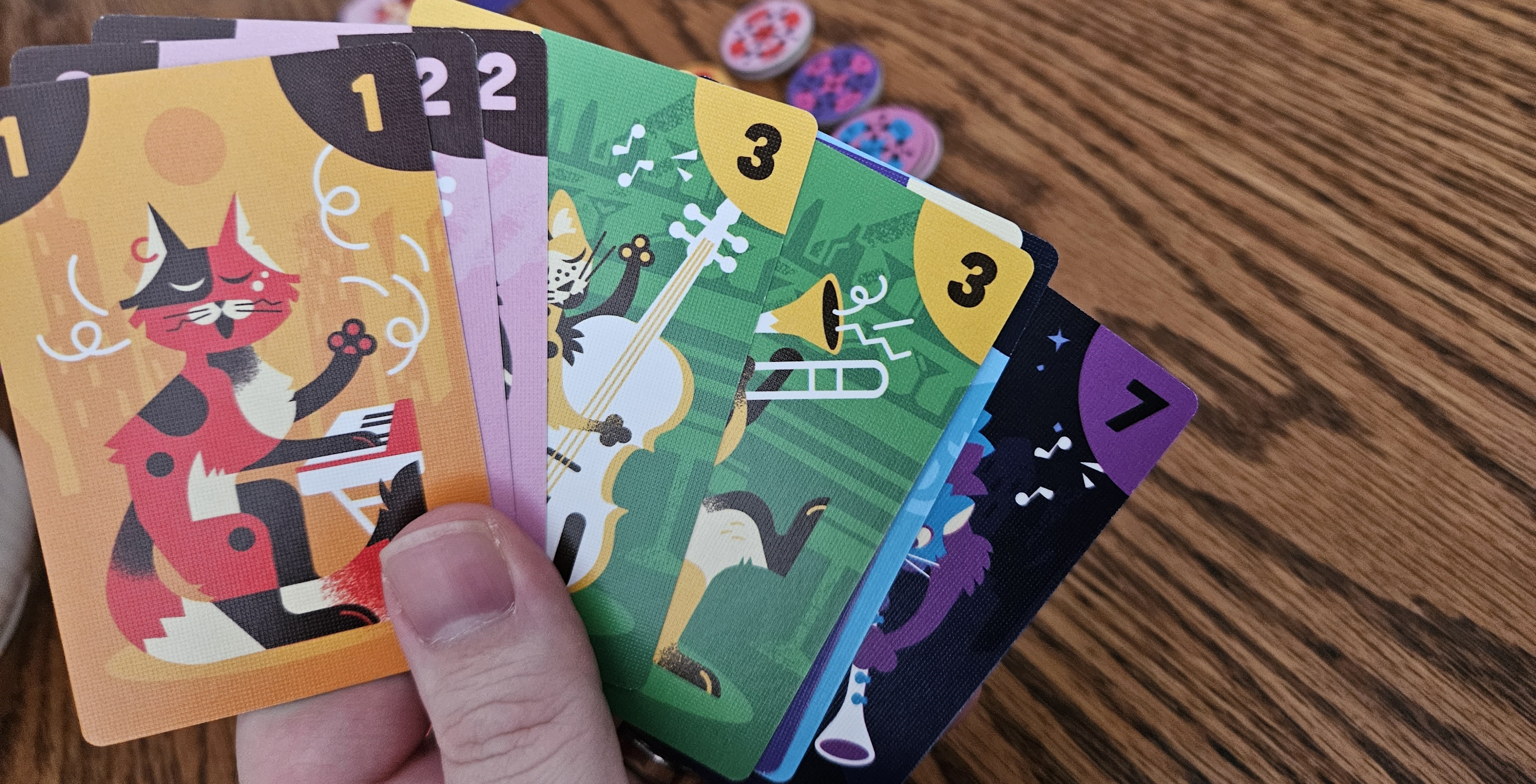
Choosing how to bid.
A few changes amplify the acoustics of this edition. There’s a new seventh ranked suit that can also be played as quartets, but only for points rather than for those bonus endgame tokens. Players also draw back up to four cards after playing a quartet, preventing anybody from so severely depleting their hand that they’re knocked out of the game — although purists like myself may find this a little too chancy. A full session, by the way, is three full games rather than only one, creating a nice arc and giving Cat Blues a fuller body to draw from. And, of course, the count is wisely restricted to only four players.
The changes go a long way toward making Cat Blues more approachable to newcomers, and it’s a welcome offering given how long it’s been out of print. But this is still minor Knizia. The hand economy is tighter than a snare drum, often coming across as prohibitive and resulting in string of no-bids or very similar options, while the new permissibility of drawing back up to four cards can result in unfortunate swings. It’s good to see Cat Blues back in print. To some degree, though, even this improved version is a reminder of why it had become so hard to acquire in the first place.
BWAAAM.
Shuffle and Swing
Designed by Robert Hovakimyan
To be entirely transparent, Shuffle and Swing is the sort of nu-Euro I prefer to avoid, more about solving the puzzle of the rules than about interfacing with one’s fellow players. It’s a game of clockwork precision, but one that might sport a few too many flywheels for its own good.
You are mice. The mice Shuffle and Swing, if we’re being precise about it. Bonded over your shared love of jazz, our murine entrepreneurs have established a factory for producing gigantic instruments. Their managers are mice, their laborers cats, and if that isn’t a masked commentary about how capitalism selectively elevates merit, I don’t know what to tell you.
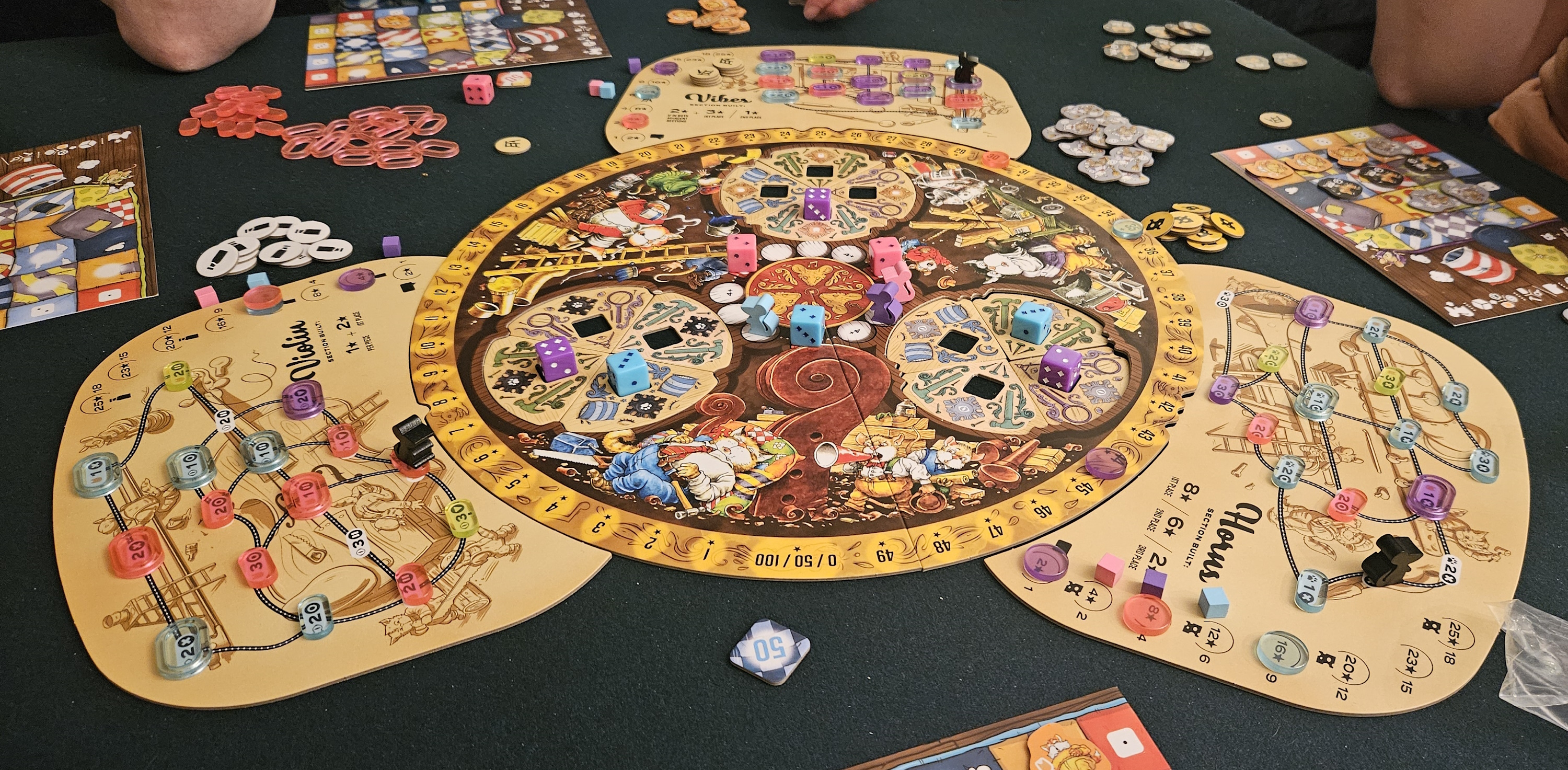
In this case, the merit in question requires dice placement, rondel movement, area control, and more. What begins simply enough with the placement of your mousy manager spills outward. Dice are placed onto actions across three departments, building or upgrading instruments, resting your exhausted felines, or moving around an inspector between the finished portions of a given instrument to award points. Along the way, it’s also necessary to manage stockpiles of cheese, ladders, and milk for enacting action-modifying bonuses, and to brag about your accomplishments even if you haven’t actually contributed that much to an instrument’s construction. That’s some bite.

Mice running the factory.
The true highlight here is the instruments, multi-faceted regions that demand careful allotment of resources. Each instrument is a minefield of competing interests. Taking the build action allows you to spend cats, who are sent to your personal board to snooze adorably on sections of a quilt until you rouse them. Building is a question of adding a component to the instrument you’re working on, covering it up or adding an additional ring to its outer edge. The game is smart to mix up its incentives. You’re normally limited to upgrading your own pieces, but spending ladders lets you add onto another manager’s components, soon resulting in quite the jumble of pieces.
And it’s clever stuff. Every instrument has its own scoring objectives. The vibraphone, for example, is divided into vertical regions for each tubular. Your goal is to have the most components on any given tubular when it’s finished. But everybody also gains bonus points if they also have at least one component to either side of it. The result is another degree of entanglement, with players encouraged to dominate any given region while also seeding their components into adjacent regions.
There are twelve instruments in all, each with their own scoring goals. Only three are used per session, allowing quite a bit of modularity. Meanwhile, there are those mouse inspectors. These travel between components to award points to whomever finished them. This encourages the aforementioned selective upgrading; if you move a mouse onto a space that you finished but I upgraded, we’ll both score points for it. Moreover, we can bribe inspectors with cheese to skip spaces entirely, thus depriving opponents of their hard-earned points. Seriously, this game’s veiled commentary is so sharp that I’m talking myself into liking it more.

That dratted inspector.
The thing is, I don’t dislike Shuffle and Swing exactly. Rather, it’s more that it’s a difficult game to come to grips with. Even after a couple of plays, this ball of yarn feels more Gordian than it ought to. Players are highly reliant on one another. When you use one of my dice on an action, you’re allowed to use its pips to make that action more effective. Afterward, it moves clockwise in its department, sitting on a different action and ticking one pip upward. Later, once that die has been maxed out, it’s moved to one of the “break rooms” between managers, where a passing mouse might overhear some boasting about my work.
This jumble of incentives is certainly interesting, but it isn’t always clear. It’s routine for players to inadvertently enable powerful moves for their fellows, such as permitting an inspector action. Blocking is possible, if not always reliable, necessitating cooperation between two or three players to prevent one another from taking an ill-timed action. Perhaps worst of all, the sections on instruments aren’t clearly printed, requiring players to bend and squint at tiny symbols that might be partially obscured by the otherwise smart plastic components and constantly reassess whether one spot adds to this section of an instrument or another.
Here’s the big caveat. Unlike final reviews, my time with preview copies is often limited. I’ve only played Shuffle and Swing twice. Just when I thought I had the game figured out well enough to assess a session rather than muddling through it, I was out of time and had to write about it. I’m eager to give it another shot, if only to discover whether it’s possible to play strategically or if this is largely a reactive game that’s more about puzzling through the rules than outperforming your fellow managers. Of these three games being funded, it’s lavish and clever, but I’m still uncertain quite what I think of it.
The jazziest of the bunch.
Bebop
Designed by Robert Hovakimyan (again)
Where Cat Blues: The Big Gig outs itself as minor Knizia and Shuffle and Swing doesn’t cement its designer’s name in my head, Bebop, also by the latter designer, is the finest of the bunch. I might even go as far as to say it has a shot at proving itself a modern legend.
It’s also the most explicitly jazzy of the trio, not only in terms of its setting — you’re booking agents trying to secure the best seats for your customers at a jazz festival — but also via its gameplay. It’s both carefully structured yet improvisational, forcing players to assess long-term incentives against short-term gains.
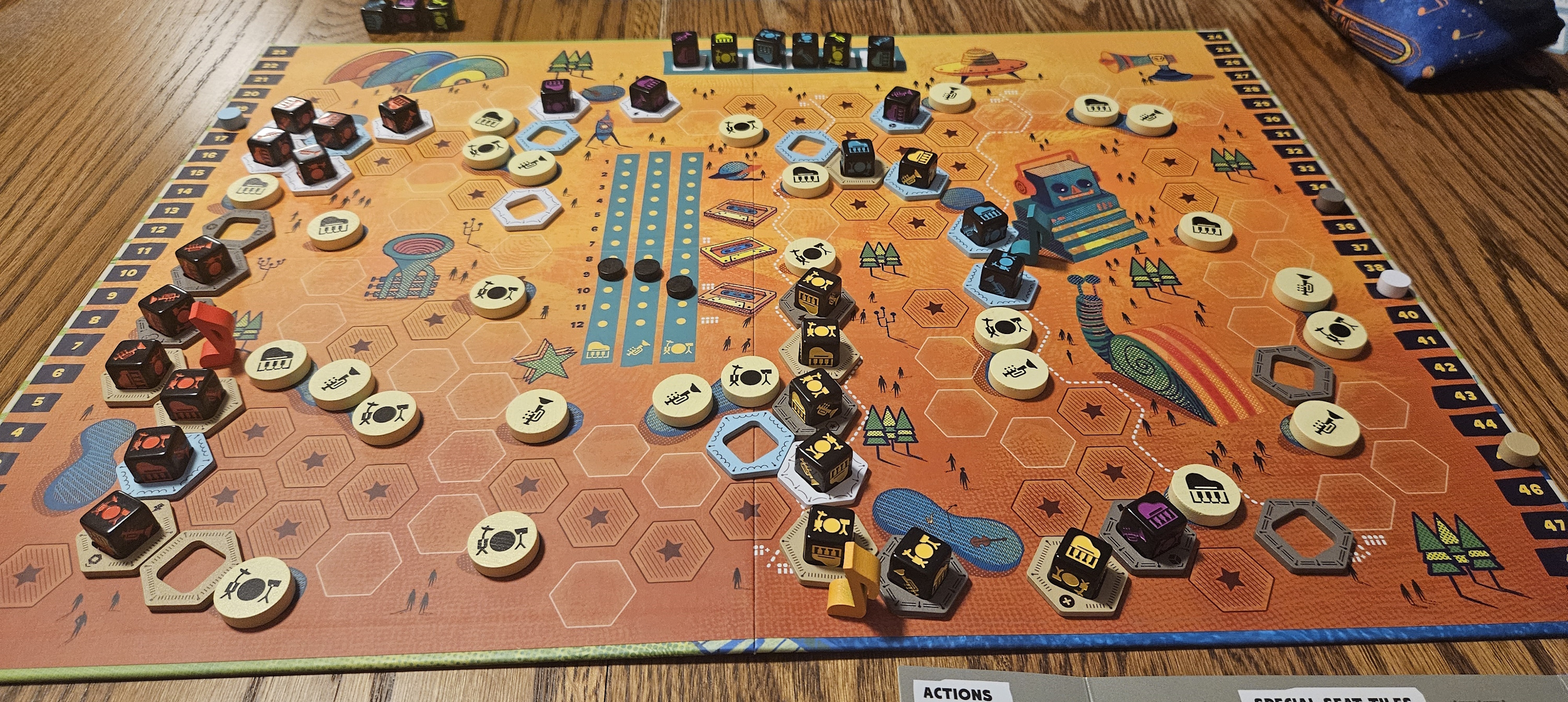
When the game begins, you’re presented with a wide-open festival space. Multiple bandstands display potential instrumentalists, divided between percussion, horns, and keyboards. There are also heaps of dice across five colors; the show’s guests and your customers, each showing preferences for the instruments they’d like to hear. Lastly, each player has their own wooden bases for securing territory and putting butts in seats.
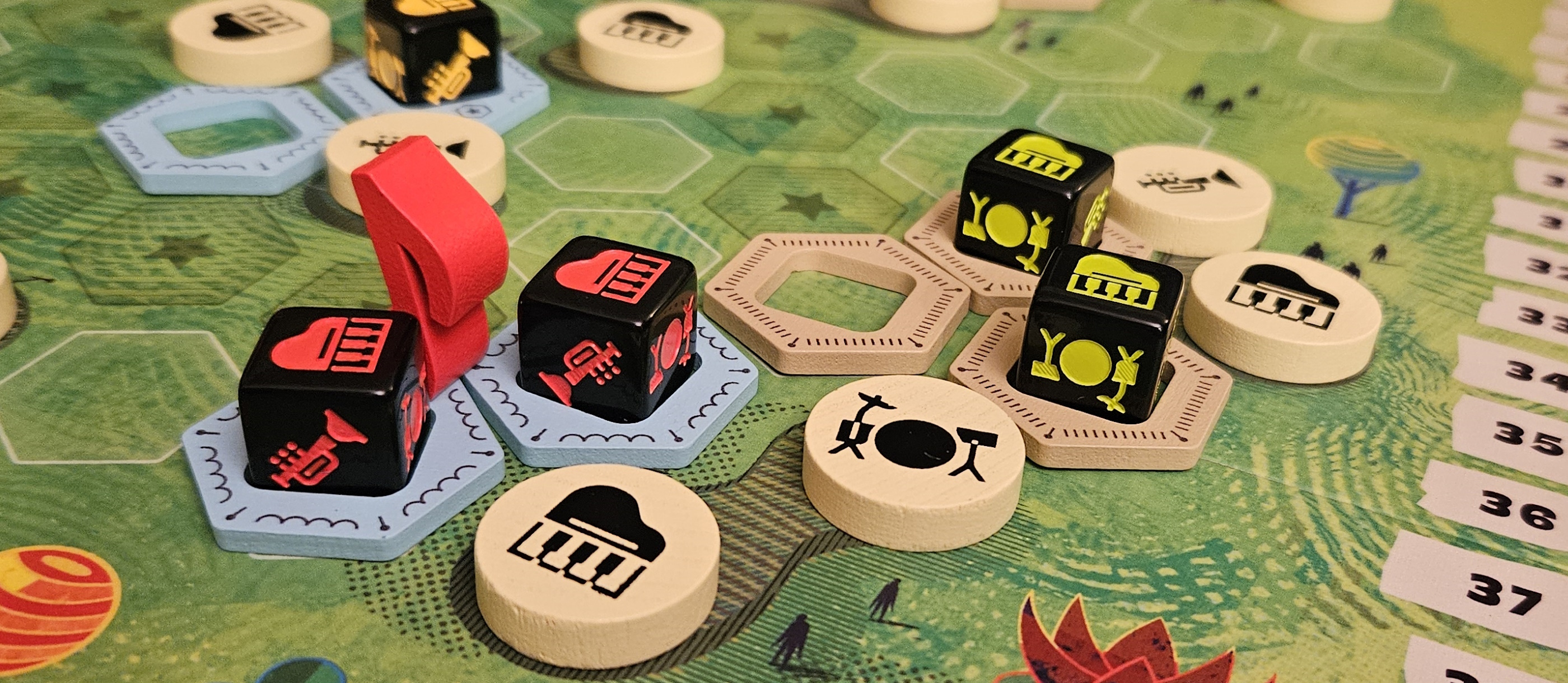
This is an area control game, albeit one that takes the intersecting interests of Shuffle and Swing and cranks up the volume. Unlike that other game, turns couldn’t be simpler, putting the emphasis on what you’re doing rather than how. In short, you either secure a seat or book a guest. The former option places one of those hexagonal bases onto the map, blocking off that portion of the festival ground for your agency. The latter ensconces one of your dice into a chair.
No cowboys here.
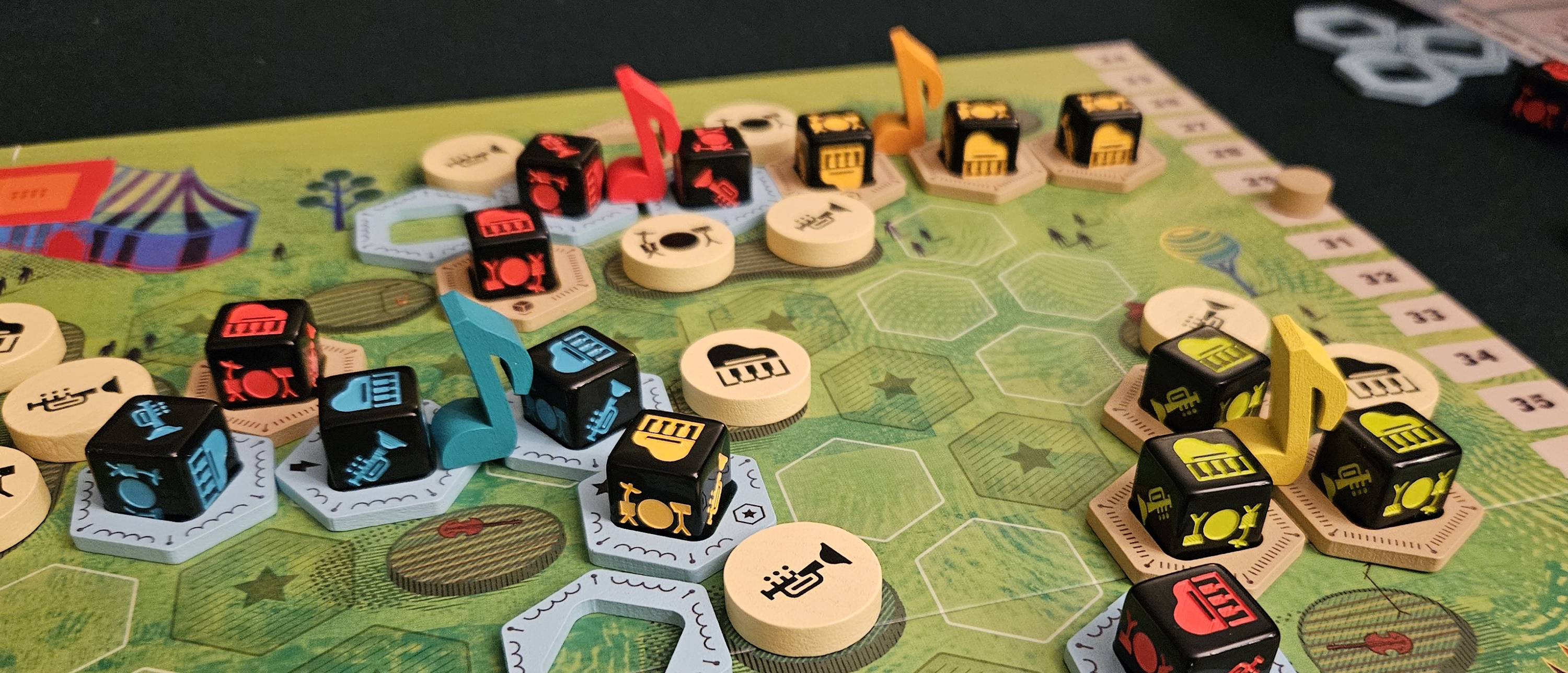
But this is where Bebop goes from interesting to gripping. While you “own” the guests in your seats, they also belong to wider groupings of their color. These are “families” of like-minded fans, to use the game’s terminology. Adding a die to a family means you score points. Maybe even a lot of points, provided there are matching faces among the crowd. For example, putting a red keyboard into a cluster that already contains four other red keyboards means you score five points. This means you’re encouraged to build and foster families. More than that, you’re incentivized to encroach upon other players’ families as well, sneaking yellow dice into clusters of opposing yellows, and so forth.
This is crucial, because family clusters are also used when assessing performances. When a bandstand is surrounded, that group comes out to wail. For each instrument being played, you figure out which agency holds the most matching guests — and they score all the points for that performance. But an instrument’s fans aren’t only those directly adjacent to the stage. Everyone in a family touching the stage, no matter how far away that family stretches, is added to the tally. Because a family will almost certainly include seats from multiple booking agencies, this can put everyone in contention for scoring. Especially once a family gets really big and other agencies want to get in on the action.
There are other grace notes at play, essential flourishes that turn Bebop into a powerhouse. Everyone has a small selection of special seats, such as VIP boxes that don’t trigger performances but can occupy special locations, rapid seats that let you claim territory or assign guests quickly, “backstage passes” for stepping onto a bandstand after its performance is over, or my favorite, “the boot,” which kicks out a rival agency’s seat. These give Bebop its essential character, making every action fraught in a unique way. The festival ground doesn’t wholly fill up, leaving a handful of performances unsung and requiring that every move drag at least a few points from the board.
Family. Isn’t it about time?
To be provocative, I would even call Bebop the most Knizian of the trio, if only because it doesn’t feel minor the way Cat Blues does. This isn’t minor. It’s a major contribution, redolent of titles like Knizia’s own Babylonia. I adore how each session is composed of beats that blend into the overall whole, with motifs and themes that feel suitably musical. One corner of the festival will secure an early performance, then gradually blend via VIP boxes and backstage passes and spillover seats until everyone is tussling for an encore. Those final turns, where everybody agonizes over every single placement, every possible pull from the dice bag, every reroll, every untouched boot or seat, is truly a performance to behold. Guess I won’t be forgetting Robert Hovakimyan’s name anytime soon.
The Jazz Trilogy is on Kickstarter for the next ten days.
(If what I’m doing at Space-Biff! is valuable to you in some way, please consider dropping by my Patreon campaign or Ko-fi.)
Prototype copies were temporarily provided.
Posted on April 15, 2024, in Board Game and tagged Bitewing Games, Board Games. Bookmark the permalink. 3 Comments.

 SPACE-BIFF!
Excellent reviews! Might have to get Bebop…
Would really be curious about a tile laying top 10 because it’s a rich genre and you seem to know a lot.
Also, have you seen Marabunta? New Knizia 1v1 «i-split-you-choose» area majority game. Recently bought it and loving it!
Oh, I haven’t. I’ll have to look into it. Thanks for the recommendation!
Pingback: Gingham Takes a Roadside Picnic | SPACE-BIFF!