The Galaxy Is on Orion’s Belt

Orion Duel is the sort of game fifth-dimensional beings play while waiting for the next Big Crunch to reset the universe. Designed by Alberto Branciari and Andrea Mainini, this is an abstract that nominally resembles John Nash’s classic game Hex, but with a few major wrinkles thrown in for good measure. I am very bad at it.
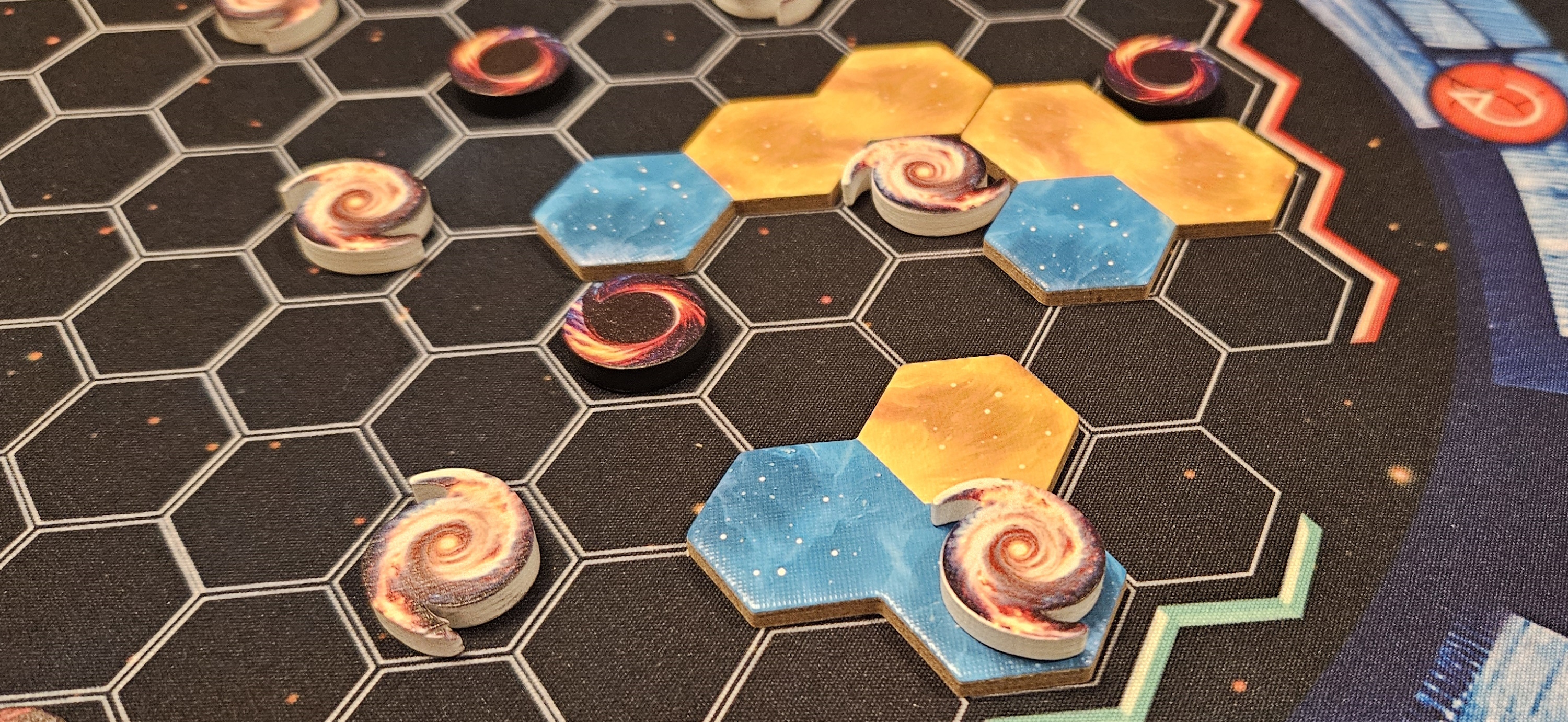
Connect four. Or six. Or more.
For anyone who’s played Hex, or crud, seen Hex, the starting point for Orion Duel isn’t going to come as a surprise. Your objective, at least at the outset, is to connect opposite sides of the board with pieces of your color. Setting it apart from Nash’s incarnation of the game, it doesn’t matter which opposing sides you opt to connect. The board itself is a large hexagon, with three opposing sets of edges. Link any two of them and you win.
But that’s really only the beginning. Right on cue, it’s time for the aforementioned wrinkles. The first is that your pieces aren’t simple stones that occupy only a single cell. Or at least they’re not only that. Ranging from one to three spaces in different configurations, pieces function more like bridges, spreading your influence far and wide. Or they would, except most of them also show a cell of your opponent’s color. In fact, all but two of your pieces do this. To place a piece in your favor is also to place a piece for your opponent. What a pickle.
What’s more, connecting far edges is only one of three possible win-states. Scattered across the map are galaxies and black holes. The former, spiraling white pieces, will award you the match if you can link four of them in a chain. The latter do the same, but only if you somehow span three of them together — for your opponent this time. In other words, you’re always bridging the gaps between stars, but it’s entirely possible to help your rival build a bridge that will collapse at any moment.
There are a few particulars to keep in mind. These prevent the game from being as intuitive as it might otherwise have been, while also providing a necessary counterbalance to flippant tile placements. The most important is that you can never place a tile “underneath” a galaxy or black hole unless such a placement includes another hex of the same color next to it, whether from another tile or the one you’re placing right now. This makes it far easier to bridge to tiles with your own color, but tricky to do so with that of your opponent. It isn’t a lot to take in, but it can feel odd at first. The scattershot and underwritten rulebook sure doesn’t help.

Selecting the proper hex wrench.
Little by little, however, Orion Duel resolves into focus. It’s uncommonly clever, one of those tantalizing games where every move tends to further your own interests while also opening new avenues for your opponent to pursue. Even the simple act of spreading across the universe is fraught. As you branch outward, seeking to link galaxies or the far-flung sides of the board, you’re also necessarily opening yourself up to sabotage via black hole. Or even something as minor as a well-placed opposing piece. The closer one gets to victory, the more vulnerable they become.
It’s rare to be blocked entirely, though, which has everything to do with the way the pieces are arranged with colors for both players. There will be setbacks, but it’s almost impossible to corner someone entirely. What’s more common is to find yourself entrapped by an opponent making moves that benefit them in two contrasting directions at the same time, perhaps stepping closer to connecting to the far edge of the map and putting them within reach of a final crucial galaxy. It’s in those moments that Orion Duel shows its hand. Despite unfurling on a plane, it rarely feels confined to only two dimensions.
Of course, the bigger question is whether this is a keeper, something worthy of seeking out, or merely worth a try when the opportunity prevents itself. That’s where I’m less certain. Perhaps it’s my preference for strong settings that prevents my interest in Orion Duel from fully blossoming. Perhaps I’m just bad at it. Or maybe it’s something else; the bland orange-and-aqua color scheme, the almost glib pacing of the thing, the daunting stack of front-loaded decisions presented by all those tiles. For such a clever game, with its intriguing and color-coded tension between what’s-yours and what’s-theirs, it’s surprisingly devoid of drama. My favorite abstracts tend to be very dramatic indeed. Which, again, might be my own shortcoming. Chess, for instance, is only dramatic insofar as you grok what’s happening on the board. But Orion Duel feels open, and therefore airy, where games like chess are constrained.
Probably I’m just bad at it.

Orion Duel is devious, but not dramatic.
Despite that, it isn’t as though I’ve regretted my time with it, which is more than I can say of some of the games that hit my table. It’s undeniably clever, riffing on ideas that have been around since the 1940s, and largely doing so with great style. If the opportunity presents itself to try this one, it’s simple and fast enough that I’d recommend spending those fifteen minutes.
(If what I’m doing at Space-Biff! is valuable to you in some way, please consider dropping by my Patreon campaign or Ko-fi.)
A complimentary copy was provided.
Posted on April 2, 2024, in Board Game and tagged Board Games, Matagot, Orion Duel. Bookmark the permalink. 1 Comment.

 SPACE-BIFF!
Pingback: Goofy Little Hamburgers | SPACE-BIFF!