Heliotropes

Three and a half hours into our most recent play of Bloodstones, I turned to the five other players sitting at my living room table. “I just wanted to say,” I began, in the tone of a hard-bitten battlefield commander trapped in Bastogne during the Battle of the Bulge. “There is nobody I would rather share this ordeal with than all of you.” And then we laughed the laugh of soldiers who had spent too many weeks cowering at the bottom of foxholes.
Bloodstones is the latest title by Martin Wallace, a designer who has produced some of my favorite games of all time. It’s an impressive production, with multiple cloth maps, six unique factions, and oh so many bags filled with wonderfully clacky tiles. Between pedigree and production, it’s an easy sell.
I can’t stand it.
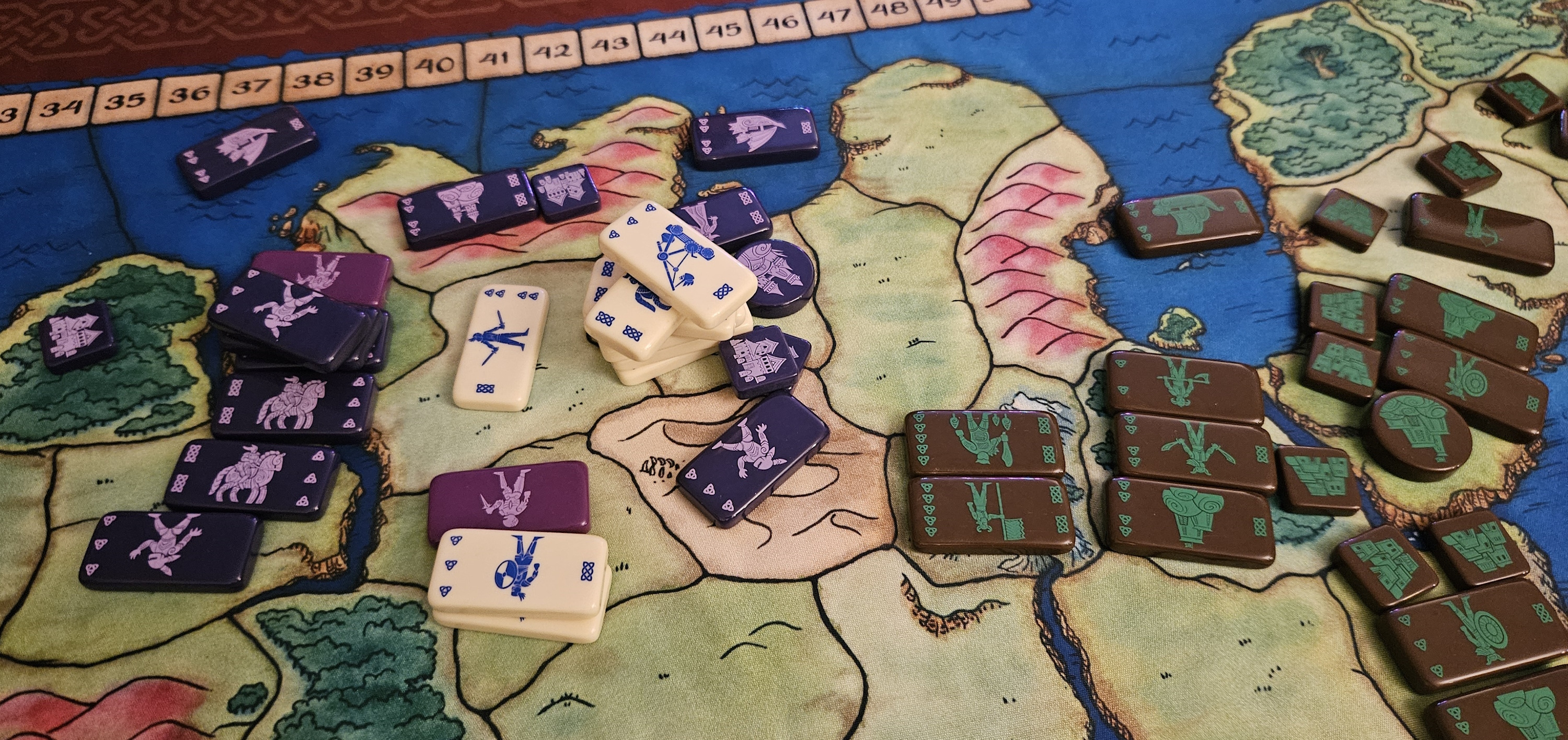
Bloodstones sure looks pretty. Messy, too.
Like far too many fantasy board games, Bloodstones opens with some well-intended fluff meant to clue us in on the particulars of its inter-factional conflict. Fair enough. While I might be obligated to read this stuff, most people are free to blip past it. And it isn’t like Bloodstones doesn’t bring the juice. While I couldn’t care less about which of its six factions is descended from the blood of elves, the real highlight here are the factions themselves. Mechanically speaking, I mean, not in terms of elf-blood.
That’s because everything in Bloodstones comes back to those tiles. Take, for example, the turn structure. At the end of your turn, you draw a handful of tiles from your bag. These function as everything. And I mean everything. Soldiers you can plop onto the map and march around and push into battle. Marshalling points for hiring those soldiers. Pips that must be spent to move those soldiers or roid out their performance in combat. Infrastructure for building villages. Even burning an enemy village requires that you spend a tile.
Moreover, those tiles must be ruthlessly optimized. Raiding only one enemy village takes a pip. But there are no tiles with only a single pip. The lowest is two. (The highest, by the way, is five.) To raid with maximum efficiency, you’ll want to burn two to five villages at a time. That requires spreading around your troops, which in turn incentivizes spending multiple tiles for movement. That, of course, assumes you have enough troops to spread around.
Put those things together and you’re looking at a game that effortlessly presents tough decisions. Should you invest a tile to defend a territory or hold onto it because you want to hire its unit on your turn? Build a fortress for defense or splurge it to move more of your troops? Spread around a bunch of villages or protect what you’ve already got? All those administrative duties have been tucked into a bag full of tiles. Delightful.
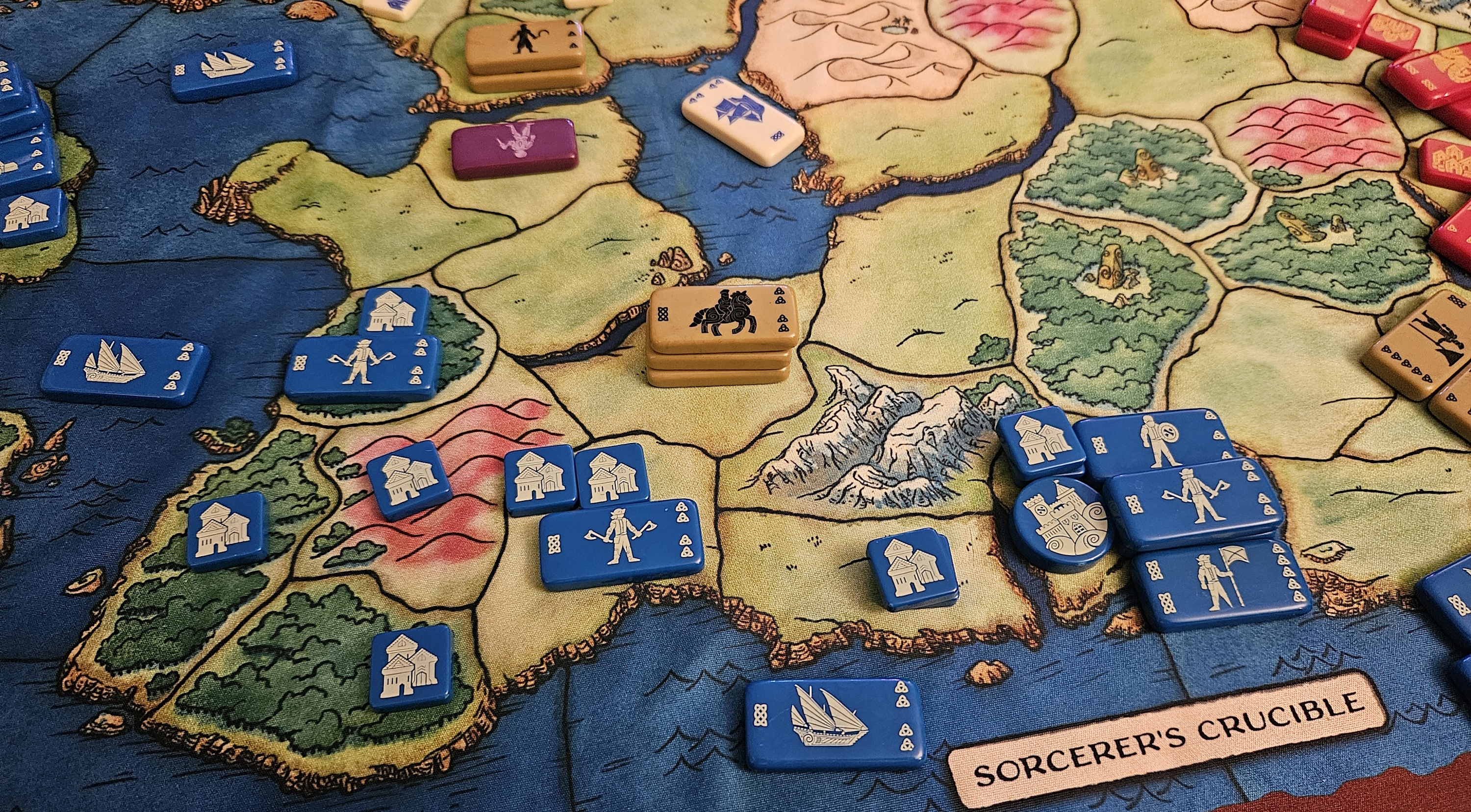
Raided by the — wait for it — Chaos Horde.
At the same time, offloading most of your faction’s identity onto the tiles themselves does a lot of heavy lifting. The Dragon Riders are cool because they have dragons in their bag, not because they’re governed by a dozen persnickety rules. The Hill Folk get giants. The Corsairs get a bunch of boats and the Horse Lords have… you get it. In some cases, the absence of a bag speaks volumes. Take the Chaos Horde. The first hint is in their name. They’re a horde of chaos people. The second clue comes when you realize they don’t have a second bag filled with villages. Chaos Hordes don’t build villages. They raid them. That’s their whole thing. So instead of handing you a bag filled with villages, they’re allowed to build troops wherever they’re standing and then bulldoze everything in their path. Neato.
Unfortunately, this isn’t to say that Bloodstones doesn’t feature persnickety rules. It’s got those by the shovelful. The first glimpse is introduced through the game’s movement rules. There are six terrain types, each with different movement allowances. Forests and hills are harder to traverse than plains. That’s easy enough to remember. Mountains aren’t traversable at all. Except by dragons and zombies. Deserts are traversable but kill your units when your turn ends. Unless those units are lizards, goblins, or zombies. When leaders move, they can bring another unit with them for free. Castles cannot move. Not that the faction sheets tell you this. Maybe it’s obvious that castles can’t move. Except for all I know they’re flying castles, or castles with legs, or castles with magic teleportation stones inside of them. Who can tell? The Dragon Riders have elvish blood. I remember that much.
None of these rules are tricky on their own. It’s only once they’re added together and squeezed onto a map — a map that’s just a scooch too small for all those chunky tiles, by the way — that the proceedings grow onerous. For a game that shoulders so much of its heavy lifting onto the tiles in its bags, the simple act of getting around is weirdly burdened. It doesn’t help that Wallace has a peculiar way of explaining things. Rather than simply telling you the rules via some standardized format, his rulebooks are full of meandering descriptions. We played two full sessions before we realized we’d been placing villages next to our citadels. Why is that prohibited? I dunno. Elvish blood.
But at heart these are nitpicks. Irritating nettles stuck in the sole of my boots. The real problem is combat.

The dominoes are nice and clacky. Clack clack.
At a conceptual level, clashes between armies sound nifty. When somebody starts a battle, both sides retrieve their own bag of combat tiles. Hey, more tiles! That’s great! Now they both draw a certain number of tiles, either three or four depending on which side has more units. Unless one side has a giant, but never mind. You can then replace a tile with one from your hand. Add them up, along with the many many combat bonuses on all those tiles — the tiles that are stacked in big heaps on the too-small map — and the higher number wins. The losing side suffers a casualty, the winner earns points, you go through the withdrawal rules, and voila. One battle.
Except that one battle takes considerably more effort than most board game battles. And Bloodstones is likely to require quite a few battles. Early on, this isn’t a problem. The maps are full of terrain to expand into. (Sometimes too much terrain, depending on player count, but okay.) It’s only once factions begin to crowd one another that it matters. But once it matters, it matters. You’ll fight a battle, maybe two, sometimes even three, in the span of a single turn. Each requires its own resolution. The next turn often sees the same battle, more or less, being readjudicated once the losing army beefs itself up and marches back into contested terrain. Back and forth it goes. All those battle resolutions, one after the other, with only the two combat bags. These are no hasty fights, as in other exemplars of the genre, but drawn-out conflicts with multiple steps and a constant need to reassess the relative strengths of their combatants.
Before long, Bloodstones becomes a chore. All those little rules. All those painstakingly counted movements. All those battles, one after the other. It never feels tuned right. Either you play with fewer factions, which results in two or three kingdoms with way too much legroom on the game’s sprawling maps, or you play with four, five, or six factions and suffer when the game stops for yet another damnable battle. If it weren’t so frustrating, I’d call it a commentary on the futility of war.
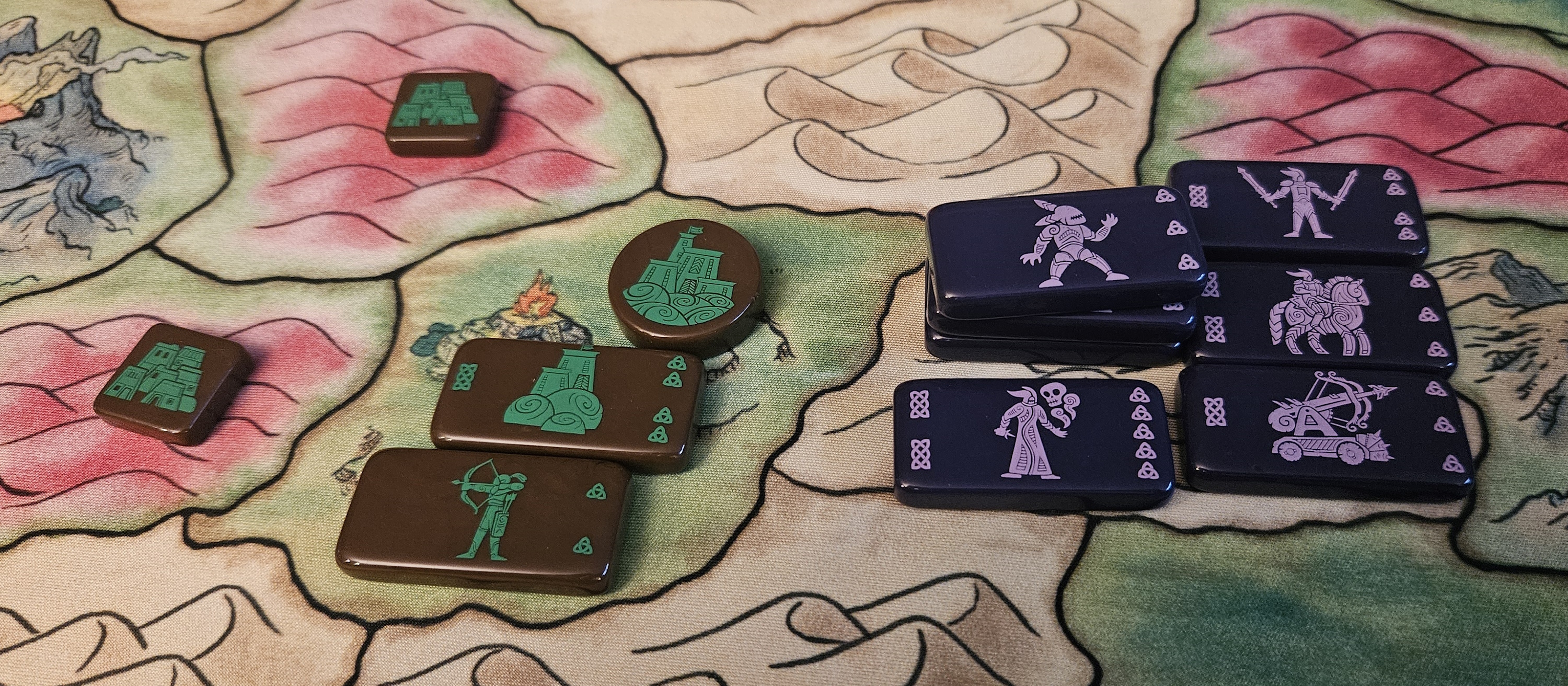
Should have defended my deserts. Oh wait. I can’t.
There are other things I could complain about. The mismatched production between big tiles and small maps. The end-game land grab. The units that almost never trigger their abilities. The faction abilities that are more contingent than others. The way battles repeat if you tie unless you have a shield unit. The many times the game says “unless” or “except.”
But what’s the point? Even without mentioning those other issues, Bloodstones is a drag. What could have been a frenetic contest for control is instead a grinding war of attrition. Despite the tactile pleasure of drawing its many tiles, Bloodstones functions like sandpaper dragged slowly, so slowly, across my nervous system.
(If what I’m doing at Space-Biff! is valuable to you in some way, please consider dropping by my Patreon campaign or Ko-fi.)
Posted on March 12, 2024, in Board Game and tagged Bloodstones, Board Games, Martin Wallace, Wallace Designs. Bookmark the permalink. 10 Comments.

 SPACE-BIFF!
I felt similarly. Our first session left me intrigued to dig deeper, assuming I had missed some nuance that would bring the game to life. Our second left me praying for it to end by the halfway point, all dynamics having been suffocated by mathematics and endless attrition. And those tiles are nice, but man it cost a lot more than chits would have. Rare miss from Martin.
I’m sorry to hear it didn’t work for you either. What a bummer.
Very nice post, thank you!
I got Bloodstones but mostly intend to play through the solo campaign. Maybe that way it won’t drag as much? And since the map is already filled with the enemy units it won’t feel too empty I hope.
Yeah, the solitaire stuff is fine. I was already soured on the game by the time I tried it, but maybe it will work better for you!
My group enjoy this quite a bit. After the first few games, I had the same I had similar impressions, but after a couple more plays things started to make more sense. The game is front loaded and punishing, decisions are all very important and positioning is central. The initial choice of where to place your stronghold and the units you field with it, is one of the most important.
I don’t agree with your sentiment on rules, these are very simple compared to other asymmetric wargames. Most units have a +1 when attacking, defending or both so it is fairly easy to tell at a glance what’s going on. Some map spaces are small, I agree, butbwe noticed this less on subsequent plays as, with more experience, we noticed that players used smaller stacks.
That being said, it’s not a game for everyone and surely not for casual play.
To each, their own. However, “The initial choice of where to place your stronghold and the units you field with it, is one of the most important.” is a huge game design red flag. You don’t want to define a session that lasts anywhere between 2 – 4 hours by the first turn. Especially in 2024.
I have to admit, I giggled a little when I saw your “I can’t stand it.”
It’s a bit of a shame since the production values are completely over the top, but I didn’t enjoy my first (and likely only) play at all.
And that’s despite it should be right up my alley: I’m a huge fan of all games about area control and ‘Bloodstones’ is at least superficially similar to ‘Neuroshima Hex’, which is one of my highest-rated games.
Your review also reminded me that I really struggled to grasp the rules when the game was explained to me. I’m inclined to forgive it, due to its asymmetrical factions, but one of my comments after playing was that it might have been good to include a set of symmetrical ‘vanilla’ factions to learn how to play (similar to ‘Tash-Kalar’).
Like you, I felt the combat resolution was annoyingly fiddly, especially if you have to repeat it several times due to achieving a draw. I think, here the designer fell into a trap I noticed before with ‘7th Continent’: Apparently, the designers were so in love with their card-based mechanisms that they decided to resolve everything using cards only, no matter how bad it fits.
In ‘Bloodstones’ it’s the (delightfully clacky) tiles that are used for everything. I don’t believe it would have harmed the tactical combats (much) if it simply used a roll of dice (or even better be deterministic like in ‘Neuroshima Hex’).
On top of it all, the factions didn’t feel well balanced, but I’d be the first to admit that’s impossible to ascertain after just one play (3 of 5 players had already played the game before, though, and agreed with me).
So, yeah, it’s nice to see a review that appears to help answering the question “Is it just me, or is it the game?”
The game is fine.
One might compare it to Root with its map and warring assymmetric factions. Bloodstones is easier to learn and has fewer rules exceptions.
And it’s about a thousandth as interesting, to boot!
Pingback: Talking About Games: One Billion Biases | SPACE-BIFF!