AMBLE

I own a pocket watch from Stratford-upon-Avon, a trinket I picked up to commemorate viewing Macbeth at the Royal Shakespeare Theater. It’s a gorgeous little thing, clasped in silver, its open face and back revealing the clockwork precision within. Everything has a purpose: the hairspring that stores tension, the jagged teeth of the escapement wheel that tick out the seconds, the gems that cap the gears to minimize friction. Sometimes I wind it up just to set all those pieces in motion.
RUN, a hidden movement game by Moritz Dressler, reminds me of that pocket watch. As an object of mechanical fascination, there’s nothing quite like it. Everything has its proper place. It ticks smoothly.
But it’s also pointless. An artifact, a curiosity, rather than something I’m going to actually carry around.

Dispatch hunts for the Runner.
At a mechanical level, there’s nothing wrong with RUN. That’s what makes evaluating it so difficult. As an interlocking set of systems, it’s unimpeachable. Within minutes of setting it up, I marvel at how all its components fit together.
Like most hidden movement games, there are two sides in contention. The Runner is the guy in flight, hoping to nab a certain number of gadgets before hightailing it to the exit. His crime: too much rizz. Certainly he doesn’t seem to be engaged in any actual transgression, unless picking up misplaced crowbars and grappling hooks has been declared illegal by an overbearing bureaucracy. He’s pursued by Dispatch, a helicopter in the sky that hopes to zap him twice and has a whole range of tools, including backup from the local P.D.
Concealed behind individual screens, both sides function according to their own logic. The Runner has a menu of moves ranging from stealthy orthogonal and diagonal steps to sprints that move him in a straight line but cause enough of a ruckus that Dispatch is immediately clued in on the type of move he’s making, if not the actual details. Complicating matters is the Runner’s rather specific obsession for not moving in the same way twice. Using a movement tile places it either face-up or face-down in between players, giving clues as to his whereabouts. Once used, however, the Runner can no longer move in that direction. His path to the exit is therefore a complicated dance of zigzags and sidesteps and shuffles. It’s exceptionally programmatic, almost charted out in advance. If I move here, then my next move had better be over there or I’ll lodge myself into a corner. On more than one occasion, I’ve mapped out my intended escape in the game’s opening minute and then executed it with only minor revisions.
This fettered state of affairs is aided somewhat by the gadgets the Runner picks up. The crowbar lets him enter a building and then exit by any egress he chooses, potentially throwing off Dispatch via the noise of multiple possible destinations. There’s a smoke bomb for moving in any direction, a grappling hook that turns tall structures into opportunities rather than obstacles, and maps with water introduce jet skis and scuba gear for rapid repositioning. These add some essential Brownian motion to the game, a fuzz of random static that prevents it from becoming too predictable.
Not that Dispatch is deterred by these trickles of randomness. This is the more interesting role of the two, effectively an upscaled and energized version of Battleship. Where the Runner’s turns usually require a significant investment of forethought in order to move a single space, Dispatch goes the other direction. The helicopter glides to the other side of the city, deploys an action that scans an entire row or column, illuminates multiple spaces via a searchlight, or fires off weaponry to bag the Runner — and even then, if the action happens to miss, draws an additional backup card that feeds them more information, eventually scanning whole quadrants of the map or questioning the witnesses printed on the board. These assists are toned down as Dispatch plays multiple sessions, but they’re always there to some degree, oppressing the Runner at every turn.

The Runner’s move options are severely limited.
As long as hidden movement games have been around, they’ve struggled to give its hunted players as much to do as its hunters. That’s largely thanks to the asymmetrical nature of the genre. These games function as changeable logic puzzles, the parameters receiving a tickle every time the hunted player alters their position. But in order to make the chase compelling, the hunter — who usually only has a fragmentary idea of where their quarry is located — can’t be left in the dust. This leads to scenarios where hunted players are mostly limited to marginal movements while hunters can reposition quickly or take multiple actions.
That’s true here as well. But where many modern hidden movement games are learning ways to shake up the formula and give their hunted players more to do, RUN still trails a few paces behind. Captain Sonar lets both crews of submariners become both hunted and hunter alike, even letting those roles pivot mid-action. Sniper Elite casts its titular sharpshooter as a hunter-murdering psychopath, potentially betraying his position but securing a path forward. The shadowy recruiter of Mind MGMT can pursue multiple avenues to victory, either taking the traditional route by evading her pursuers or instead gathering enough psychic warriors to her side to overwhelm them outright — and once enough legacy boxes are opened, further approaches are discovered. There are even two hidden movement games by RUN’s publisher, Fowers Games, that strike a sharper balance: Sabotage, which pulled a trick similar to Captain Sonar by having both its secret agents and Bond villains practice both deduction and evasion, and the recently reimagined Fugitive, a hidden movement game that relies on digits rather than a map, is blazingly fast, and feels clever from start to finish.
By contrast, RUN operates like the platonic ideal of a hidden movement game. That might sound like a good thing. But while it’s smooth and functional and could operate as the master template for the genre at large, it’s also so frictionless and absent of catches that it fails to spark any excitement. It’s like finally peeling back the curtain of reality to witness the platonic ideal of a circle, its curvature never wavering, its proportions exactly correct, only to go, “Huh. I guess that’s the circle.” Meanwhile, it imports the genre’s biggest failings. Dispatch offers a straightforward logic puzzle. The Runner makes centimeter movements and hopes they don’t get spotted. It’s so very small, so constrained and bounded, without any willingness to break free of its twenty-minute playtime or six-by-six grid.
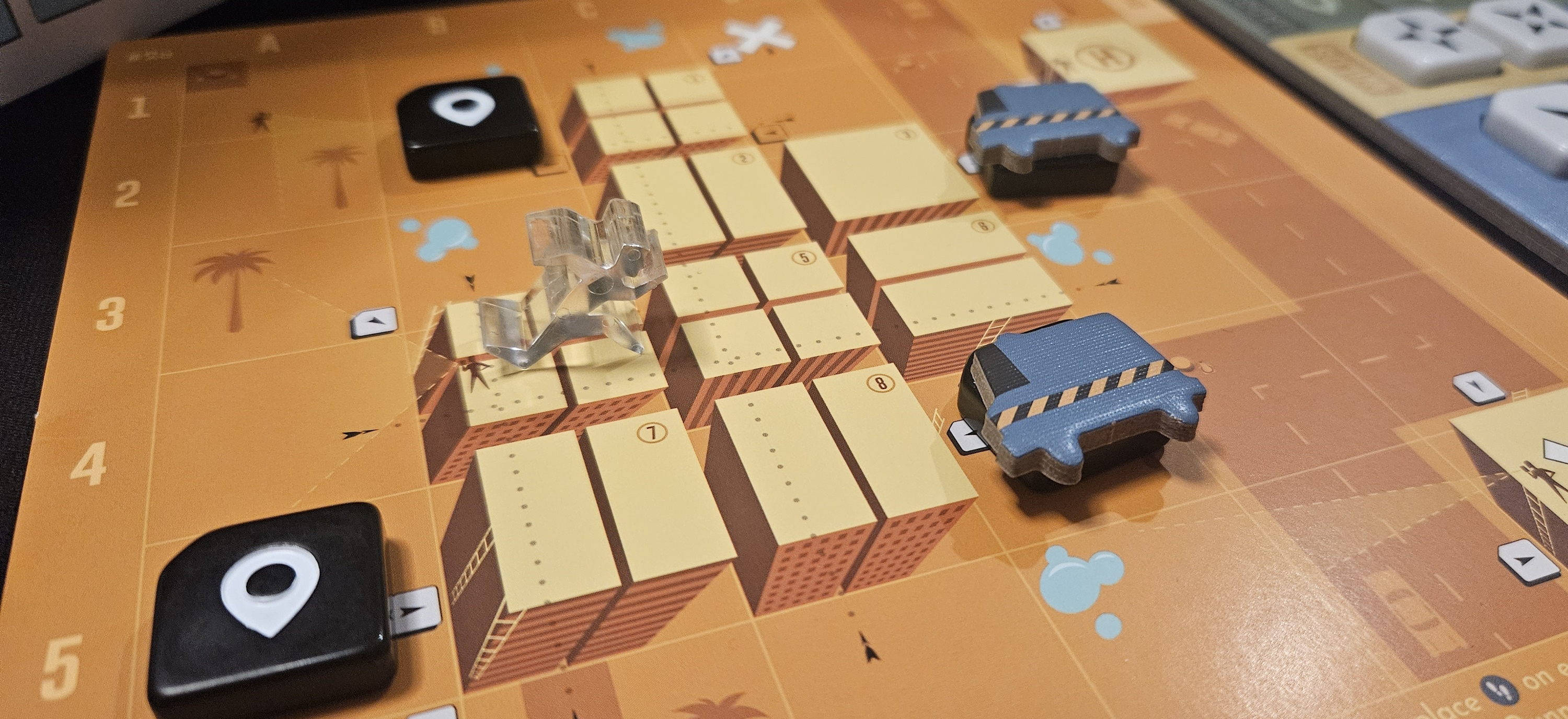
The weird acrylic pieces aren’t my favorite.
It’s all so very okay. There’s nothing wrong with RUN so much as there’s nothing right about it. It’s a feat of engineering, but it will never set my heart pounding, let alone launch me to my feet.
Every title I listed a couple of paragraphs back can produce those reactions. I remember individual sessions from each one. My crewmates hollering in my ears as I strained to hear the whispers of the opposing team. The sniper shot that connected only moments before the enemy soldier could draw a bead on me. Becoming a psychic who tricked my foes into chasing exactly the wrong target. Crud, I even remember sessions of Fugitive, and that game is pretty much a numbered deck.
Hidden movement is a worthwhile genre because it plays on our desire to peel back the unknown, the prickle that crawls along our spine when something might clamp down on us at any moment. RUN understands the engineering. It misses the feeling.
(If what I’m doing at Space-Biff! is valuable to you in some way, please consider dropping by my Patreon campaign or Ko-fi.)
A complimentary copy was provided.
Posted on February 28, 2024, in Board Game and tagged Board Games, Fowers Games, RUN. Bookmark the permalink. 1 Comment.

 SPACE-BIFF!
Pingback: Back to the Burgle | SPACE-BIFF!