Snoozing Gods
It’s been a while since I’ve visited, but I think back on my three campaigns in the world of Sleeping Gods with nothing but fondness. I could probably sketch a rough map of the Wandering Sea: that ivory hive on the map’s edge, the ancient spires stacked like dominoes rising from the seabed, the far-flung deserts. Ryan Laukat’s vibrant brushstrokes establish an adventurous tone, giving the world a sense of scale that hasn’t often been replicated. What will you find around the bend of the next island? You’re practically itching to find out.
Sleeping Gods: Primeval Peril swaps the colorful palette of the original for muddy rivers and tangled jungle, not to mention a more claustrophobic perspective. This was originally a free print-and-play for those who backed the crowdfunding campaign, now given fuller development and a shelf-ready production. I hate to say it, but its status as a rejiggered freebie is all too evident.
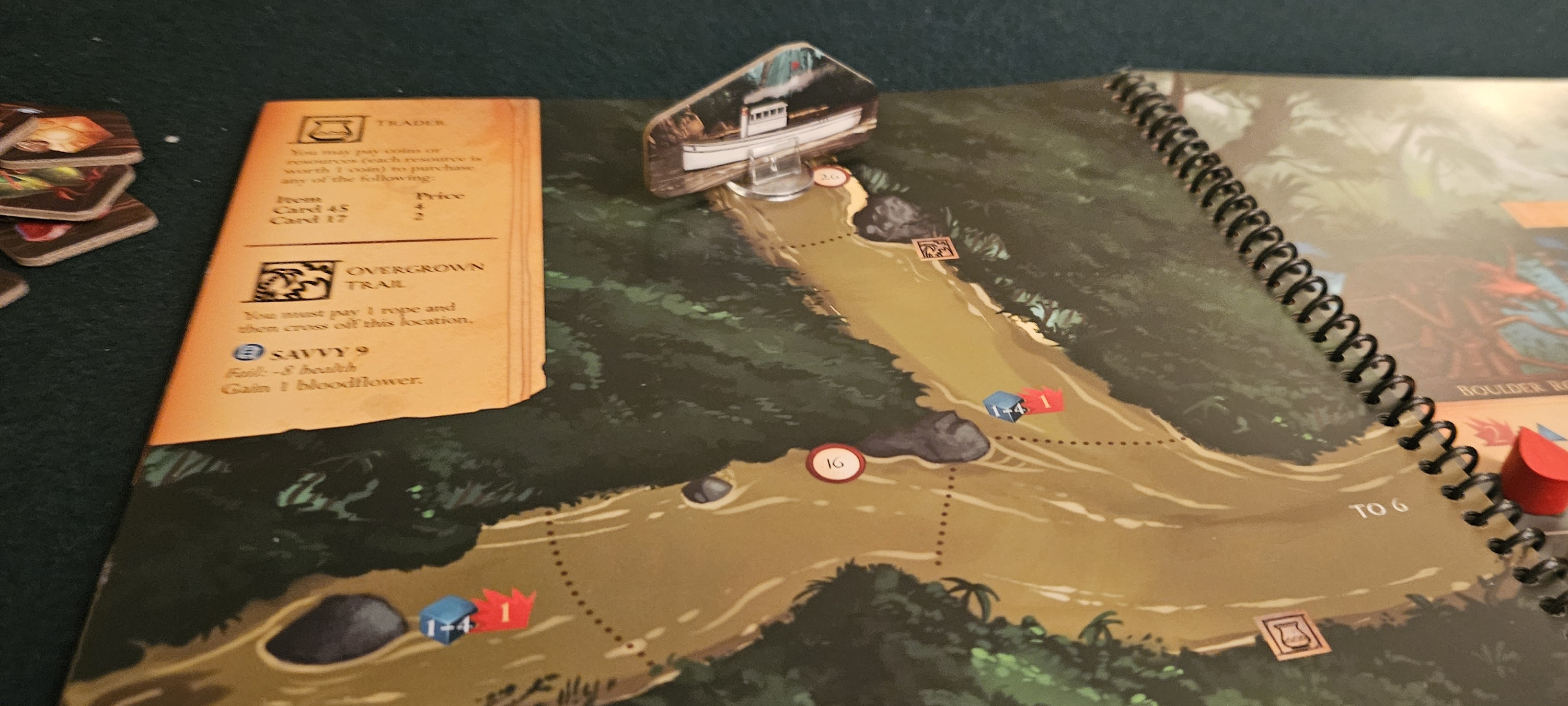
Lost on a primeval river.
As in the original Sleeping Gods, this is the story of a boat that has gotten itself lost. The Harpy, a small fishing vessel owned by the Li family and operated by a diverse crew, is swallowed up by the San Francisco fog and transported to the dark waters of an unknown location. Other incidents kick the plot into motion: a kidnapped family member, mysterious guests retrieved from the water, a menacing stranger (also a waterborne visitor) whose advice seems uncannily like the trigger to a main quest.
The ensuing adventure plays out in much the same way as before. There are four layers to consider, all entangled with one another and crucial to the holistic experience. There’s the Harpy, a fragile vessel that navigates the map but needs to avoid taking too many bumps. There’s your crew, heroes all, with health and conditions to manage, supplies to consider, and the requisite special abilities, not to mention frequent combat encounters. Turns revolve around a time-allotment system, in which your chosen crewmembers parcel out their hours. And then, of course, there’s the storybook, where snippets of text whisk the characters in any number of interesting directions.
Taken together, it’s all very familiar. Some fine-tuning has been done beneath the hood. Combat is smoother thanks to a streamlined deck that players build together by purchasing new weapons from traders or finding equipment in dusty treasure troves, and shuffling them together to form a suite of opportunities. Resting is also easier, allowed anywhere rather than forcing your boat back into port. The ingredients are lined up on the counter.

You’re a real pirate now, Meiling.
But while the raw ingredients are present, they don’t find the proper measure to bake much of a cake.
The first indication is the map itself. While Laukat’s illustrative talents are considerable, there’s only so much one can do with muddy jungle rivers — and I’m not convinced he even met that benchmark. Without the benefit of the larger map, navigation would be the watery equivalent of wandering a hedge maze. Every stretch is identical to the rest. The water is sometimes punctuated by rocks or reeds, the banks are crowded with vegetation unless intruded upon by a squint-or-you’ll-miss-it sandy beach. There are two landmarks in the entire game. Both are waterfalls. Both are located at the conflux’s utmost north. It doesn’t help that certain directions boil down to “head to the waterfall.” Which waterfall? The waterfall to the north? Or the other waterfall to the north?
This uniformity suits the notion that the Lis and the Harpy are hopelessly lost, but doesn’t do anything for the game’s emphasis on exploration. Nothing evokes wonder or delight. In the original game, turning the page was its own reward, lavishing the player with new sights and possibilities. Here, one knows what to expect. You’ve seen it already.
That would be bad enough, but this also causes trouble when it comes to the narrative quests. The original game sometimes allowed players to solve conundrums on their own by mentioning landmarks. In at least one case, the distinctiveness of the terrain allowed Laukat to initiate a quest via a riddle. Here, the best the narrative can do is give directions. “There’s something over there,” the game says, gesturing northward. Good thing the magnetic poles of this otherworldly realm don’t set our compass spinning.

Smooshin’ bugs.
Of course, it’s entirely possible that there’s a method to this blandness. Maybe Primeval Peril is meant to be a game set in a hedge maze? Leaving aside the question of whether this is a good idea in the first place, maybe we’re meant to feel lost and trapped, a handful of bodies packed into a coffin adrift on the current, rather than tasting the salt air of the Wandering Sea?
Except we aren’t lost. We have a map of the surroundings. Nor, really, is there much reason to wander afield. I don’t want to spoil the main quest in either narrative or mechanical terms, but the game more or less points you in the right direction from its earliest moments. It encourages some sideways exploration to gather quest MacGuffins, but this can mostly be accomplished en route to one’s main destination.
Which brings us to Primeval Peril’s main limitation: its length.
The original Sleeping Gods required multiple sittings. Everything in the game, from the limited resources your crew rationed to the way the event deck cycled, was geared toward providing that sweeping narrative arc. Many of those same concepts are found here, in one form or another. The event deck, for instance, is no longer curated, instead swapping your crew’s rest periods for a depletable supply of camps. Either way, Primeval Peril still feels like a multi-session campaign game that’s been crammed into one prolonged sitting. There’s very little room for, say, character development, either within the game’s fiction or because new cards and combat abilities are being added to your roster. The effect is that everyone and everything feels disposable in precisely the way they weren’t in Sleeping Gods.
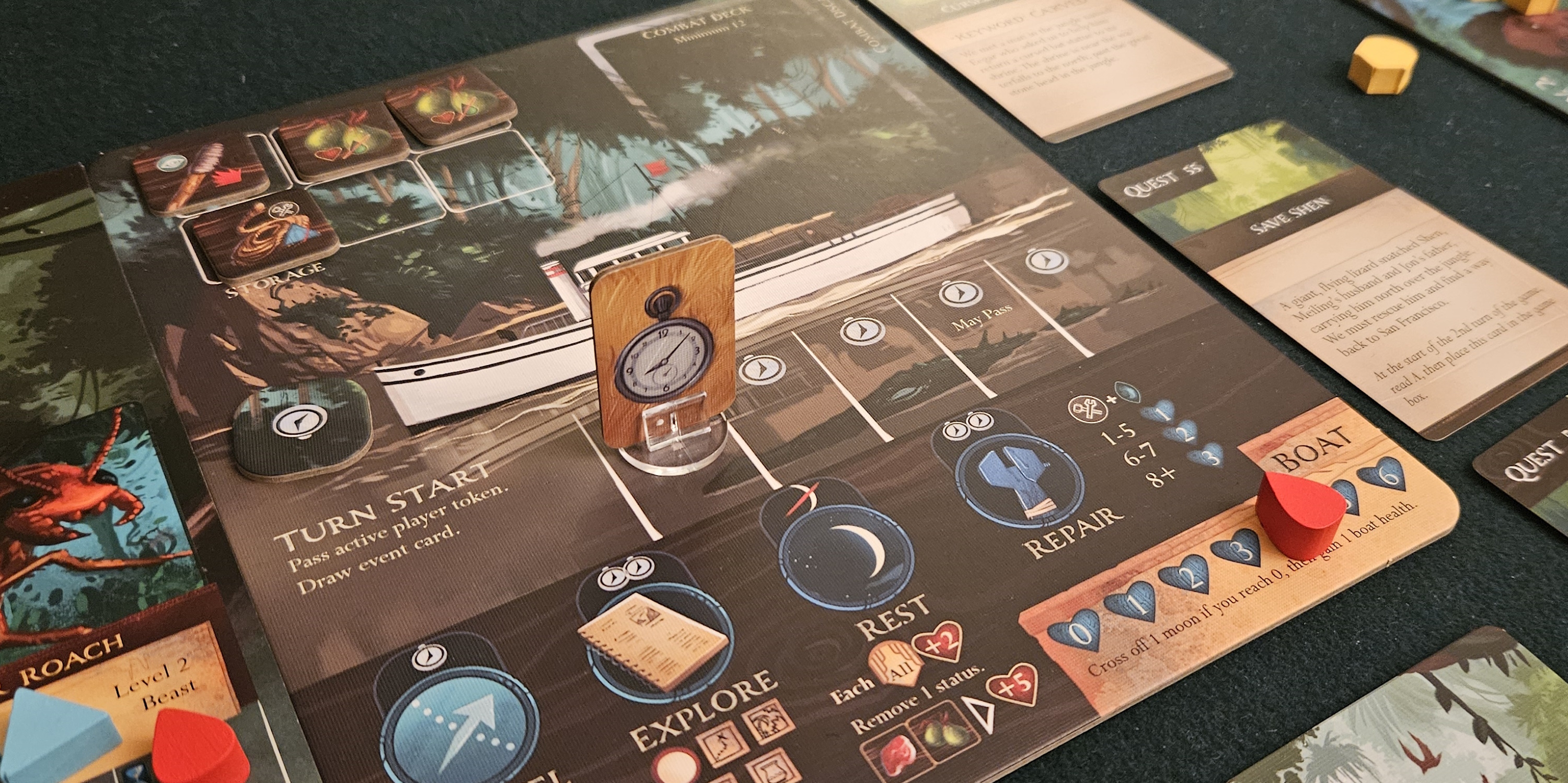
Don’t run out of time!
To some degree, that’s the point. Primeval Peril is a revamped freebie. As an introduction to the world and systems of Sleeping Gods, it works well enough, although it invokes none of the awe or wonder that made the original game so addictive. Its bland setting and truncated considerations could well drive players away rather than drawing them in.
Which would be a shame. Sleeping Gods remains one of the best campaign experiences I’ve ever had. I’ll soon play the sequel. I’ve heard mixed things. But even a glance at the map, at Laukat’s lush illustrations, tells me there will be more of a reason to visit Distant Skies than Primeval Peril.
(If what I’m doing at Space-Biff! is valuable to you in some way, please consider dropping by my Patreon campaign or Ko-fi.)
A complimentary copy was provided. Also, Ryan Laukat had my family over to his house for dinner last month.
Posted on February 22, 2024, in Board Game and tagged Red Raven Games, Ryan Laukat, Sleeping Gods, Sleeping Gods: Primeval Peril. Bookmark the permalink. 2 Comments.

 SPACE-BIFF!
Pingback: Smothering Gods | SPACE-BIFF!
Pingback: Our Sea-Washed, Sunset Gates | SPACE-BIFF!