The Suns of Malvios

The suns of Malvios are dying.
I haven’t a clue what that means. Evocative, though. I wouldn’t expect any less of Peter C. Hayward. He created That Time You Killed Me, which featured some of my favorite writing in any board game to date. Give me one good sentence over a languid storybook any day.
Converge is the card game equivalent of one good sentence. Maybe four good sentences. This is a Button Shy production, and like all Button Shy productions it’s an 18-card wallet microgame. Except there are three wallets plus a solo mode, and they can be mixed and matched. Purists might argue that this pushes it past some self-imposed boundary of microgamedom. Good thing I’m no purist, because Converge is possibly the best microgame I’ve had the pleasure of playing.
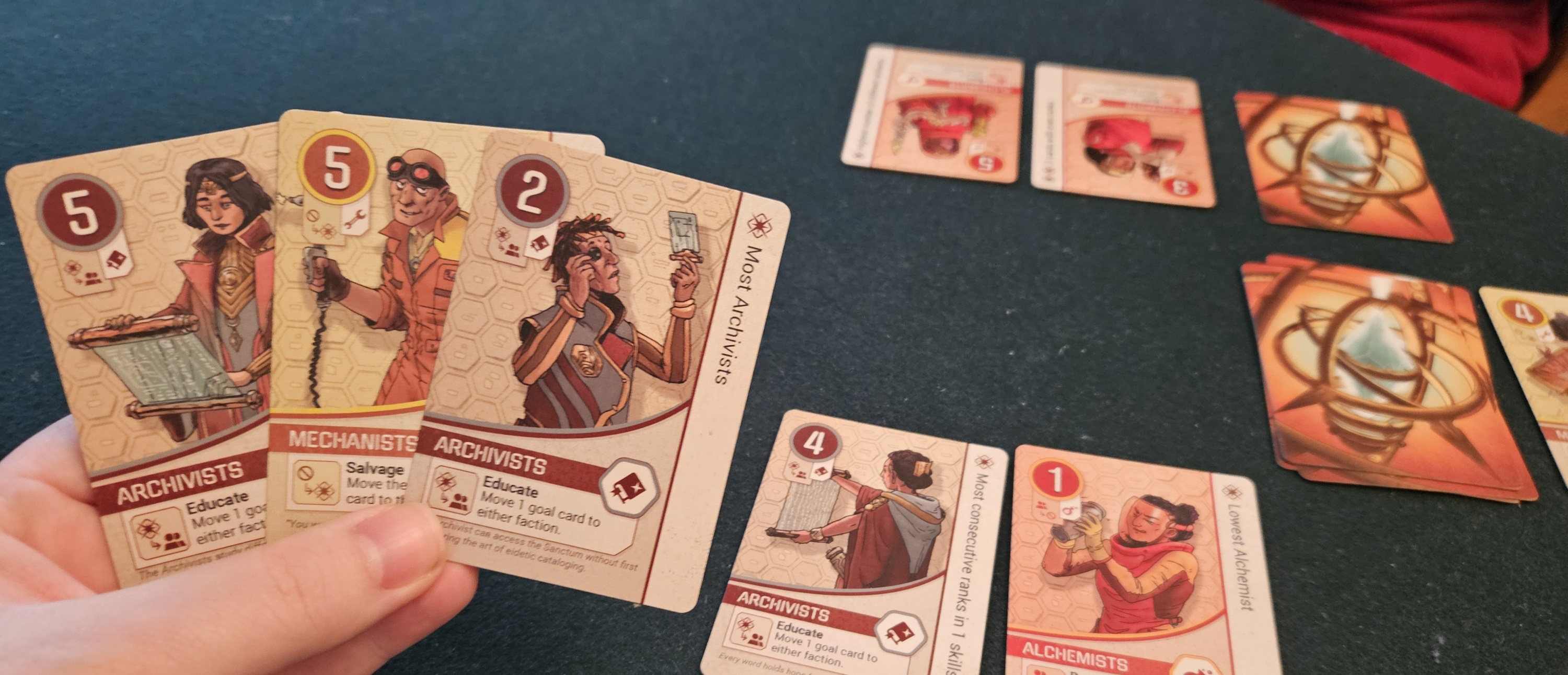
Cards in conflict.
Let’s start with basics: the two-player game.
The suns of Malvios are — you know. In order to solve the whole dying thing, various factions are vying for control of an artifact. We have no idea what this MacGuffin will do to save us; like the game’s introductory sentence it’s best taken on faith.
The first step of Converge sees players shuffling together three factions. Each wallet comes with three, making them standalone productions, but you’re free to pick and choose from any of the game’s sets. Once shuffled, a few introductory cards are dealt: three per player, one into the discard, one face-down to whomever most recently lost a game, including this one. This face-down card is the artifact. Keep your eye on it, because a lot of what’s to come will depend on who currently has it in their possession.
Now we begin to play.
There’s a simplicity to Converge’s actions that belies just how agonizing it is to decide on any given move. There are three possibilities, corresponding with the three sections of each card. First, you can play a card from your hand into a faction, either yours or your opponent’s. This grants its owner that card’s rank and suit. This is important because the second way to play a card is to the middle of the table, in the neutral zone between players. Now the card is flipped sideways to emphasize its objective. There are a bunch of these, but the gist is that each objective awards one or two points to whomever meets its goal. Finally, you can use a card’s discard effect, tossing it out of the game but enacting some ridiculous ability.
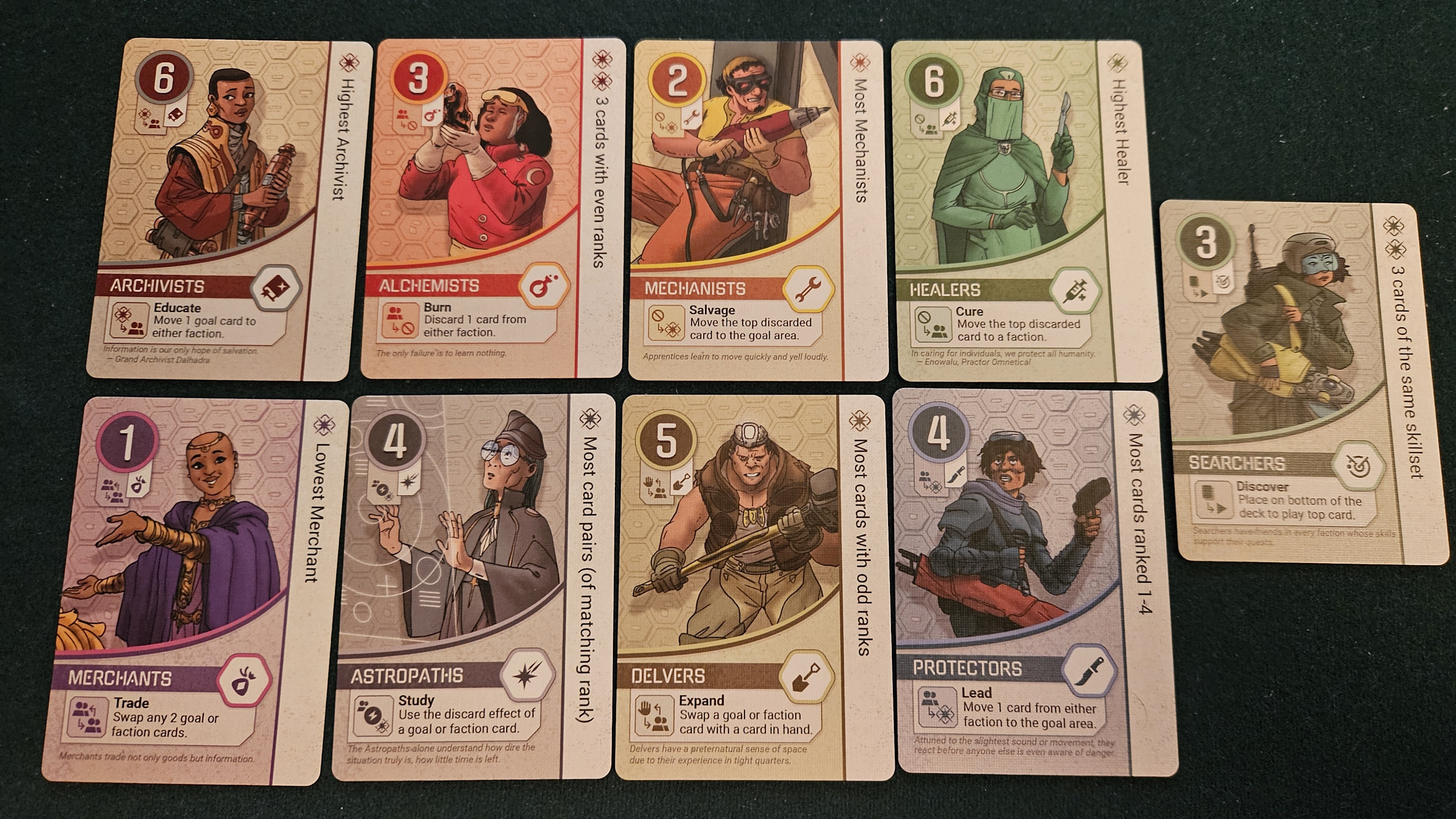
The nine suits are nicely differentiated.
Here’s the problem. The good problem. After both players use a single card, you see who scores highest. A lot of the time, even a majority of the time, players will either be tied or both score zero. In that event, the artifact stays put in front of whichever player controls it and the game moves onto the next round.
But if someone has a higher score, things get interesting. If you don’t have the artifact, you claim it. If, on the other hand, you’re already holding it, you win the game. Now you shuffle the cards together and play again, with the ultimate victor winning two of three sessions.
In other words, a lot happens in a single round, even though both sides are only playing one card. Small moves, big impact. The effect is like a series of rapid volleys, with lots of drama and positioning packed into two thwacks of a ball. The comparison to a racquet sport is apt. As in tennis, you only score when you “serve.” You want to hold the artifact in order to win, but holding the artifact also forces you to play your card first, bestowing a natural disadvantage.
Along the way, the cards prove disruptive. I mentioned that their abilities are bananas. That’s true. The Protectors, for instance, whisk a card out of a faction and into the goal area, effectively robbing someone of their strength and establishing a new objective at the same time. Outlandish. The Alchemists discard a card from somebody’s possession altogether. Horrible. The Delvers swap a card from anywhere on the table with one in your hand. Preposterous.
But here’s the thing: all six cards of a faction have the same ability. That means there are only three abilities per match. That’s reasonable — three isn’t so many that you’ll ever be blindsided by some ridiculous power you couldn’t have fathomed beforehand. That’s bankable — while there’s an undeniable element of chance, you’ll almost certainly get your grubby hands on the exact same abilities your opponent is using. That’s countable — after a certain number of Astropaths have turned up, or Searchers, or Protectors, you’re now reasonably safe from their interference.
Back and forth it goes. In a close match, the artifact may change sides three or four times. It’s kinetic, but also thinky, asking both players to squeeze real mileage out of every play.
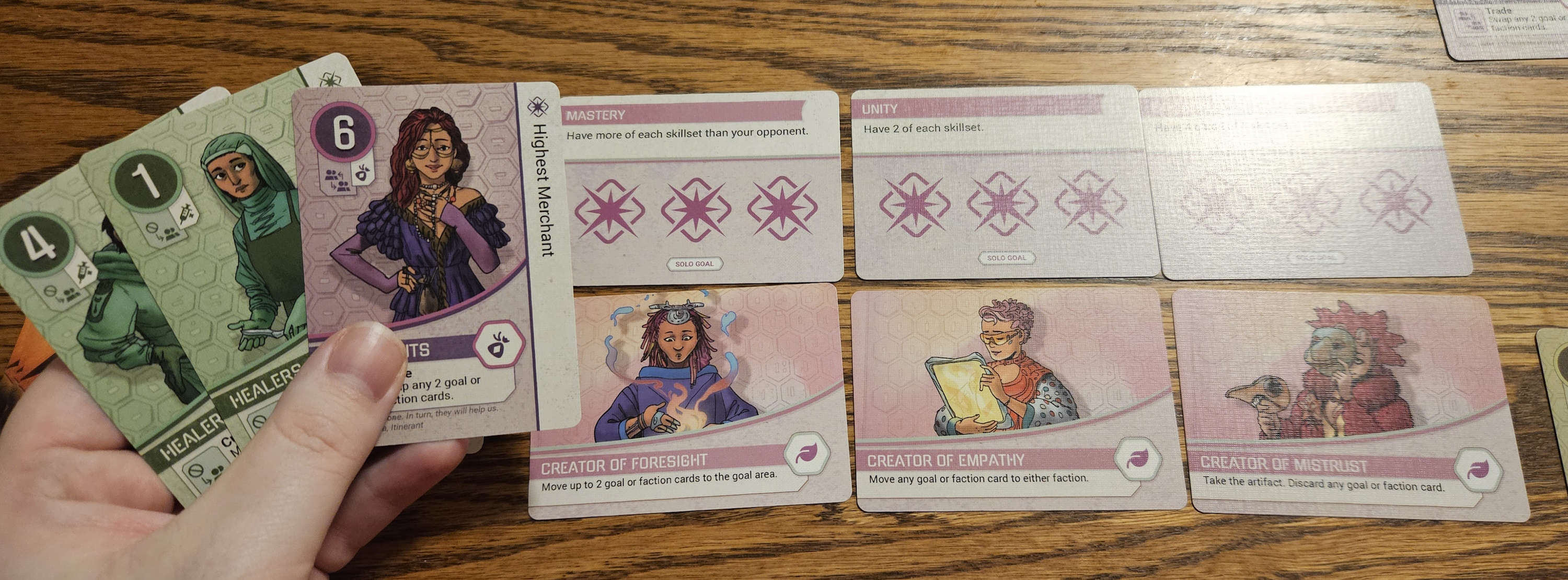
Cards in conflict. With the self.
The solitaire game leans into the latter feel, although it sheds the energetic volleys of the two-player mode.
Here your goal is twofold. First, you need to prevent the automa from claiming the artifact and scoring with it. This is a challenging proposition since the automa “scores” when it earns any points at all, while its cards pull dual use as both faction cards and goal cards. Certain cards are cleverly designed; for instance, the 6-ranked card in every suit has an objective to hold that suit’s highest rank. In the two-player game, that forces some tough decisions and presents no small measure of risk. In the solo mode, it’s a conundrum generator. When the automa reveals a high or low card, they’re now holding an automatic victory. Rude.
As the human player, you’re permitted two plays per turn. It’s amazing how much this opens up Converge’s decision space. It would be more notable if you weren’t pushing the Suns of Malvios uphill. You’ll need to swipe cards from the automa and screw with objectives, all while building your own faction. The solo pack adds a handful of randomized objectives and special powers only you can draw upon. These are a necessity, especially since victory also requires you to meet a certain score threshold. It isn’t enough to prevent the automa from stealing the artifact, you also need to somehow eke out a bunch of points.
It’s hard, is what I’m saying. It’s also quite the thing to behold, a relatively faithful translation of Hayward’s dueling game into solitaire. The tone changes somewhat. Rather than a series of volleys, it’s like peeling apart a conspiracy. The automa begins with five cards, all face-down, and reveals them one at a time. Your task is to react, react, react, all while chasing points.
But it isn’t my preferred way to play Converge. Not only does it trade away the two-player game’s velocity, it also becomes ponderous and mathy. Playing one card is tough enough; as soon as we’re looking at two in sequence, things go haywire. For that, there are plenty of dedicated solitaire games I could be playing.
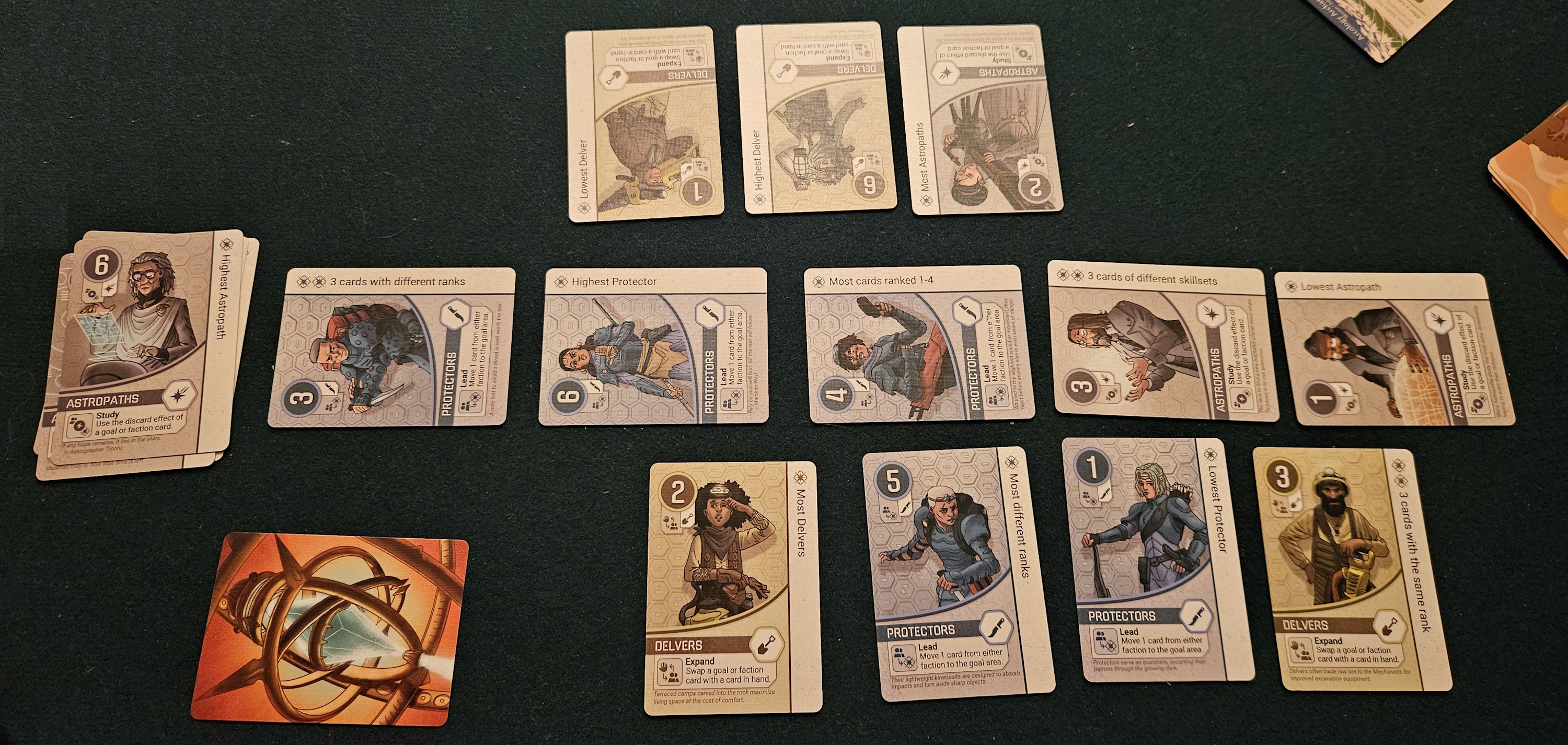
For such a small game, the contests can feel surprisingly big.
As a dueling game, though, I’m smitten with Converge. All too often, microgames leave me feeling like they’re too small for their own good. That’s not the case here, and not only because combining all three sets provides enough cards to constitute a regular playing deck. Even as singular experiences, these wallets hold surprising depth, not to mention some seriously good gameplay. The suns of Malvios are dying. In Converge, their death is a supernova.
(If what I’m doing at Space-Biff! is valuable to you in some way, please consider dropping by my Patreon campaign or Ko-fi.)
A complimentary copy was provided.
Posted on January 25, 2024, in Board Game and tagged Alone Time, Board Games, Button Shy, Converge. Bookmark the permalink. 12 Comments.

 SPACE-BIFF!
What IS your favorite solo game or microgame?
I think this might be my favorite microgame. Solo, there are a bunch. Clicking the “Alone Time” tag will lead you to a number of them.
Am I right in sensing that this feels like an evolution of Red7? There at least seems to be the parallel of “play a card to your area for its number and color, or to the center for its rule”, with the rules accumulating rather than replacing each other (and with a bonus third option of burning a card for a disruptive effect).
Sure, a little bit! There are a few parallels. It winds up feeling quite different, but I can see the comparison.
If you HAD to pick just one from the Engines/Catalysts/Sparks trio, which would be your overall favorite?
That’s a toughie. I think the abilities in Engines might be too “bouncy” for my tastes, especially in combination, so not that one. Between Sparks and Catalysts… probably Catalysts, I think.
Would you say this plays in the same waters as Air Land and Sea? Which would you gravitate towards if both were available for a 1v1 game card night?
Apart from being dueling games, I don’t see them as all that similar. AL&S is one of my favorite games ever, so I would probably lean toward that one, all other things being equal.
Pingback: Red Fish, Blue Fish, Fish What’s Ticklish | SPACE-BIFF!
Pingback: Strip Poker | SPACE-BIFF!
Pingback: Best Week 2024! Snacked! | SPACE-BIFF!
Pingback: Sporks | SPACE-BIFF!