Skipping School

Not many board games make me tired. Sankoré is the rare exception. As a follow-up to Merv: Heart of the Silk Road, it has certainly shed the reservation I felt at the time, that it was a boilerplate nu-Euro with a wonderful action selection system.
This time, Fabio Lopiano, working alongside Mandela Fernandez-Grandon, has crafted a nu-Euro that does everything at once. Too many things at once. After I prepped for its requisite second and third plays, a setup I clocked at twenty-two minutes, everybody filed in and groaned. It’s not a good sign when people are weary before a session has even started.

Books are one of your most precious resources.
Under the reign of Mansa Musa, the Sankoré Madrasa boasted the largest collection of books in Africa since the Library of Alexandria. Situated in Timbuktu, it grew from a tenth-century mosque into an educational institution of enormous proportions, with a student body that ranked in the thousands. It was a monument to the Mali Empire, a center of learning that produced innumerable manuscripts and drew visitors from across North Africa and the Middle East.
As a board game, Sankoré isn’t especially invested in depicting the particulars of the madrasa, but there are details to glean. Rather than dividing topics across specialized colleges, as European universities did, each player takes on the role of a headmaster who hosts multiple courses of study at once. Students, meanwhile, function more like disciples or apprentices than the relatively itinerant pupils we associate with universities today. In game terms, they “belong” to their teachers; players recruit them directly, then advance them through courses on their personal boards. This sense of residency is historically accurate. Students tended to live with and study alongside their ulemas for years at a time. It was a tight-knit process, marked by collaboration and interdisciplinary pursuits. One didn’t merely graduate from a school; one graduated from a teacher.
Which sounds both exhilarating and exhausting. In my experience, students avoid office hours and despise group assignments. So much for revitalizing the Sankoré Method.

Welcome to my school. Class list forthcoming.
Board games can be learning tools, but Sankoré’s interests lie elsewhere. Although one witnesses a non-European method of education in action while playing Sankoré, it isn’t easy to pick apart where the game portrays history and where it portrays abstraction. The direct recruitment and possession of students is one example. Are you enrolling students, designing courses of study, and shepherding those students through those courses because you’re an individual or because you’re an abstracted institution? The rulebook describes the player as “the master of one of those schools.” Not the most helpful epithet.
Okay, so Lopiano and Fernandez-Grandon are more interested in explaining game rules than grounding those rules in the setting. Fine. The irony is that Sankoré is in desperate need of such grounding. On the surface, Sankoré adheres to one of the most basic conceits in the hobby: on your turn, you take two actions. Those actions, however, tend to spool outward. Everything is connected to every other thing. Even the simplest actions are entangled with outcomes that carry more import than the casual observer might be capable of deducting.
An example. Enrolling a student looks like a simple affair. You pick one of the game’s four student tracks — more on why there are four in a moment — and move the rightmost student from the track to the beginning of your personal curriculum. But this can potentially trigger a wide array of effects. Regional scoring! Placing a tile in the madrasa! Earning a free favor! A free-ish favor! How these effects interact is difficult to describe even with the game set up on the table. It’s the sort of thing best taught by observing it in motion, like a dance, but with none of a dance’s elegance.

Mathematics: What are they good for? War. That’s what they’re good for.
Teaching a class is the game’s most involved and important action, and it’s one wise players should endeavor to undertake every single turn. I’ll skip the particulars; suffice it to say that teaching a class brings a handful of Sankoré’s tangled strands together, students and courses and bonus tiles and more besides. But its main application is to let you alter one of the four regions on the board.
I mentioned four student tracks. There are four because they correspond with those four regions, each signifying a different course of study. Right away, this is the best thing about Sankoré. Rather than depicting the pursuits of these schools as pure abstractions, it insists that theoretical knowledge has practical application.
Consider astronomy. Charting the heavens may sound egg-headed, but it’s also how trade caravans find their way across the dunes of the Sahara. When you teach an astronomy class, you therefore zoom outward. Rather than being stuck in the madrasa, you’re now journeying a camel token from Timbuktu to distant oases and ports, spending gold to earn salt and eventually greater bonuses.
This being Sankoré, the process is somewhat more burdened than it needs to be. There are thresholds that move tiles from one part of the board to another, and regional scoring triggers that are more gamey than rooted in medieval trade routes, and a whole lot of icons to keep straight. As we will see, that problem extends to every other domain as well. But it still captures the reason behind all the book-work and star charts. A course of study isn’t merely a way to occupy some rich family’s nerdy kid. It’s the means to alter the world.
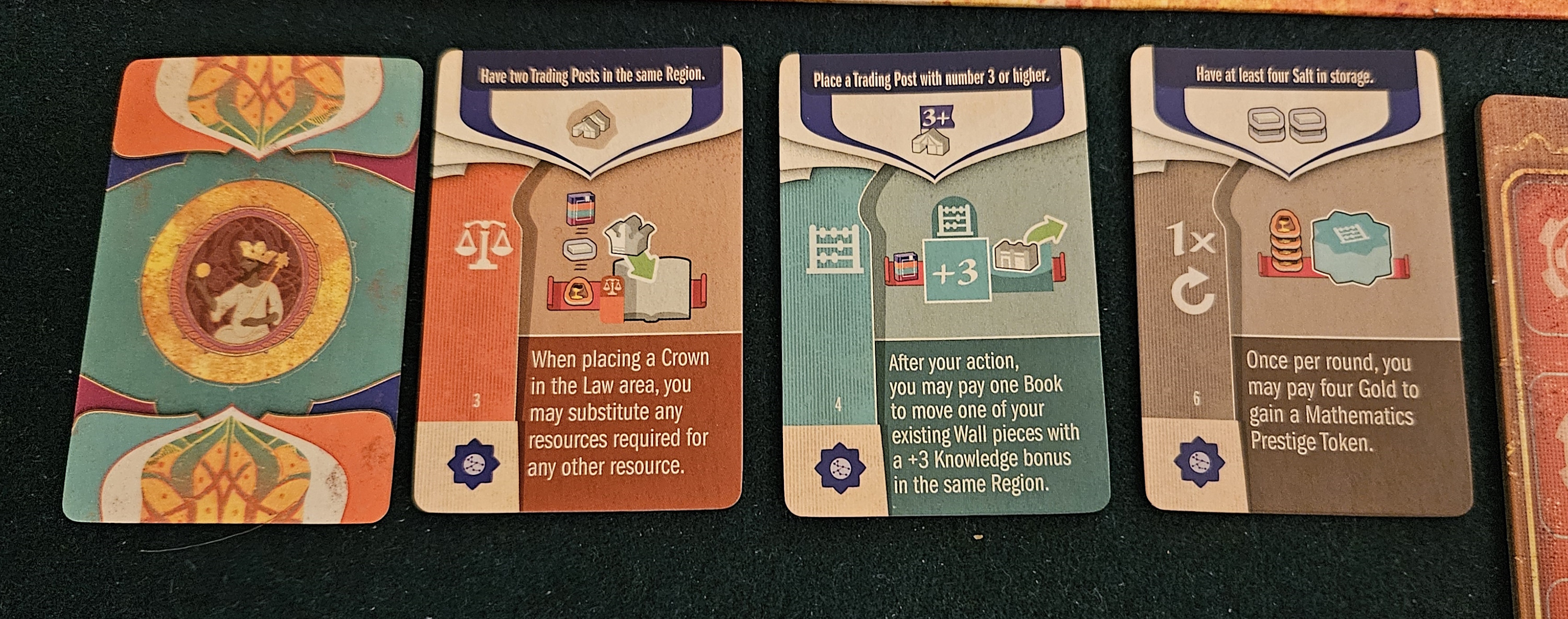
Objective cards guide the action… to some degree.
That goes for the other fields, too. Law lets you add bonus tiles to your other actions, honing your activities so they produce resources in the background. Theology is about far more than god-bothering. It’s the action that emphasizes literacy, producing the books that allow you to establish courses and score points. Mathematics is all about warfare and architecture, letting you erect walls around the madrasa and activating the tiles that have been placed there by other actions.
Bit by bit, these applications knit Sankoré together. The process is slow going. As in Lopiano’s previous efforts, there’s an undeniable cleverness to how everything ties together. The tiles in the madrasa are eventually awarded via majority thanks to the walls you’ve erected. The books in the library becomes scoring values.
But like the scoring and herky-jerky actions of Autobahn, the final weaving is fuzzy with loose strings. The connections between your school’s classes and the real world are concrete and satisfying. The scoring, on the other hand? Sankoré eschews the usual victory track for something more obtuse. As you play, certain activities award various amounts of prestige. These are hard-fought to begin with, but the actual value of these prestige tokens vacillates during the game as books are stacked in the library. Meanwhile, prestige seems to come from everywhere — the tokens you’ve pried from the map, markers in each of those four regions, students you’ve graduated, missions you’ve completed. When the final tabulation rolls around, Sankoré winds up feeling like a point salad game even though it doesn’t have a scoring track in the first place.

Caravans carry our gold to far-off lands.
What it evokes, in the end, could also be considered accurate — the bitterness of acting as an effective headmaster and educator and not being recognized by Mansa Musa because you didn’t properly play the political game. On paper, this might sound like a fascinating twist, on par with the machinations that make alternative titles like the Pax Series so compelling.
In action, however, the whole process feels baggy and dissociative. The game’s underlying economy isn’t all that difficult to parse. Mathematics turns books into gold as you’re remunerated for your renovations to the city; astronomy turns gold into salt as you help establish trade posts; theology lets salt-licking copyists turn out manuscripts; law bolsters the efficacy of the other fields. This is already enough to hang a game on.
However, each of these steps is only useful insofar as it forwards your score, yet the scoring criteria fails to engage with a significant portion of the game’s pursuits. Like the disconnected tallies of Autobahn, which exhibited little interest in the many things that game asked you to do, Sankoré is less about its subject matter and more about solving a puzzle, about determining which aspects matter and which don’t. In a sense, you’re excavating the game itself. Your goal isn’t to play well; it’s to successfully play the second game buried underneath the first one.
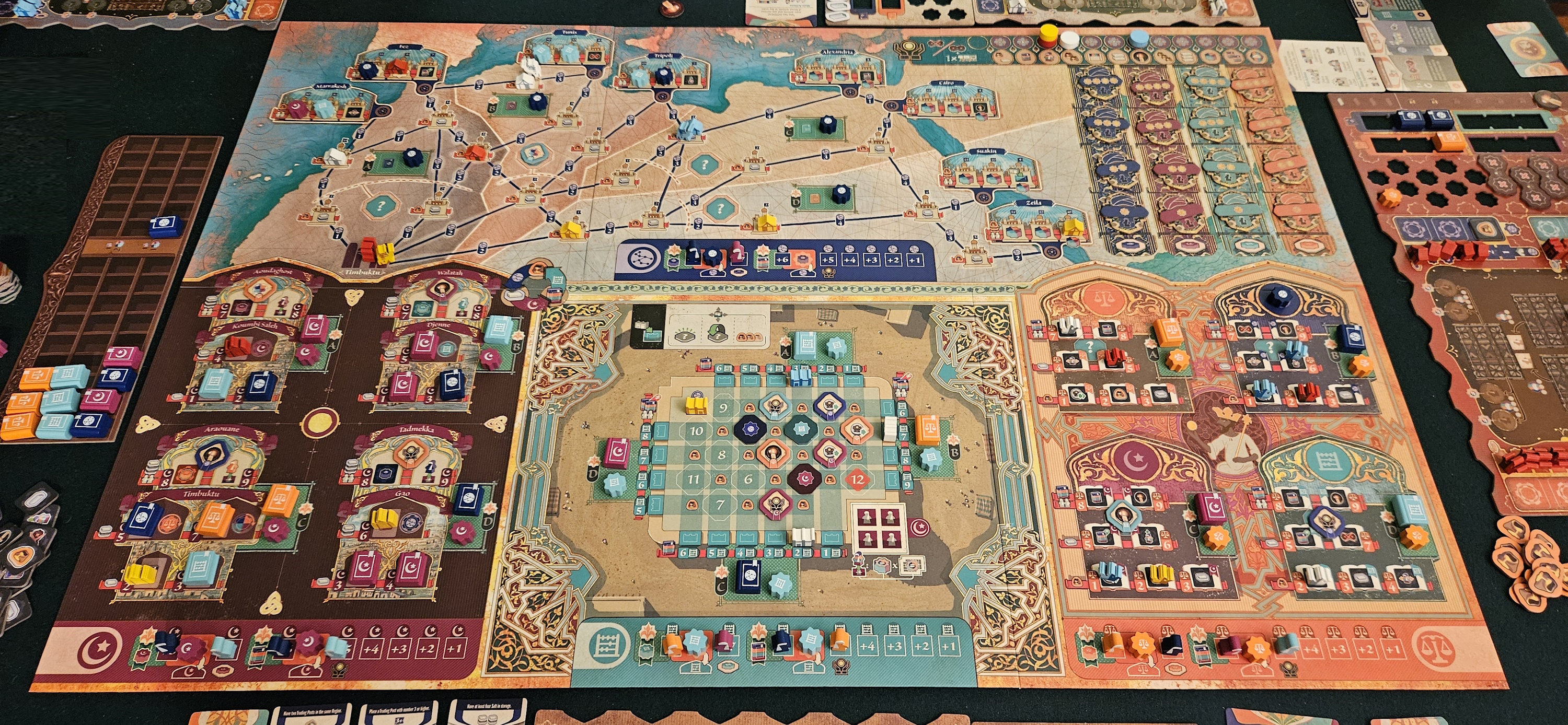
Gah!
Can that excavation be interesting? Sure. But it also happens to be so very wearying. The scoring system reminds me indirectly of the prestige systems in games like Pax Porfiriana or Pax Renaissance, dynamic criteria that require careful assessment lest you chase an objective that won’t pay off. But Sankoré is no Pax Porfiriana or Pax Renaissance. It lacks their dynamism, their changeability, their emphasis on speculation and wagering and brute force. Not to mention, you could play either of those games two or three times in the span of a single runthrough of Sankoré. Crud, presuming an early imperial win in Pax Ren, you could wrap up a session before completing Sankoré’s setup. Along the way, you might also develop an odd opinion about banking.
Meanwhile, Sankoré is like a professor who doesn’t teach the class they wrote the syllabus for and assigns grades through an ill-defined methodology. My plan is truancy.
(If what I’m doing at Space-Biff! is valuable to you in some way, please consider dropping by my Patreon campaign or Ko-fi.)
A complimentary copy was provided.
Posted on January 5, 2024, in Board Game and tagged Board Games, Osprey Games, Sankoré. Bookmark the permalink. 11 Comments.

 SPACE-BIFF!
So refreshing to read criticism about a game that is actually critical.
A good reminder to sit down and play Pax Pamir again.
Always a good course of action.
I did not have to cope with a rulebook – instead someone explained it to me at SPIEL. The difference a good teacher can make (at madrasas or elsewhere)!
Still, the game left me a bit bewildered with its myriad of opaquely interlocking subsystems.
I had to read the rulebook three times to understand what was going on. And I read a lot of rulebooks.
A point salad without a victory point track actually sounds fascinating.
It is interesting how you seem to have been yearning for Victory Points in this game; something that would directly reward you for playing the “first game” and less so the excavated one.
I tend to love games which eschew the trappings of expectation and I think your glib reading of a school master having taught well but not shook the right political hands to be more interesting than you perhaps allowed it to be?
I do agree that the area majorities lack grounding, especially as you score them all no matter what. I felt bummed at that revelation as it seemed to uncork my supposed careful planning of being in the right place at the right time. Of forcing a majority scoring and then perhaps later sweeping up at the law court overflow section.
And yeah that overflow section. That annoyed me too. Could players not enact a game wide law there rather than collecting free parking as the best reward? The other 3 locations felt suitably mnemonic to their thematic intentions but the law section and its ‘skills’ felt distant.
In all, I liked my experience and shared a lot of your reading. The humdrum of taking 2 actions included. However, I found the scoring system to be the main thing which allowed this to not become an empty facade of a game; a dressed up area majority game with VPs.
Indeed, the limited and tightened nature of the scoring entices me to wonder about such a game that eschews scoring completely. Something that we play simply to experience the puzzle. The first third of Sankore feels like a game without scoring. That is interesting. That is later turns out to be a mirage as the end game points crystallise into shape is not as fully disappointing as if it just attached and placated with the usual VP track from the start.
Pingback: New Year, Old Year: 2021 Revisited | SPACE-BIFF!
Pingback: Upscale Court Officiants | SPACE-BIFF!
Pingback: That Wizard Came from the Moon | SPACE-BIFF!
Pingback: Calimala Olives | SPACE-BIFF!
Pingback: Sun Besties! | SPACE-BIFF!