Once More Unto the Omen

Omen is an old friend. I first wrote about John Clowdus’s masterpiece eleven years ago, and swore off repeating that review more than once. We’ve been through good times (the Olympus Edition) and shaky times (the eventual glut of Kolossal spinoffs). I once alienated my brother-in-law by trouncing him a little too thoroughly. When my daughter’s appendix ruptured, I grabbed the first thing off the shelf on my way out the door. Dusty and well-worn, it was Omen I spent the night shuffling, drafting deck after deck, doing anything to keep my mind occupied.
Clowdus recently bought back the rights to Omen. Now he’s rebuilt the game from the ground up. New art, new style, tighter focus. It’s a different experience, in some ways. That’s no surprise for a game that’s always shifted with the times and Clowdus’s evolving design sensibilities. I can’t wholly assess whether it’s the best incarnation of the series; we’ve grown old middle-aged together. But I think it’s great, the work of a designer who can’t quite leave his masterpiece behind.
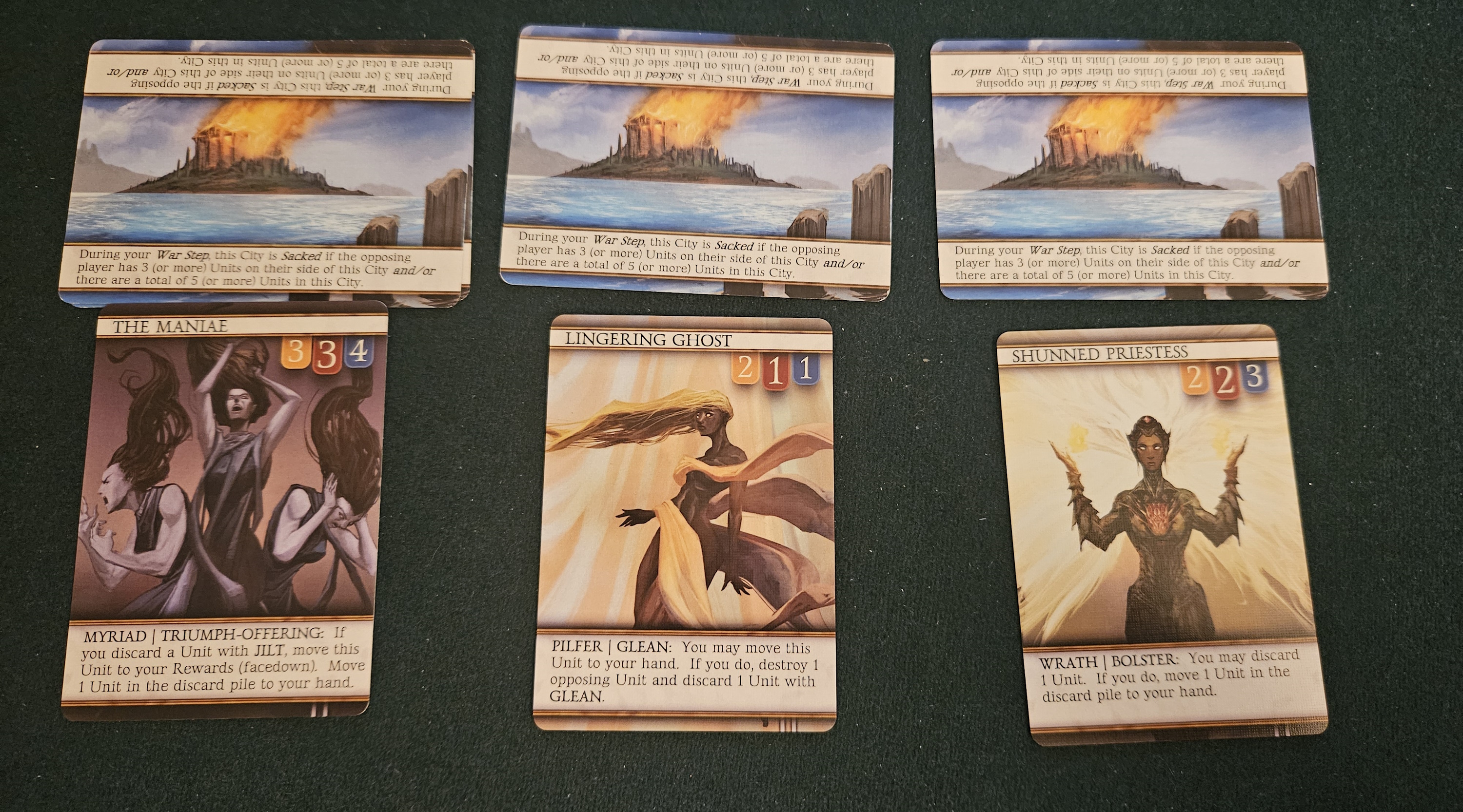
Commanding the Greek aisles. It’s a pun.
For those who don’t know… I’m tempted to tell you to look up Omen elsewhere, perhaps in one of the many reviews I’ve written about it. But let’s do this. For the last time. The last last time.
You’re a demigod. Gods know they’ve produced plenty of the bastards. Now you’re warring against your twin for a holy promotion. Because you are demigods, and therefore some of the most awful beings in creation, the criterion to this contest is three cities in need of sacking. So you rally minions, deploy them to those cities, and haul off their treasures.
In genre-speak, this is a lane-battler, not all that far off from Reiner Knizia’s Battle Line and its many inheritors. By dominating a lane during battle, you peel the topmost card from its deck. These spoils are worth points, but can also be spent to increase your potency in battle. This halves their value, but may prove essential to your campaign for dominance.
Where it diverges from the norm is also where it grows most interesting. For a city to become war-torn and thus sackable, it requires a certain bulk of units in its environs. This is the source of Omen’s most definable yet strangest metric: a battle only occurs when there are either three units on the opposing side of a city or five units there total. Because resources are scarce, both cards and coins, the entire game becomes one of upped wagers, spearpoints always needling a city closer to resolution. This, by the way, is a source of inbuilt balance. Deploying a troop to a city means you’re nudging it toward a tipping point, and not always in your favor.
This doesn’t mean that Omen is incremental or sluggish. If anything, the opposite is true. There’s no such thing as a minor play. Even withholding troops is an act of aggression, like mustering a horizon-eclipsing force. The lanes and cities are only the focal point. Omen is also a game about managing resources and tempo. This requires a delicate touch, sometimes hoarding cards and coins like a miser, sometimes spending yourself down to zero in a bid to overtake the opponent and secure as many points as possible. Just last night, my opponent scored six points in a single turn. Some matches only score that many points total. Still, the final tally was only off by a single point. (Before you ask, yes, he won.)
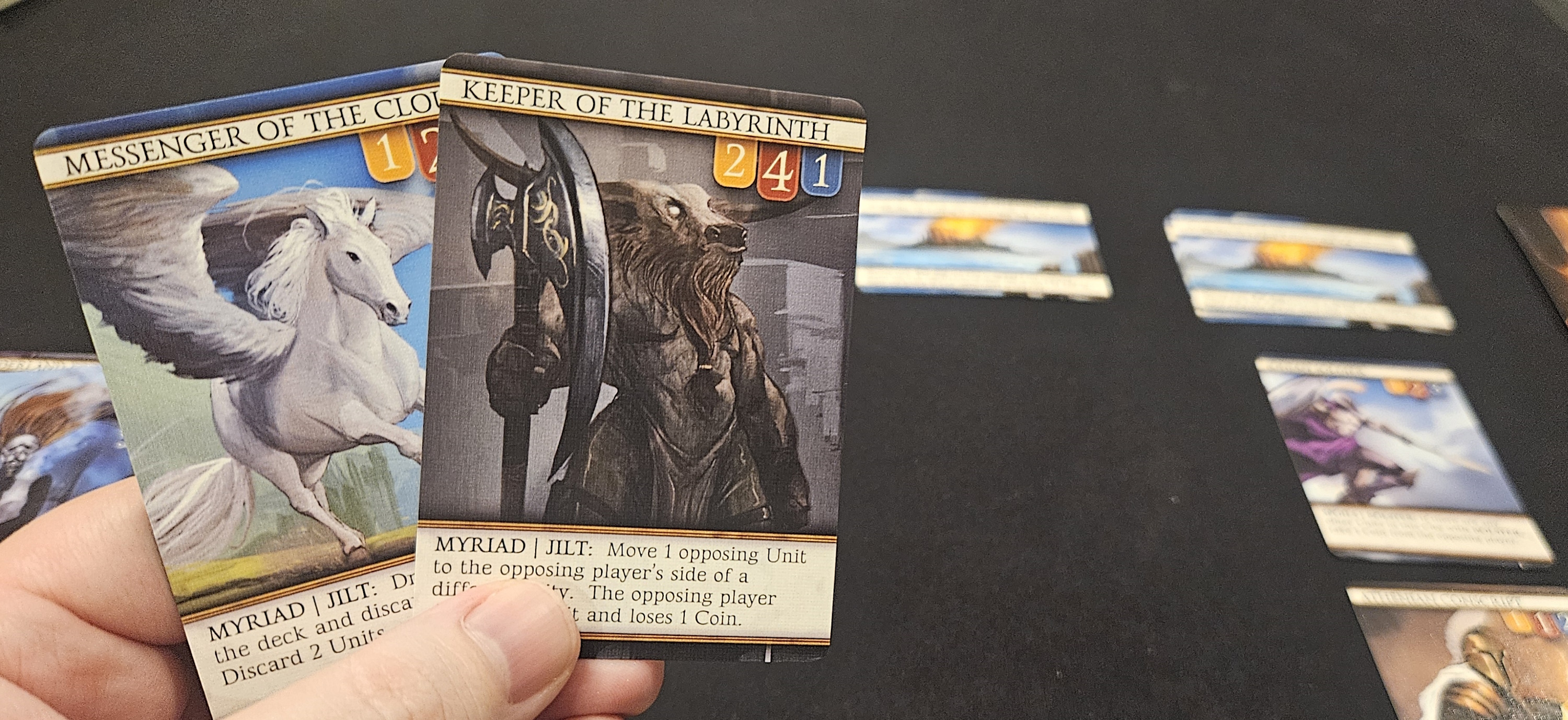
Deciding how to field my big hitters.
But it’s the small changes that set this version of Omen apart from its predecessors.
The biggest alteration is the absence of feats. Previously, Omen featured a set of cards on the side that acted as scoring objectives. These have been replaced entirely. Their substitution is a new type of card, triumphs. These are tied to certain soldiers, functioning as miniature objectives that enter and exit play over the course of a game. Scoring a triumph is as potent as sacking a city, with the penalty that you no longer have access to that soldier’s strength — or, it should be noted, the premium value of that soldier as a sacrifice to Olympus. It took me two full plays before I realized feats had disappeared from the design entirely; that’s how little they were missed in favor of triumphs.
A second ability marks certain troops as coveted; these are worth points if they’re still in your hand at the end of the game. Since your hand size is limited, and even the spoils of a sacked city hog up precious space, the concluding turns of the game are often a scramble to draw as many cards as possible, churning for castoff value.
Cities, triumphs, coveted troops. These three sources of victory points are the hinges upon which Omen turns. When playing via draft rather than one of the three pre-constructed sets — which, it should be noted, is the ideal way to play Omen — this is precisely what decks are built around. First you draw and select four triumphs, then four coveted units, establishing a baseline strategy. Then you draft fifteen more troops, both to support those objectives and sack cities. In contrast to other dueling card games we’ve looked at this year, John Clowdus has always excelled in crafting a tight draft. Omen’s drafts require only a few minutes to produce some truly gripping decks, packed with opportunities and spring-loaded traps alike.
Oh, there are things to quibble over. It’s text-heavy. Certain keywords could have been icons. The triumphs don’t tend to disperse units to all three locations the way the feats did. It’s also about as confrontational as it gets. To succeed, it’s essential to build combos and fiddle with your hand of cards. But this is no heads-down engine builder. There will be disruptions. Your troops will be murdered in their bunks before they ever set sight on the city. Your treasury will be drained. That minotaur you were relying on to carry the day will get sliced apart by some lady with knives. Teensy knives and big technique, supposedly.
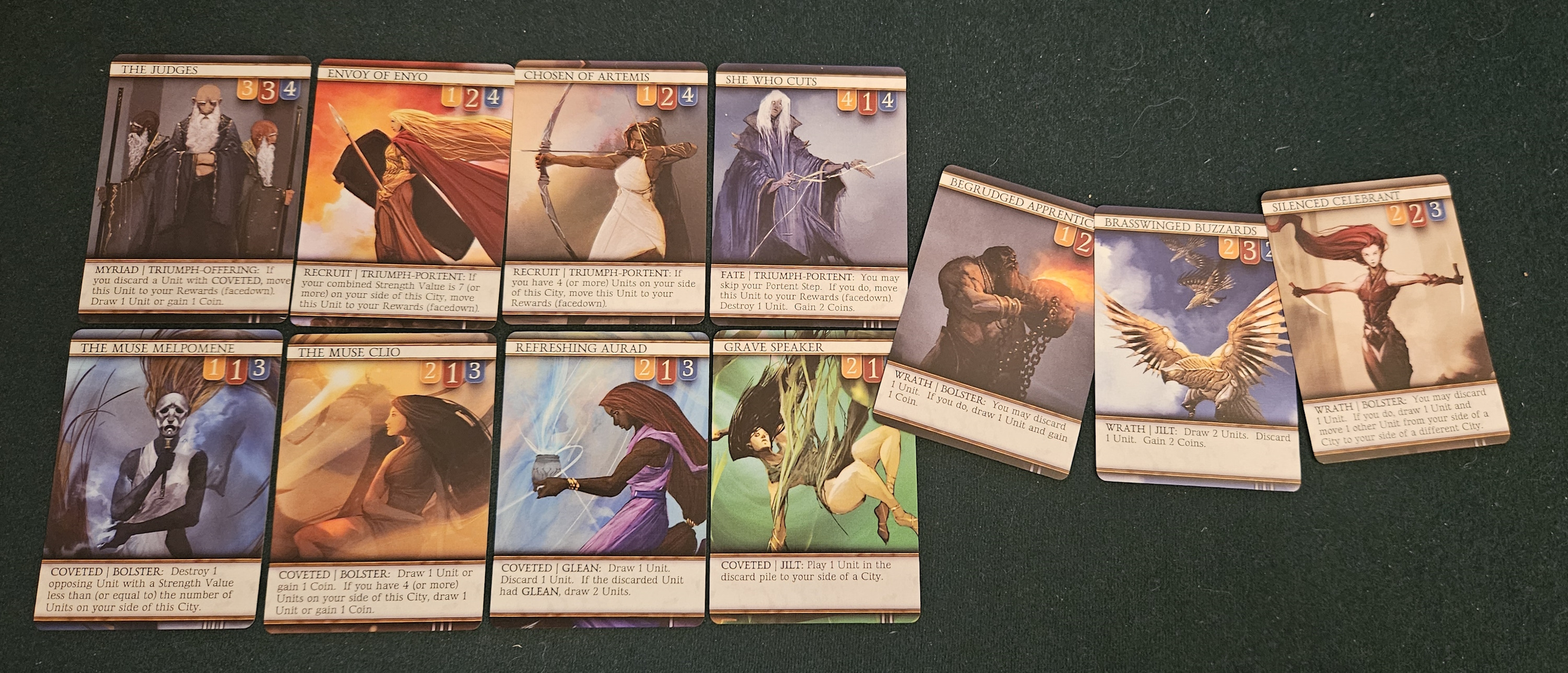
The draft is Omen at its best.
That’s also what makes Omen so imminently rewarding. After eleven years, this is still one of my favorite games, a face-to-face rumble that’s equal parts brute force and graceful elegance. Ballet with a sledgehammer. With this latest set, Clowdus has taken what I considered a perfect game and added “near-” in front of its previous iterations. This is the version I’ll be playing going forward. Hopefully not at the hospital.
Omen is on Kickstarter for the next couple of days. You can find it here.
(If what I’m doing at Space-Biff! is valuable to you in some way, please consider dropping by my Patreon campaign or Ko-fi.)
A complimentary copy was provided.
Posted on December 19, 2023, in Board Game and tagged Board Games, John Clowdus, Omen: A Reign of War, Small Box Games. Bookmark the permalink. 9 Comments.

 SPACE-BIFF!
I applaud you for your “Commanding the Greek aisles” pun, and I applaud John Clowdus for returning to Omen with fresh ideas. I am eager to see how new tweaks to a favorite game play out.
Thanks, Lee! I’m especially proud of that pun.
I’d be curious how this compares to a game of his you reviewed a while back: An Empty Throne. That one, for me, replaced the original Omen in my collection and I’m now curious if these might once again have their place.
I prefer this one, but that’s likely because of my history with Omen. An Empty Throne is excellent, and I could see how it might replace Omen for some.
Pingback: I Gave My Blood to NAWALLI | SPACE-BIFF!
Pingback: Pariahs Non Grata | SPACE-BIFF!
Pingback: There Can Only Be 0001 | SPACE-BIFF!
Pingback: Sockeye Salmon Slayers | SPACE-BIFF!
Pingback: Omen Review – Clowdus With A Chance of Bloodshed | Player2.net.au