Colors of Abstraction

As a youngster one of my prize possessions was The Book of Classic Board Games from Klutz Press. I didn’t know at the time that I was in good hands, the book being authored by none other than Sid Sackson. While Sackson seemed intent on imparting how much could be accomplished with a single set of Go stones, mostly I was enamored with the more “thematic” games in the collection, such as the clay-molded landscape of Dalmatian Pirates and Volga Bulgars or the plump wrestling moves of Hasami Shogi. Thus began my lifelong appreciation for abstract games. (Although please note that “appreciation” and “skill for” are very different traits.)
Over the past few months, I’ve been enjoying three modern abstracts at a leisurely pace. Their common thread is that they were all designed and self-published by Khanat Sadomwattana. Not that you’d know they were self-published by looking at them. These are lavish productions, each visually arresting on their own, with striking aesthetics that aid in making their gameplay as smooth as possible.
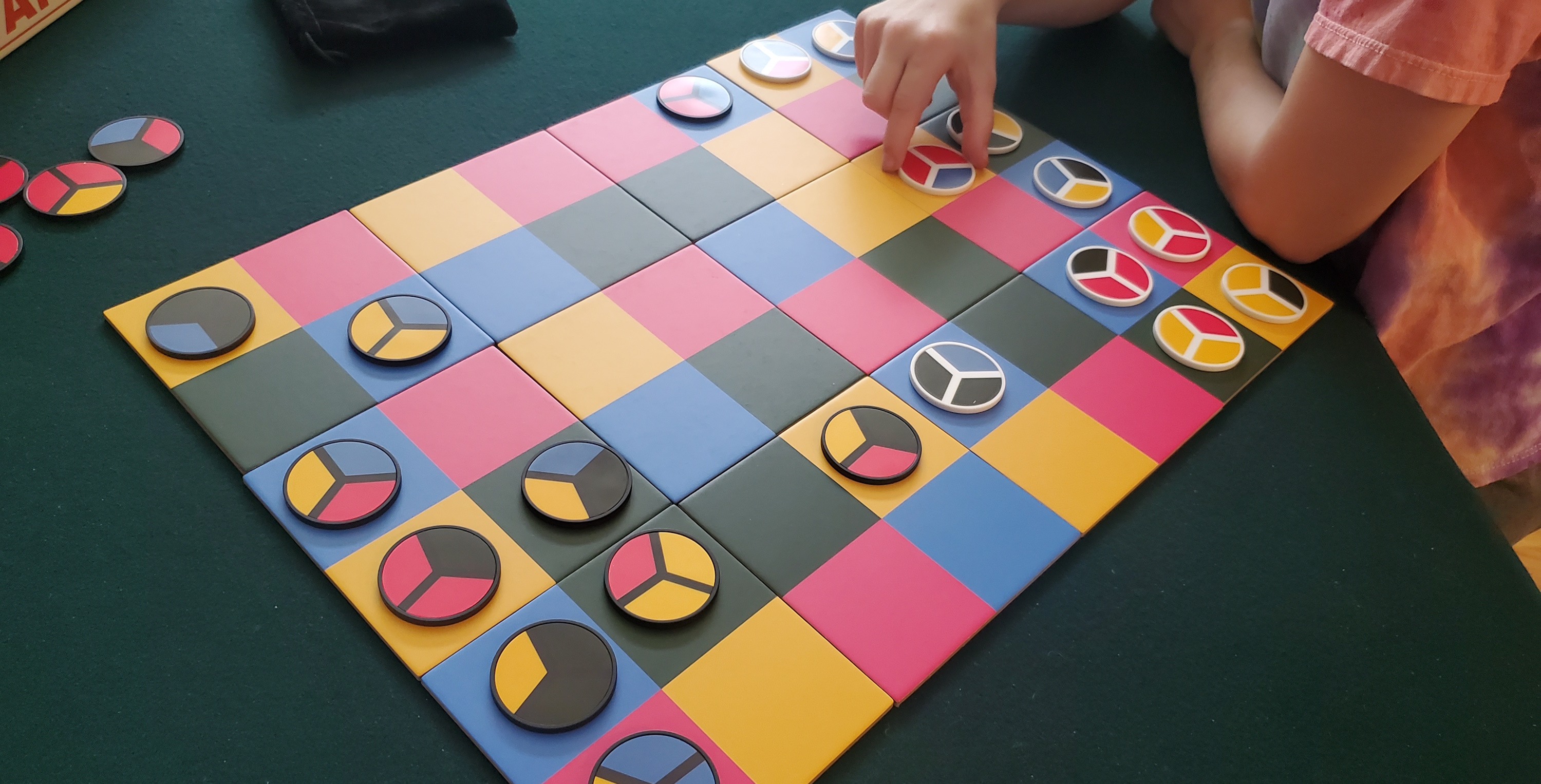
The colorful counters and board of Iro.
Iro
As an example of aesthetics-as-gameplay, Iro is the clear standout of the trio. The board is randomized each game, a grid of twelve squares that produces 48 color-coded spaces. Moreover, your pieces are similarly coded, each showing three colors. These, you will be unsurprised to discover, indicate the spaces onto which those counters may move.
But there’s more to a turn, or even the setup, than simply making a move. For one thing, you’re free to determine which pieces begin on the board, occupying the back two rows of your side of the board. This is laden with significance in and of itself, requiring you to assess the field in advance. That’s because every piece is permitted to move as far as its colors permit — three spaces in total, but only when their colors align. A disc composed of pink, pink, and blue, for example, could step onto a pink space, then a blue space, and then conclude on a pink space. There’s a sense of geography at play that’s compelling without relying on the player’s memory of the pieces, one of the places games like Chess or The Duke stumble.
It helps, too, that the objective is so straightforward. All it takes to win is moving a single piece to the opponent’s back row. This tends to generate sessions that are more tit-for-tat than I prefer, especially early on when there are enough pieces on the board that there’s very little hope of squirreling yourself into an opposing blind spot. Once the counters have been thinned out, there’s more room for clever play, such as interlocking defenses or probing attacks to remove key counters. It helps that the whole thing is so rapid that those early stages aren’t belabored. Judging by these three games, one of the hallmarks of Sadomwattana’s designs is an accelerated tempo, making Iro a worthwhile filler game for two players even if it doesn’t wield the staying power of more robust offerings.
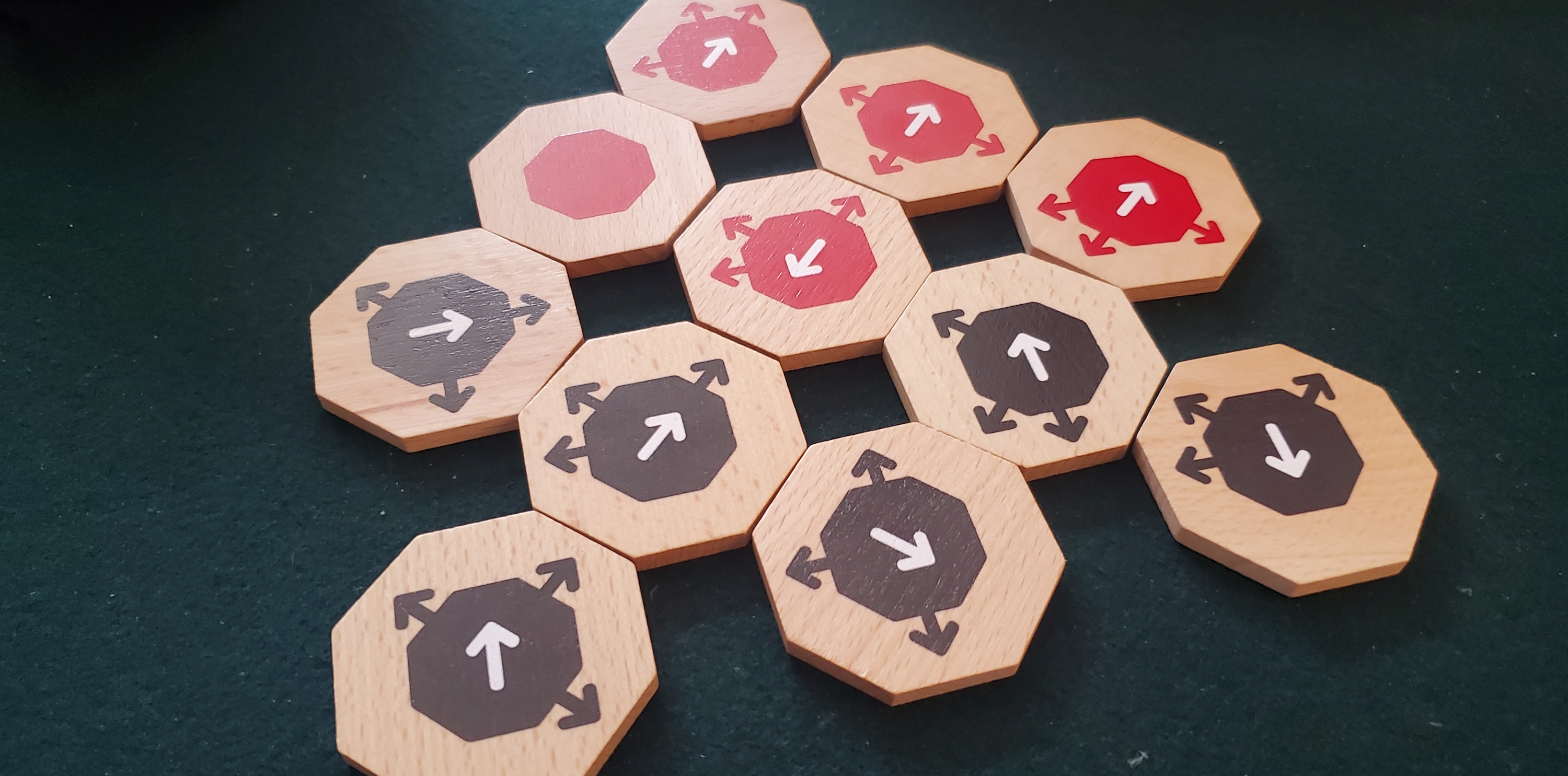
Parsing directions in Sayū.
Sayū
Speaking of robust, Sayū’s early game is a broadside of options that left my head spinning. This is a game about detonating chain reactions. Players command either brown or red, with the goal of flipping as many pieces to their side as possible by the conclusion. Placing a tile flips the tile it’s pointed at, provided it isn’t blocked by the direction of either its inner or outer arrows. Then the flipped tile also explodes, possibly triggering further flips and thereby snaking around and across the entire play area.
This is a messy process. Messy as a conceit, because the tiles aren’t especially prohibitive, meaning it’s a rare turn that won’t see you flipping quite a few of them, and also because the entire pool is available to both players from the outset. Talk about information overload. Further, it’s also messy on the table. Flipped tiles must be correctly oriented, itself not such a difficult task — they always flip along the axis of their inner arrow — but fiddly en masse, which is exactly how you’ll likely be flipping them. It’s the sort of game that begs to be constantly pressed back together as the spacing and orientation of its tiles becomes increasingly flabby from being manipulated so often.
The result is the sole game of the trio that failed to keep my attention for more than a few minutes. Perhaps more notoriously, it has become the only game my nine-year-old has ever requested we conclude early. An interesting concept, then, but one that doesn’t quite live up to its intentions.

Trapping an opponent’s marble in Wana.
Wana
Of these three titles Wana is the one that feels closest to a classic abstract. Its simple grid, connected by straight and sweeping lines alike, sparks memories of Roundabouts from that Klutz collection by Sackson. Known in its mother tongue as Surakarta or Permainan, Roundabouts is a Javan game about capturing opposing stones via expressive loop-de-loops. Wana is the better of the two, and isn’t even all that close to Roundabouts when you get right down to it, but covers similar ground by encouraging players to come at one another from unexpected directions.
Here the goal is deceptively simple: trap an opposing marble. Just one. As a note of clarity, a marble is considered trapped when enclosed on all four sides, whether its captors be friend or foe, leading to seemingly small plays that have long-term ramifications. Marbles not only curve around the board, turning even simple moves into panoramic alterations to the game state, but may also wrap from one edge to the far side, putting players in more claustrophobic proximity than the setup might first appear. The first time a piece is trapped by a marble on the other side of the board, Wana snaps into focus.
Like Sadomwattana’s other titles, this one is fast. In theory it could devolve toward infinity; pieces are never removed, nor does the board state degrade or force a reckoning. But the play space is sufficiently confined that these haven’t presented the anticipated problem, at least to me. Maybe it helps that the game looks like it could be discovered etched into sandstone somewhere; I’ve always had a soft spot for games as anthropology, and Wana bears the appearance of an artifact. Still, there’s an elegance at play that’s more refined than Iro or Sayū.
Unsurprisingly, Wana is also the one I keep returning to. Like Surakarta or Mancala, it eschews fathomless depth for the simple joys of making one or two clever moves. It’s the sort of game one could play with seashells and lines in the sand. That makes Sadomwattana’s production all the more handsome, like a custom chessboard even though it could be played with hand-drawn pieces.
(If what I’m doing at Space-Biff! is valuable to you in some way, please consider dropping by my Patreon campaign or Ko-fi.)
Complimentary copies were provided.
Posted on December 5, 2023, in Board Game and tagged Board Games, Iro, Khanat Sadomwattana, Sayū, Wana. Bookmark the permalink. 5 Comments.

 SPACE-BIFF!
Holy crap, I never once thought I would hear someone else talk about that klutz game book! It, along with gobblet and blokus, are what mainly made me as interested in abstracts as I am today. These all look really neat, although maybe not enough to supplant my current obsession with Tak. (Which I highly recommend you check out, it’s a really wonderful abstract!)
I’ve certainly heard good things about Tak.
It sounds like Sayū might be better off as a computer game. Thank you for shining a light on these!
Thank you for reading!
Like Asher, I’m also loving Tak, and I also had the Klutz game book as a kid. (In fact, I think I still do — although I never break it out any more.) I loved everything about The Dalmatian Pirates and the Volga Bulgars, not least of all the name. And I remember how thrilled I was when one of my younger sisters finally got old enough to play that game against me and actually put up a challenging fight.
“Play fair!” — the professor bird