Knizidito
Cascadito is a tiny version of Cascadero. That’s the easiest way to sum up the similarities between these twinned titles by Reiner Knizia. They’re both about placing grouped envoys next to cities in order to move up tracks. In some cases, they even award the same spills of bonus points.
But the differences between them are more interesting than their similarities — and more telling. Cascadito is a roll-and-write game. It also sheds much of what makes Cascadero so good.
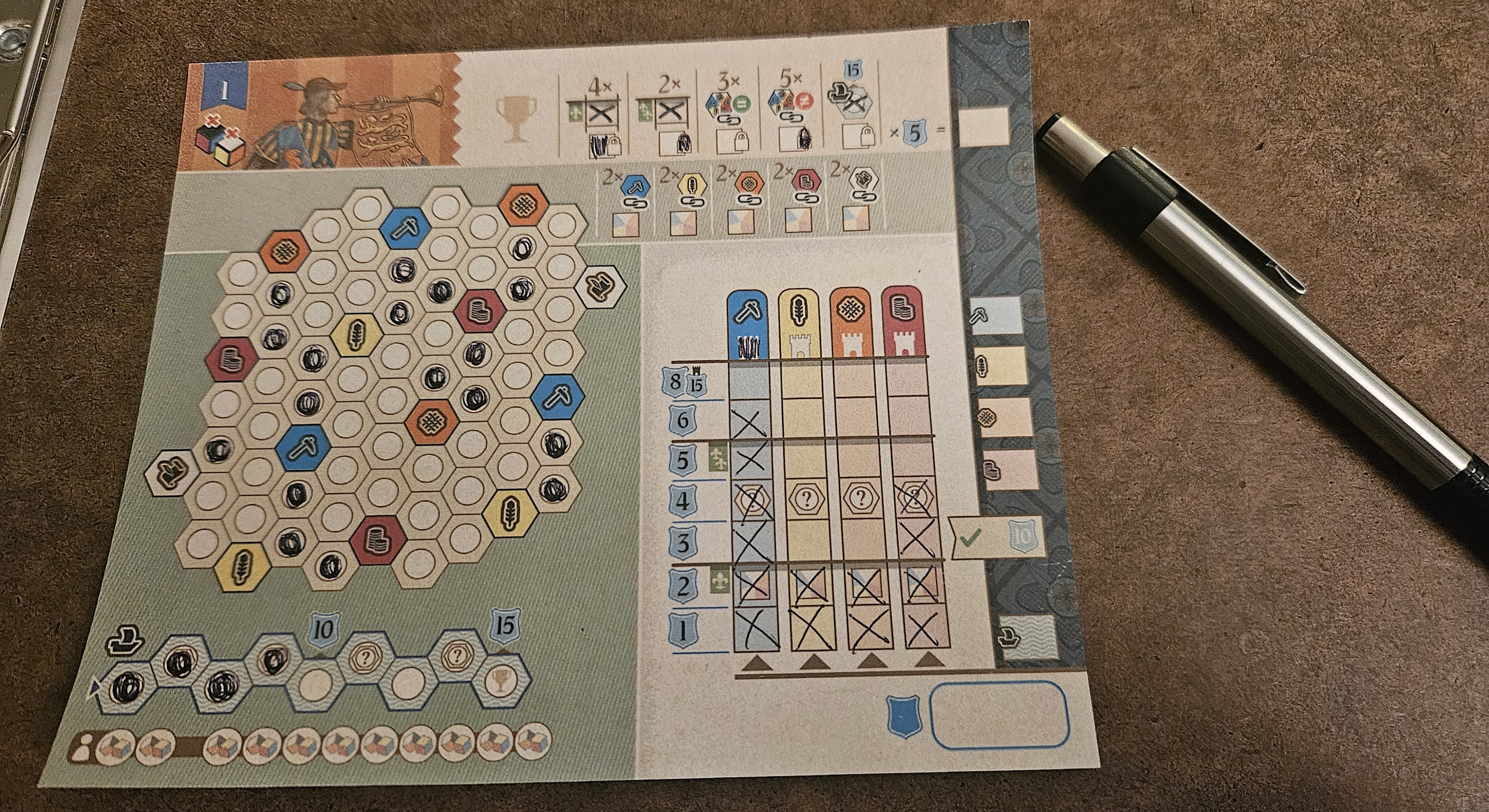
After Cascadero, Cascadito is familiar.
If you missed out on yesterday’s review of Cascadero, here’s the rundown. This tiny kingdom has been afflicted by civil war for so long that its neighboring cities aren’t talking to each other anymore. As a minion of El Cascadero, it’s your job to knit the community together with envoys. There are five colors of city — or only four on Cascadito’s first map — each with its own track that ticks upward when you place a group of envoys next to it. By hitting the right spaces, whether on the map or those tracks, you can gain bonuses that stretch a single placement into two or more.
Right away, the roll-and-write format exchanges the meat of Cascadero for one minor benefit. That benefit is multiple maps. There are four in all, with each presenting its own novel challenge for the players to tackle. The first, which functions as a set of training wheels, offers fewer options at any given time. Others see the players fending off bandits, bridging far-flung destinations despite a kingdom-spanning river, or amassing trade goods. There’s a nice variety on display, and Knizia has created four scenarios that ask players to realign their priorities without significantly altering the rules or adding any real overhead.
But there’s also the question of the aforementioned meat. That meat is player interaction. Like most roll-and-writes, this is a largely solitary affair. There’s some sharing — more on that in a minute — but apart from one or two filaments of interaction you’ll be spending the game laboring over your own map, largely ignorant of what your fellow cascadados are up to. Newfound unity indeed.
There are two ways of looking at this. The first is my gut reaction. The jostling between players is precisely what elevates Cascadero, and there’s no escaping how empty Cascadito feels by comparison. A more generous outlook would be that there’s nothing wrong with so-called “multiplayer solitaire.” Crud, sometimes I prefer putting my head down and tinkering with my own little factory. Especially if Geoff’s inability to remember even the simplest of rules is getting to me.
But Cascadito still feels lonesome in a way that most roll-and-writes don’t. And this despondency has everything to do with how it leverages the “roll” portion of the genre.

One of these is not like the others.
It begins with a roll. The dice show the five city colors, plus a blank side that’s always discarded. When the game begins, the lead player tosses them onto the table, selects one, and fills in a space on their map that’s adjacent to a city of that color. From there, play passes around the table. Everyone picks a die. If it comes around to somebody’s turn and the pool has been exhausted, they grab the whole handful and roll them again.
Simple. But while there’s nothing strenuous about this process, it also produces a couple of problems. The first is that the sequence of play is unusually jerky. You aren’t quite playing simultaneously, as is the hallmark of many roll-and-writes. Oh, sometimes your turns overlap, especially when there’s a healthy pile of dice to choose from. Everybody grabs one in sequence, then puts their heads down to labor over their respective maps. In these moments, Cascadito tends to move along at quite the clip. But then the dice run out. And there’s such a difference in pacing between when everybody’s turns have been occurring in near-simultaneous overlap and when the game suddenly halts. Prepare to hear the phrase “Is it my turn?” a lot. Like, a lot. Because everybody has been hunched over their own pocket dimension. When they breach the water once more, entering again into that shared space, it highlights just how odd a fit this selection method is for a roll-and-write.
Of course, you could do the obvious thing and not move onto the next player until the current cascadingaling has wrapped up their turn. But this isn’t as satisfactory as it might sound. Rather than waiting for a player to change something on a shared map, as in Cascadero, you’re waiting for them to jot something onto a pad of paper. Their turn doesn’t have the same degree of import, at least where you’re concerned. Waiting, then, goes from a suspenseful act to a tedious one.
Further, because turns will almost certainly overlap, there’s some wishy-washiness to the game’s other tidbit of player interaction. Namely, achievements. Everybody is chasing the things for bonus points. Some of them are shared between players, so that when one cascaduderino accomplishes it, everybody else marks that it’s no longer available. But because turns can encompass either one action or many depending on how many bonuses you fill in, it’s possible that one player announces the fulfillment of an achievement only well into someone else’s turn. And roll-and-writes do not excel at undos.
In other words, the glimmers of player interaction actually make the players in Cascadito seem more isolated from one another, not less. The result is a pure efficiency puzzle with little else to recommend it. The solo mode even puts this emphasis front and center by having you chase points against a round timer. Fair enough.

Rivers act as dumping grounds for bad rolls.
To be sure, there is some lizard-brained pleasure at Cascadito’s core. I enjoy filling circles and ticking boxes as much as the next fella, and there’s nothing wrong with taking joy in some well executed accountancy. Moreover, I’ve long been a roll-and-write agnostic. While some of the genre’s exemplars hit the right notes for me, most leave me wondering how many people actually peel through those pads of paper or scribble through all that dry-erase ink.
Cascadito, though, leaves me cold. It reminds me that I’m not exploring the player-driven interactions of its bigger brother. It simply lacks that game’s highs, not to mention its deviousness. Pobre Cascadito.
(If what I’m doing at Space-Biff! is valuable to you in some way, please consider dropping by my Patreon campaign or Ko-fi.)
An early copy was temporarily provided.
Posted on October 5, 2023, in Board Game and tagged Bitewing Games, Board Games, Cascadito, Reiner Knizia. Bookmark the permalink. 6 Comments.

 SPACE-BIFF!
As a Spanish-speaker that was left somewhat disoriented by the title of Cascadero (that’s a suffix for toponims and calls to mind a rasping voice, not cascading effects!), I applaud your plays on it!
Ha! I’ll take it.
When I first heard they’d be a “smaller brother” on offer with Cascadero, I was a bit worried I’d want to get it as well, racking up the overall price for the acquisition. But when I started looking into it, I breathed a sigh of relief as I could see this was simply not a game for me at all. So, once again, thanks for the confirmation! 🙂 Also, cascaduderino is perfect 🙂
Happy to help!
“A more generous outlook would be that there’s nothing wrong with so-called “multiplayer solitaire.””
Indeed. I’m so tired of the copious uses of this as a “negative” critique on BGG. It’s a valid game-type, y’all.
Yeah. Sometimes I want to put my head down and tinker. That’s how it goes.