Roadside Picnicking

There’s always been a bit of an identity crisis rattling around the copper-bottomed hull of Scythe. Jamey Stegmaier and Jakub Rozalski’s alt-history speak to one thing, those continental hamlets shaking at the approach of smoke-belching combat mechs. Then you play it and it’s about moving logs. And I say this as somebody with an above-average appreciation for the thing.
After multiple expansions and a spin-off for kids, Stegmaier and Rozalski are back at it with a proper sequel. It’s called Expeditions, and it swaps the battle-torn countryside for the barren tundras of Siberia, where a recent meteor fall has kicked off a series of otherworldly events. It’s a tantalizing excuse to groom your animal companion, check the bolt of your rifle, and hop into the old mech for one last adventure. It’s too bad the winter air doesn’t work any miracles on the series’ neuroses.
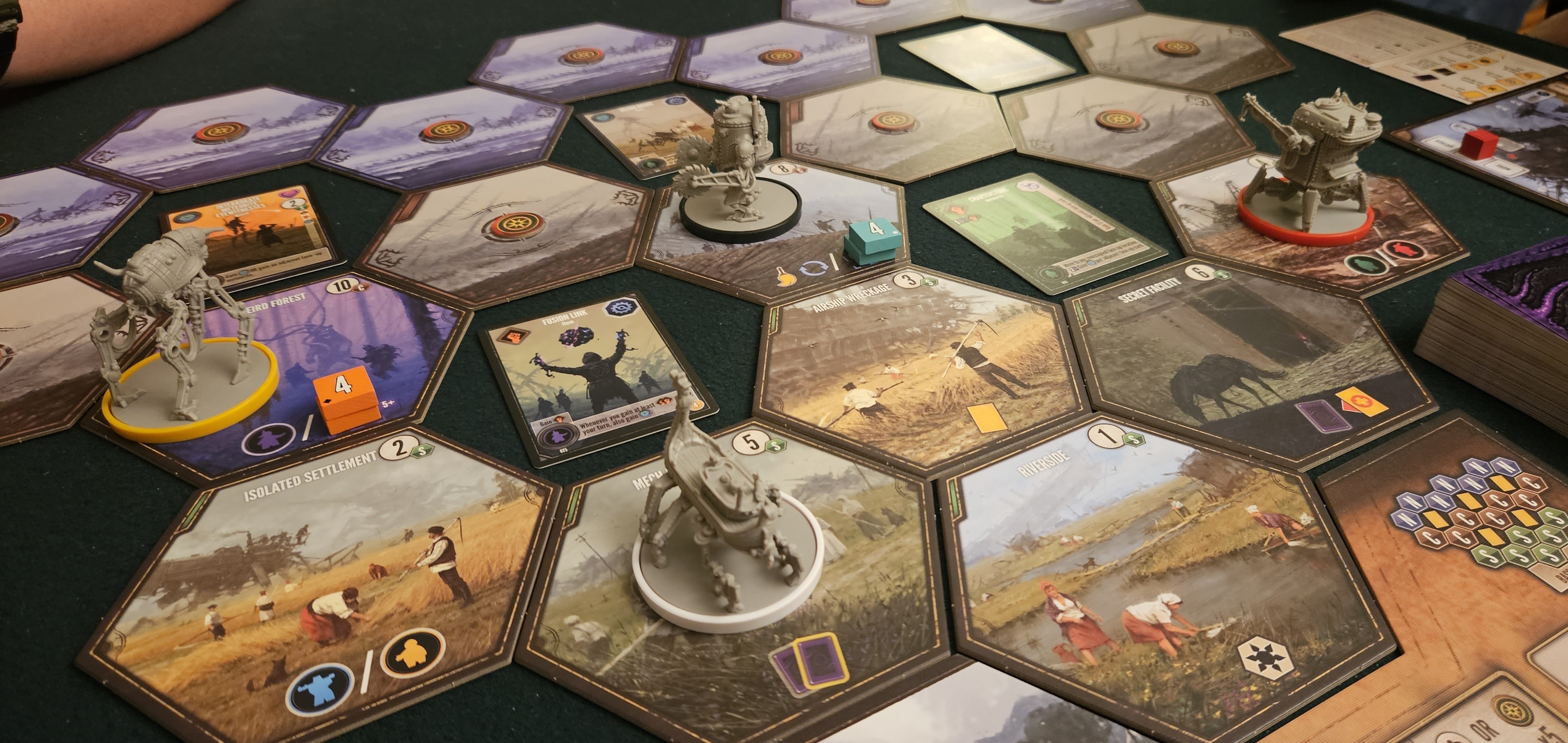
Wandering into the unknown.
Welcome to Siberia. Turns out, it’s very much like the hills of central Europe, at least near the base camp. Expeditions starts with everybody in the same space, the southernmost edge of a map that scatters up and outward like an overturned barrel of apples. Nearby there are scattered settlements. Women wash baskets of clothes down by the stream. Farmers harvest brittle stalks of grain in the shade of a fallen airship. A sawmill presides over the stubbled corpse of a forest.
There’s an aura of menace to these pastoral scenes that was largely absent from Scythe. A horse stands near the mouth to an abandoned facility. Within the darkened embrace of the forest, creatures sprout novel appendages. Men who wander too far unprotected return transformed in hideous and distressing ways.
It almost goes without saying that the presentation is immaculate. This applies to the game’s components and illustrations, which are handled with Stegmaier’s usual Midas touch, but also owes mention to the game’s subtler elements. The arrangement of the map, for example, with its already chilly tones draining to harsh and inhospitable whites and alien violets. Or the fragmentary nature of the landscape, pockmarked by a five-card offer that feels disorienting, even wrong. Something has gone terribly awry in this place, much the way something went terribly awry in our own timeline, when in 1908 a meteor airburst set off a twelve-megaton explosion that toppled two thousand square kilometers of trees like dominoes. Unfortunately for the inhabitants of Rozalski’s world, something crawled free of the meteor and has set to work twisting the countryside and people to better suit its needs.
It’s hard not to come away from Expeditions without an inkling of Polish and Ukrainian anxieties about the atomic age and the soiled winds of Chernobyl. This is a journey into a poisoned place, one that evokes Arkady and Boris Strugatsky’s Roadside Picnic, Andrei Tarkovsky’s Stalker, and more recent video games like S.T.A.L.K.E.R. and Chernobylite. This isn’t to call Rozalski’s vision derivative so much as emblematic. Hooded figures don high-tech gas masks. Strange anomalies friscalate the gravity around them. By entering this place, you are yourself entered and altered.
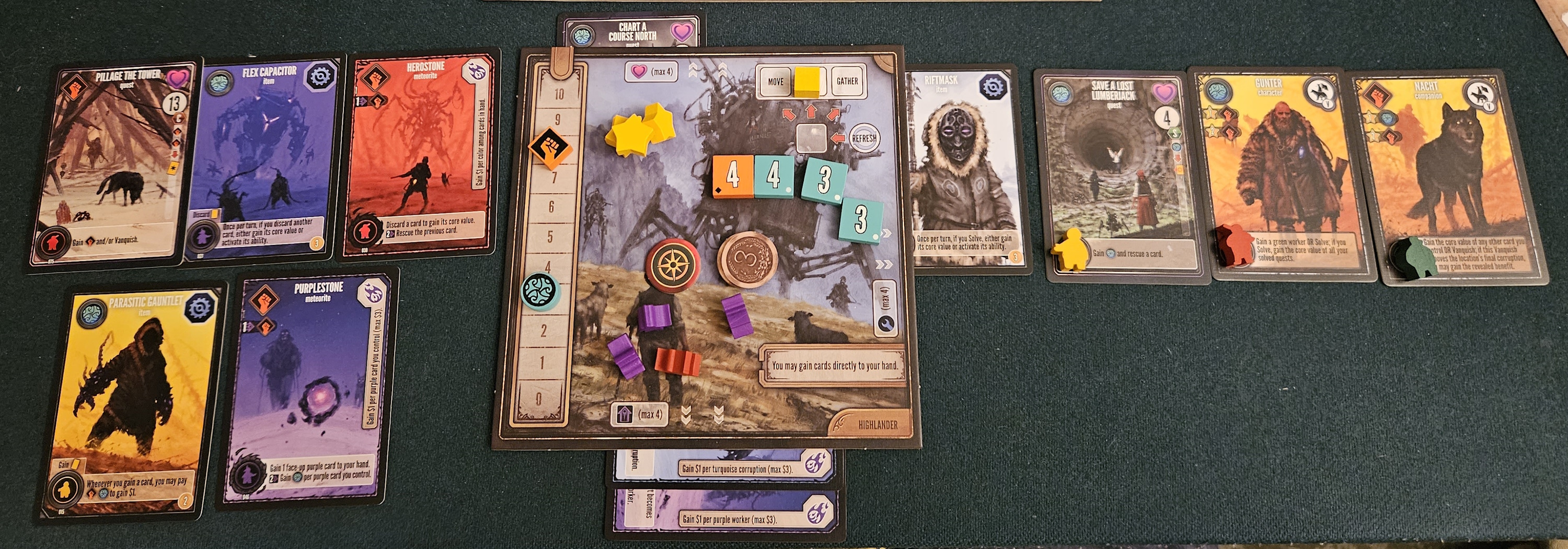
Outfitting my mech.
Conceptually, this idea of metamorphosis is central to the gameplay itself, although it takes some time to gather steam. Your initial actions are all about securing resources. This being a Eurogame in the Stegmaier tradition, there are a few to juggle. There are two combat resources for beating back the afflicted zone’s corruption. Coins represent victory points and stars track your progress in a handful of achievements, much as in Scythe. There are also workers, five types in all, who join your crew and are crucial because they trigger the powers of the cards you collect.
But the foremost of these many resources are the cards themselves. Most of your activities in Expeditions revolve around either gathering, moving, or upgrading cards. The whole thing could be described as a complex card-drafting game, which isn’t nearly as reductive as it might seem. When you aren’t stomping around the map or picking up a resource, you’re playing a card. You’ll always get a small resource reward for your troubles, but the bigger deal is the card’s ability. This requires the right worker, and then the card stays used until you take a rest to scoop everything back into your hand.
Every card is unique, adhering to three broad archetypes. Items are the most familiar, offering ongoing abilities that tweak your other actions. These can be activated manually, but it’s more efficient to graft them directly to your mech. This makes them permanent additions, but also removes them from circulation. The same goes for the other card types. Quests require you to reach a specific destination, at which point they become solved and increase the value of your end-game points. Meteors are powerful, but are often worth more when melded onto your board in exchange for a bundle of points.
In each case, the big question is whether to keep these cards around, functioning as renewable sources of resources and abilities, or place them out of reach by attaching them to your mech. Both are desirable in their own right. A healthy hand gives you the tools you need to succeed, but winning the game all but requires you to upgrade items, solve quests, and meld meteors. The question isn’t whether to attach a card, it’s when you can afford to do so.
Hence metamorphosis. By the end of your journey, what began as pilot, companion animal, and mech will have become something else. You’ll be decked out in weird technology, humming with meteor bits, and famous for your undertakings.
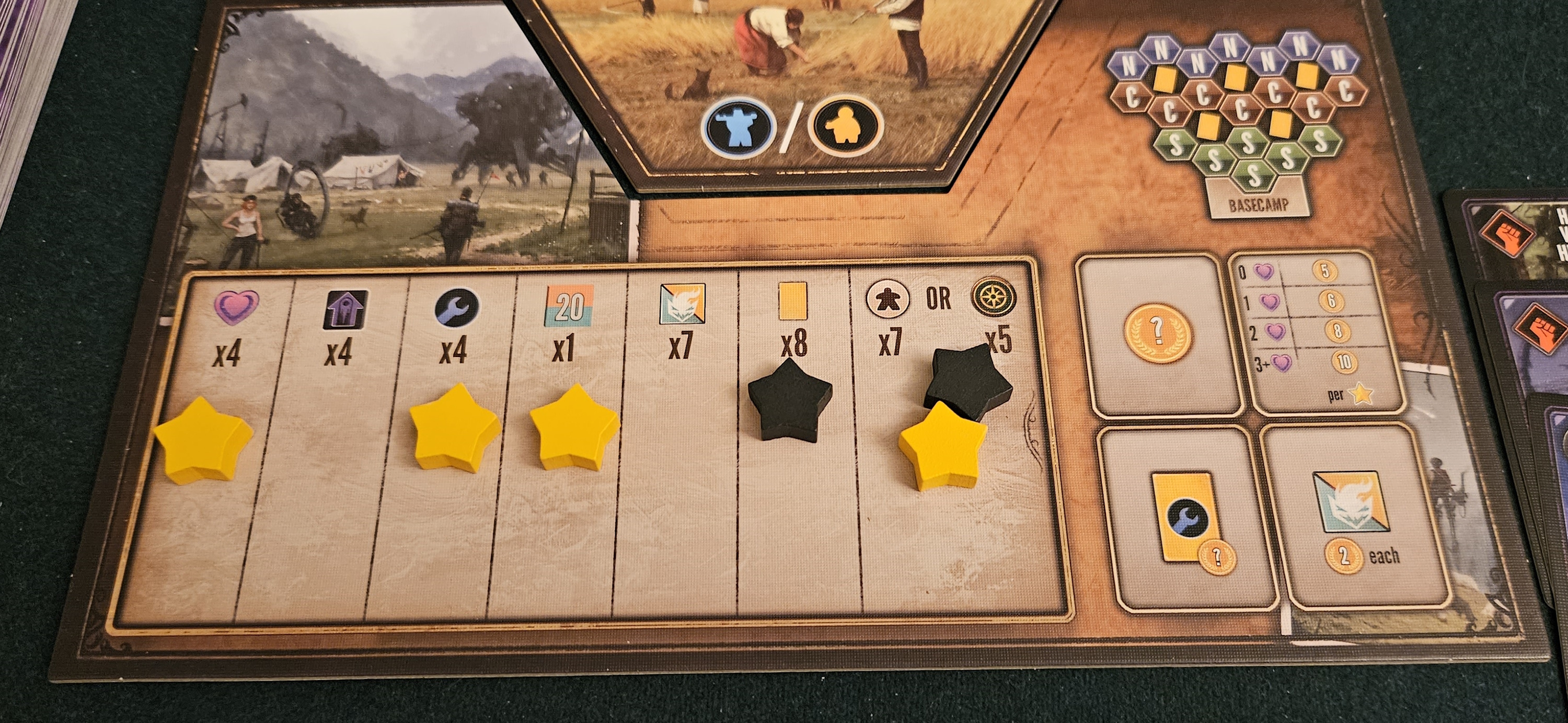
Stars lookin’ at our planet.
The hitch is that this process doesn’t require sacrifice. Every addition is all benefit. By traveling into this dangerous zone, full of alien fauna and possessed hussars, you don’t become stranger or less human. Only more badass.
It’s hard to complain that you aren’t mutated into a betentacled monstrosity when perpetual growth is very much the norm in board games, so I don’t want to oversell this particular detail as a problem. Rather, it’s telling of a deeper issue with Expeditions, and it’s exactly the same one Scythe suffered from. Stegmaier and Rozalski have gone out of their way to tell a story about a dangerous place that alters everybody and everything within its reach, only to stop short of using that fiction as anything other than pretty set dressing. The cards will transform you, but not a way that resembles the shambling soldiers or violated animals that populate the tiles and cards.
Nor, even, will there be any friction. Scythe may have been more interested in shuffling around logs than crashing armies into one another, but at least one’s rival factions could send your mechs and laborers packing, if only temporarily. Expeditions lacks even that. Rival mechs block tiles, and it’s possible somebody will ninja a card you wanted, but apart from that your fellow players act as little more than a game timer.
The biggest offender is the map. Everything about the game warns that you’re headed into precarious terrain, but there’s no reason to balk at uncovering one tile after another. Here be no dragons. Here be no thorn bushes. Here be nothing but a cozy stroll. Indeed, it isn’t long before the map has been revealed and players begin the arduous task of bouncing back and forth between locations to claim bonuses and resolve quests. It feels closer to a delivery service than an expedition, minus even the perils of precipitation or canine the average deliveryman must face.
It is, to put it baldly, very dull indeed. Oh, there’s still a race on. There are efficiencies to manage. Resources. Combos. And there’s plenty of pretty scenery to gaze upon on the way. I haven’t had a bad time with it, strictly speaking. But it wears thin before the end of a session. I’m relieved when it’s packed away and done, not eager to crack it open again. That alone marks it as distinct from Scythe.

Must… avoid… proboscis…
What to make of such a thing? Here is one of the handsomest settings ever put to cardboard, but its most alluring figments are entirely absent from the actual gameplay. In one recent session, a sequence of quests summed up my feelings. First I recovered the bones of a lost expedition. Then I hacked the robot guardians of a remote outpost. At last I communed with the beast. A creature beyond imagining, a mass of gravity-defying orbs and tentacles, and I had tapped into its consciousness.
And then I helped some farmers sweep a field.
We’ve all had those moments. Playing an RPG, we return to an earlier area and stumble across a rat-clearing quest we somehow missed on the first pass. Such occurrences are worthy of a chuckle. The great hero, slaying rodents.
In Expeditions, everything feels like that. Meeting an alien mind is as easily executed as some agricultural busywork. The requisite costs differ, but only a touch. Had one been tougher than another by a greater margin, I would have pursued an easier quest anyway, since they’re all alike in the end. It’s the very definition of superficial. Stegmaier and Rozalski have created something gripping. If only they’d translated that narrative onto the tabletop. I’ve had roadside picnics that were more hazardous.
(If what I’m doing at Space-Biff! is valuable to you in some way, please consider dropping by my Patreon campaign or Ko-fi.)
A complimentary copy was provided.
Posted on September 18, 2023, in Board Game and tagged Board Games, Expeditions, Stonemaier Games. Bookmark the permalink. 18 Comments.

 SPACE-BIFF!
A splendid review. I felt that the whole affair was a little tame- though I think I still enjoyed it a bit more than you did. I wonder if an expansion- maybe with some Northern tiles that do come with a cost- would spice it up? There seems to be plenty of room in the box for more stuff. Maybe Stegmaier has something of the sort in mind.
Possibly. I wouldn’t mind seeing something else added to give this one some kick.
Ah yes, the two problems with Scythe. Too much theme and player interaction.
… huh?
That was sarcastic. I was hoping that this new version would fix my problems with the game, not make them worse.
Oh, got it. I agree.
Watching entropy and pain in this world, but not being affected by it, could be intentional metaphor: to make us maybe start to wonder how the chaos in our lives could pass as sane.
…Regardless, I think even if I directly mention the band Switchfoot, that would only be song-identifying *adjacent*. =P
Oh noooooo
I mostly enjoyed the game, but where Scythe can be replayed without any expansions, I feel as though Expeditions really needs one. Loved the subtle reference to Wes Anderson’s The Royal Tenenbaums.
Yeah, I’m very interested to see if this develops after an expansion.
And good eye! “Friscalate” is a word as far as I’m concerned.
I think the first sentence in the paragraph that starts “it’s hard not to” is accidentally a double negative.
Now that I’ve had time to play a few games I agree with just about everything you said. Not allowing players to directly attack each other is fine, it could have been like in Clank where the environment becomes increasingly dangerous as the players progress. Or other players could have been the main hazard, where table politics is the most important like in say Root. Or even just have the decision space be heavily intertwined with the choices of the other players, like in an Uwe Rosenberg euro.
But to have none of that, instead going for what’s essentially a solo experience where you merely wait for your turn again, rather than take interest in what the others are doing, that’s an odd choice of SM games indeed.
An expansion could fix a lot. Easy example, two decks of cards in a box with two more mechs.
One deck for what happens to you when you explore a tile (it could all kinds of stuff, maybe one of your corrupted workers strangle one other worker or runs off or whatever, maybe your mech runs out of fuel, maybe you find something neat, maybe the corrupted creatures attack?) Give the exploration something exciting going for it.
And one deck for resolving ‘battle’, stop on an enemy mech and draw a card and read what happens. Or draw two and choose one. Whatever. Just something so there is a point with having your friends over to play.
Give the game something that’s exciting.
One thing we were surprised didn’t make the transition from Scythe was the little narrative decisions. They were always ultra-light, and only amounted to picking which bonus you wanted. But a more intimate single-mech game seems like the perfect opportunity to expand on that sort of thing.
At any rate, I agree. There’s room for improvement. I just wish the base game had bothered to make its adventures feel more adventuresome.
I definitely hear some of your criticisms of the game. I’m okay with the theme, though. I take the title literally: they’re just on expedition, like to reach the North Pole, circumnavigate of the globe, or find the jungle-shrouded source of a mighty river. It’s just that instead of hacking through vines they’re hacking through biomechanical tentacles. They’re not really in danger, because they’re driving huge mechs. The question is whether they have the guts and brains (and support staff) to become the most accomplished explorer AND report back first to achieve the fame. It’s entirely about their egos, not their sanity or well-being.
I think the “narrative decisions” are the quests themselves. One can solve all the quests they need to maximize their points simply by helping the folks in the southern area, but thinking of all quests as equal overlooks the fact that the higher-latitude quests offer more rewards, including more cards, more money, more card tucks and more uses of of on-table card abilities and location benefits. The choice to focus on helping the people in the south is still glorious, in the end, but the choice (and ability) to expend more power and cunning in the north could mean accomplishing more overall. It’s like choosing the left side of a Scythe encounter over the right side, but by trading in physical and mental capacity, rather than popularity.
Which isn’t to say that anyone else does, should or can thing of it that way. That’s just my rationalization, and the one I give to new players.
I’m happy to hear that your rationalization works for you, but it’s largely the same problem I have with the setting. Because people died on those expeditions. The cold froze their fuel, the ice broke their ships, the atmosphere drained their balloons. Their cutting-edge equipment failed. Within the universe of Expeditions, mechs can be corrupted and go on rampages. But not yours.
Damage and disaster are, for me, bundled in with the Power and Guile tracks, as well as the refresh mechanism. I can solve a quest that gives me goodies, but only if my equipment, my people and I are strong or clever/sane/insane enough, and I have avoided spreading my resources too thin. If not, I may need to turn back to regions where I can improve my capabilities, or make camp and recall all my support staff. Meanwhile, the more prepared expeditions with smarter logistics (and some better luck) are making progress, being lauded in the press back home, and maybe scooping up an item or meteorite I need.
The heroes don’t die in Scythe either, they just suffer setbacks, which equate to glory for their opponent. I gather that mechanic also isn’t your cup of tea. But if one is bought into that, it shouldn’t be hard for them to buy into Expeditions.
You gather incorrectly, but this seems like a pointless discussion to continue. I’m glad your rationalization works for you.
Pingback: Expanditions | SPACE-BIFF!