Eila and Something Disconcerting

I’ve never taken a firm stance on age ratings, in part because I’m not sure what they’re trying to impart. Most of the time, I take them as an evaluation of a game’s complexity, and a wishy-washy evaluation at that. A rating of 12+ won’t prove much of a deterrent to my nine-year-old because she plays more board games than her peers. That’s only the first limitation. I also can’t be certain that the designer invested much thought into it. Before I had children of my own, I couldn’t have told you the cognitive difference between ten and twelve years. And it isn’t as though the other numbers on a box bear much resemblance to reality. How often has a game’s estimated playtime proven to be hopelessly optimistic? These days, the only digits that really catch my eye are player counts.
I didn’t play Eila and Something Shiny with my daughter. Jeffrey CCH’s narrative experiment is a solitaire game, and for once I took that suggestion to heart rather than offering to loop in my kid. What a relief. Given the game’s friendly exterior, she might have accepted.
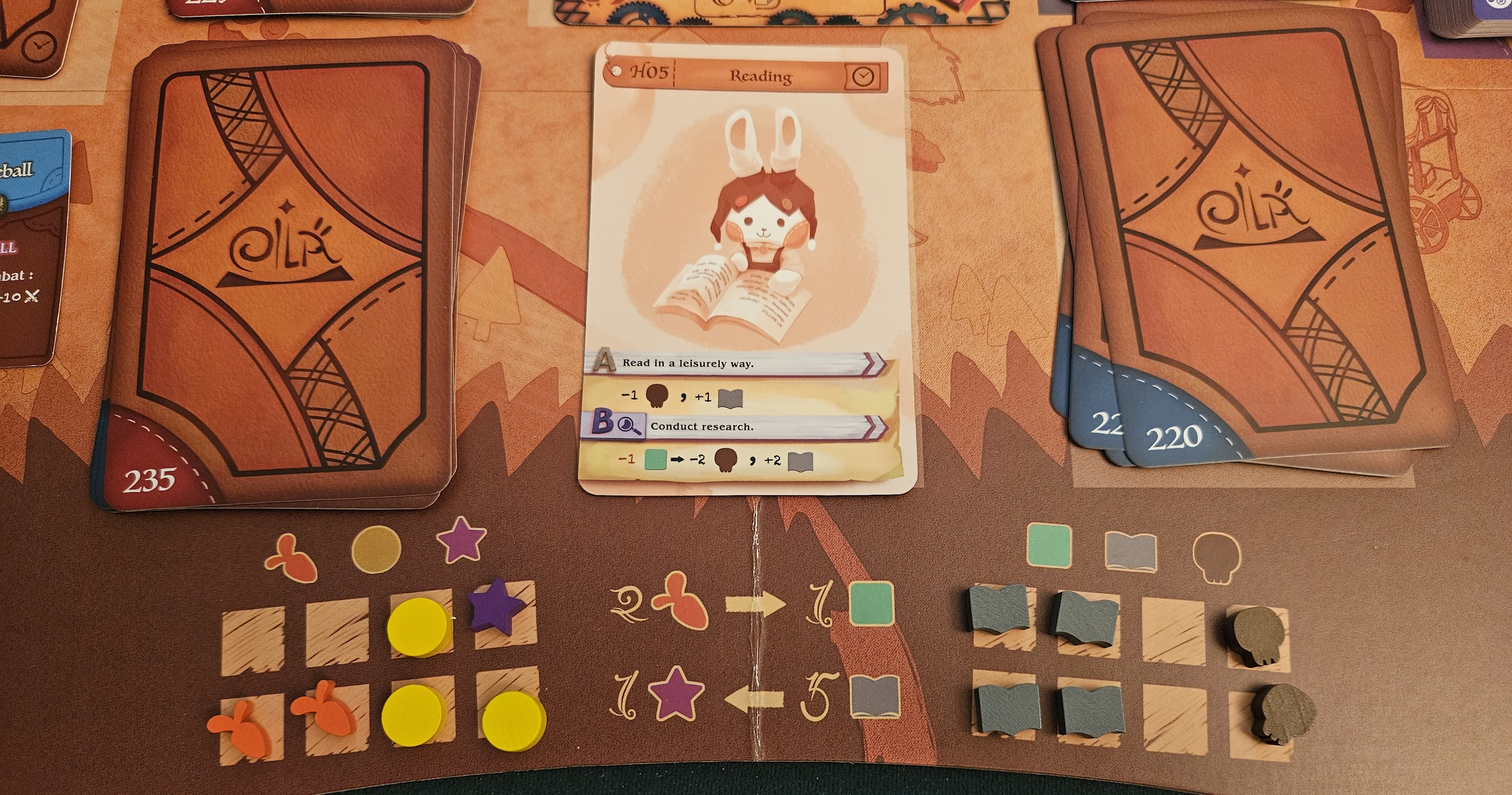
Looks innocent enough!
I don’t want to misrepresent the narrative of Eila and Something Shiny as bad. Instead, during play there was one question that kept niggling at the back of my mind. The question: “Would Winnie the Pooh have told a better story if Piglet had been disemboweled?” And the answer: “Maybe, if it had served the (very different) tale A. A. Milne was trying to tell.”
Eila is a rabbit stuffy. Her rosy cheeks are stitched onto the felt of her face. She has buttons sewn into her hat. Her best friend is a friendly tree. Her life is carefree, all things considered. She needs to eat carrots lest she get hungry, and she picks up the occasional gig job in exchange for an ill-defined currency that seems standardized enough that everybody in the game will happily trade for it. For the most part, though, her life is a breeze. Life in the woodland is pleasantly sedate. She goes through each day with a sense of adventure and discovery.
Discovery is the watchword of the game. Every day is represented by a stack of cards, usually shuffled. You flip one over and get a description, a snippet only, and usually make a decision. Maybe today you will sell some carrots for coins; maybe tomorrow you will sell coins for carrots. Upon resolving a card, it moves elsewhere, sometimes moving forward to tomorrow, to be shuffled back into the deck and encountered again, or sent to the repository of the past. Often, a decision will prompt you to add a new card to the deck, whether right away or as part of tomorrow’s encounters.
It’s a light game, at first. Airy. Cool like a down comforter before your body warmth has suffused it. Your main objective is to balance your resources. There are six in total across two pools, one physical and the other mental, and it’s common to need to discard one thing in order to make room for something else — say, withdrawing some energy to declutter your head for some knowledge. As resource conversion games go, this is more than suitable for ages 12+. It would be suitable for a precocious five-year-old.
It isn’t long, however, before Eila’s world takes a dark turn. Her attention is caught by something shiny atop the nearby mountain. Thus she begins preparing for a journey that will take her to… well. To places that perhaps would have been best left unplumbed. Or is the destination worthy of the journey, no matter how difficult? Is the summit worth the climb, no matter how traumatizing? I’m not sure I can answer in the affirmative, such was the nature of my disconcertment with where the tale took me.
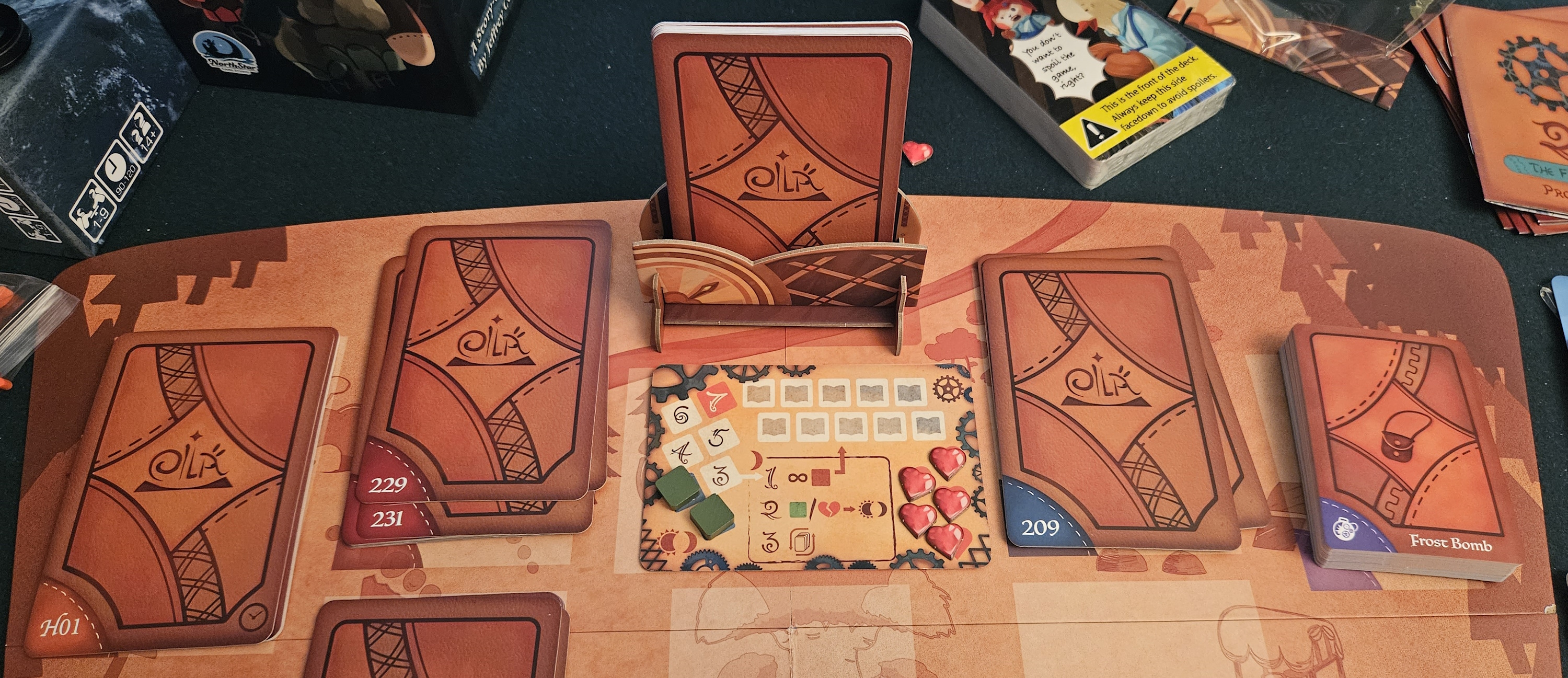
Cards aplenty.
The journey itself is brief, much the way a tooth extraction might be brief. This isn’t because the game is bad. Each chapter, of which there are six, introduces new concepts. There’s an awkwardness between the rulebook and the actual game, with one page reserving a concept for “the second chapter.” This left me confounded for a portion of chapter one, which only qualifies as the second chapter if you count the skippable prologue as a chapter; needless to say, my overly literal rule-reading brain hadn’t made that jump. Never mind. Soon I was cruising through the story. The design begs to be cruised through. There are new ideas aplenty. Where one chapter is all about painstakingly balancing resources and making combat rolls, the next will introduce spelunking through a modular map. These aren’t spoilers as such; one of the first things you’ll see upon opening the box is a pair of dice sporting shields and an X-eyed rabbit, and the map tiles are right there on the punchboards. Rather than hiding its goodies within sealed envelopes and boxes, Eila and Something Shiny tantalizes by holding its breadcrumbs right under your nose. As befits that promise, I finished the entire thing in two sittings.
Two rather uncomfortable sittings. It’s plain from the way the game’s narrative beats are handled that Jeffrey CCH intends them to be disquieting. In that regard, it’s undoubtedly effective. I don’t want to spoil any of the game’s specifics, but bodily injury, starvation, morality, and even some heftier material such as harm to children and implied animal testing are introduced.
While these carry the expected shock value, I’m split on whether they come across as honest. To be frank, the entire thing strikes me as manipulative. Whenever I mention Eila and Something Shiny on social media, the most repeated question is whether this would be a good game to play with kids. And, well, that’s a different question than we’re accustomed to asking, even when we say those exact words. There’s nothing in Eila and Something Shiny that’s complex, mechanisms-wise. A child could play it. But morally complex? Emotionally? In terms of keeping the acid in one’s stomach? There’s more wiggle room there.
Of course, this should tell you more about my sensibilities than those of anybody else, the designer included. I dislike seeing children in peril. If I dislike that, then I very much dislike seeing even worse things than peril befall children. Jeffrey CCH puts his characters through the wringer, and by extension of the game’s impressionistic touch with its narrative, the player goes through the wringer as well. I have no doubt that somebody with different sensibilities could emerge from the game unchanged and unchallenged, but I wonder what exactly the point of that would be. This is a game that wants to bruise. If it needs to begin with the perception that it will be something else entirely, something more innocent and unthreshed, then so be it. I have reservations about the forthrightness of such an endeavor — there are plenty of ways to discuss serious and even dangerous topics without pulling out the rug from under your audience’s feet — but like I say, my reactions to Eila and Something Shiny were conflicted from its very first twist.
For what it’s worth, the story did touch me. And then it kept touching. Most of the worst days of my life were those that concerned the health and sickness of my children. The narrative guided me to the river and dredged those bones to the surface, but didn’t wholly connect its conclusion to the events that had built to them over the past five hours. For a game that’s willing to stare some difficult topics square in the face, it still lands on a conclusion that’s so simplistic that it made me want to holler in the author’s face.
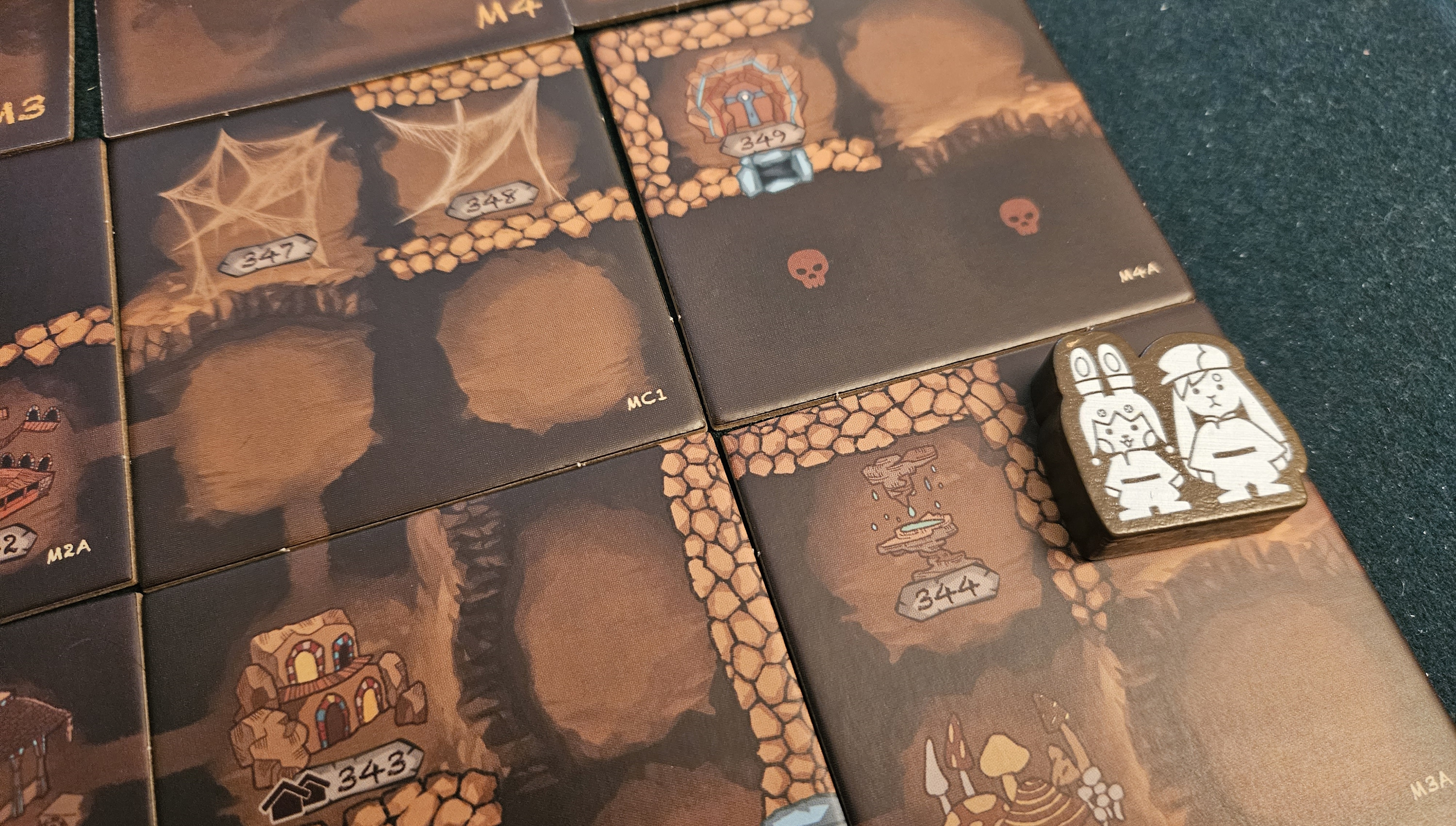
Each chapter has its own mechanisms.
AND REALLY, THERE IS NO WAY FOR ME TO DISCUSS THIS PART WITHOUT SPOILERS. BIG SPOILERS. TERMINAL SPOILERS.
Because, in the end, it turns out that Eila’s suffering is that of a child wrestling with a coma. But there are multiple endings. Three, to be precise. The first two are dark and despairing, with Eila the rabbit stuffy succumbing to the beastly part of her nature. Because she has not been kind — a rather fraught proposition in some of this game’s scenarios, especially when “kindness” requires that you not fight back against a gang of prison inmates — because she has not been kind, she is swallowed by a shadow that pits fanged mouths in her ears and black coals in her eye sockets. But if she has been a good girl, and done everything right, she is rewarded. She cracks her eyelids, Eila the girl, in her hospital bed. Through her goodness, she is saved.
Again, this speaks volumes of me as a person experiencing this work of art, but I fear it taps into something more universal than my own hangups. I remember as a child hearing somebody say that my younger sister had been cursed with type-1 diabetes because of something she had done in her premortal life, and that she could be healed if she had enough faith. She was four years old. Four goddamned years old. Too young to be baptized or considered morally accountable in the Mormon tradition, and already rotten with imagined sin. I remember being a Mormon missionary and being sick and depressed and choked with doubt, and a know-it-all sister missionary loudly boasting that physical health was connected to spiritual health, and that’s why she had yet to fall seriously ill.
And I hate it. I hate it. I hate that connection. It’s such a natural one, in this western tradition with its bellyful of Bible, glutted as we are on Original Sin and the Ten Plagues and Naaman and lepers and the centurion’s servant and a hundred easy but unverifiable stories about how someone laid hands on a suffering child and then everybody wept when the child rose from their bed and walked. Except I’ve never witnessed that. I have seen children die because the healing didn’t work. I have known children to die because they couldn’t pray the gay away. And I’ve attended church the next Sunday to hear people offer platitudes about how God must have needed that child back in heaven more than here on Earth. Such horrible, unthinking platitudes. They touch people, too. And keep on touching.
That’s what bothers me most about Eila and Something Shiny. Not the way it pulls the rug from beneath your feet when the innocent stuffy is forced into prison labor. Not the way it becomes the stuffed animal version of a slasher flick for one horrible moment. No. I’m bothered by the simplistic connection between good behavior and whether a child deserves to be saved from a coma. Because behavior has nothing to do with deserving. She deserves to be saved either way. If while in the imaginary realm of a stuffed rabbit she had sacrificed her best friend to a blender and chugged the whole thing chunks and all, she would still deserve to wake up.
And that’s why I’m glad I didn’t play the game with my child. My heart, my life, my beautiful nine-year-old, who I love for her cleverness and kindness, yes, but also for her mischievousness. When I sat with her for a night and a day in the hospital because she needed emergency surgery, she deserved to wake up. I stared into her face, waxen and still and maybe dead so shallow was her breathing, and I couldn’t have cared one whit if she’d been a terror the day before. She deserved to wake up. Not because of her good behavior, and sure as hell not because of her good imagined behavior. She deserved to wake up because she was a child. And she deserves better lessons than this game can teach her.
SPOILERS: FIN.
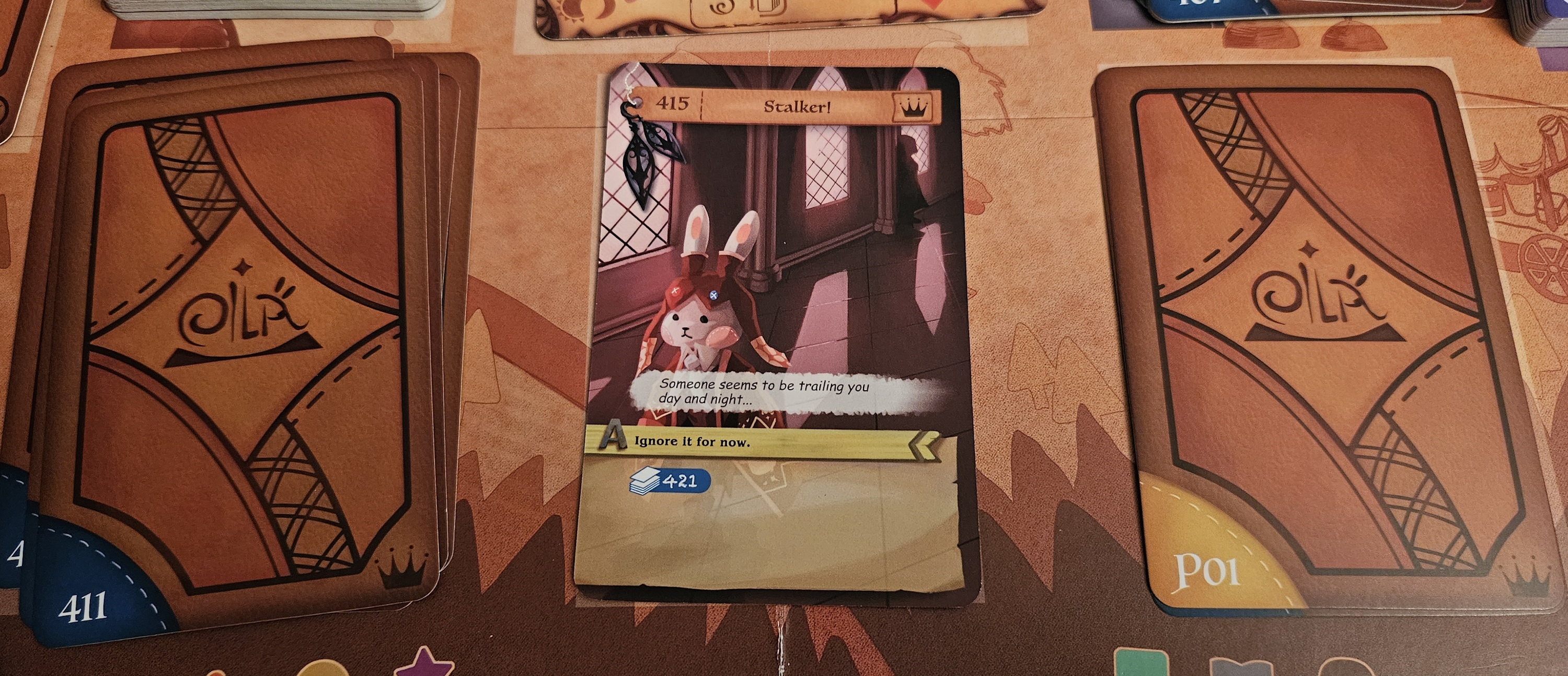
Before long, the story gets distressing.
Eila and Something Shiny is a bold game. I mean that. It takes chances without losing its ease of play, and I would love to see its system adapted to other tales, other narratives, other storytellers. Like I said, it touched me. But it also pinched. It turned me over. It accused me. By the time it was over, it had filled me with such a sadness. It was a sadness I very much doubt Jeffrey CCH intended, but that doesn’t change its timbre. I’ve known too many people who were afflicted by the same facile message this game imparts. For all its boldness and all its cleverness, I abhor its conclusion. This is me hollering in its face.
(If what I’m doing at Space-Biff! is valuable to you in some way, please consider dropping by my Patreon campaign or Ko-fi.)
A complimentary copy was provided.
Posted on August 17, 2023, in Board Game and tagged Alone Time, Board Games, Eila and Something Shiny, North Star Games. Bookmark the permalink. 33 Comments.

 SPACE-BIFF!
Spot on, Dan. I wish I hadn’t played this game with my child. He was so upset.
Oh jeez, I’m sorry to hear that.
Thanks. He’ll be okay. But he’s had health problems his whole life, and drew similar connections to the one you did. We had a long talk and it turned out alright. I just wish I had known before we started that it would hit so close to the bone for us.
I’m glad to hear that. All the best to you and your son.
I feel the passion, and I agree with it. Well articulated.
Thanks, Nicholas.
I haven’t commented in a while, but I had to add my voice: Dan, this is the sort of critique board games need. Thank you for being willing to write about good games, bad games, and morally sticky games.
Thank you, Matt.
Wow. That was a bit of a heavy, but excellent as always, read for first thing in the morning! Without seeing much of the box/blurb etc. I wonder if an innocent family would be totally unknowing to the contents until already purchasing a box off the shelf? (In which case there is a serious marketing/accessibility issue here)
Totally agree with you Dan regarding that mentality of do something bad and you should be punished/do something good and you will be rewarded. Totally get how on the face of it people do get brought up with that ethos or believe that behavioural management it that kind will bring positive changes. I’m lucky enough (I guess) to work as a speech therapist and consistently work with adults who have challenging behaviour (learning disability and/or autism) and therefore know that punitive measures / taking away of things etc. does not equate to supporting someone’s behaviour become better or supporting them to make better/the “right” decision and often does the opposite (reinforces the behaviours). So yeah, I digress, but man that bit in your review hit home hard. And now I’m in a grump for the rest of the day. Thanks Dan! 😅
Being serious for a sec, many continued thanks for your brilliant, thoughtful and informative writings.
Have a great weekend
Thank you for your perspective, Jonathan!
I feel like I just went through all of your emotions just reading that review. I was curious at first, then intrigued to find out more about the game. I got to your spoiler section and decided to stop there, because despite your warnings, it did sound like something I wanted to make my own mind up about. I looked up the game and found that it was quite more expensive than the photos made it look, and also not available in German yet. So I was probably not going to buy it, right? So I went into your spoiler section and was appalled. (As a father, I agree with everything you say.) I finished reading with my hand over my mouth, ending somewhat glad that I got to take the shortcut to the ending. I’m still a bit fascinated by the concept of the game, but I’m glad I didn’t play it. Thanks for the journey.
Thank you for reading, Nils.
Thank you for your review.
I have not read the spoiler because I am still waiting for the German translation of the game. The German publisher is aware of the issues regarding more mature themes in the game and intends to include a warning message as well as an alternative ending for families and younger children.
I am not aware what this alternative ending will include and how much it will differ from the original ending. But do you think that an alternative ending could solve some of the issues or are the problems much deeper? I have a nine year old daughter and I am not sure if the game will be suitable for her.
I think those sound like very helpful measures. I can’t really speak to whether they’ll be “enough,” since I haven’t seen them firsthand, but I appreciate the German publisher taking steps to make sure nobody blunders into the game unaware.
That said, I’m not sure the solution fixes my core concern, the one concealed behind the spoiler tags. My complaint isn’t only about the game’s content. I’m not a child-coddler; my nine-year-old is exposed to plenty of tough narrative and historical material. Rather, my issue is ethical, even to some degree theological. (And I say that knowing just how loaded it might sound.) So… short answer: I wish I could tell you more without spoiling the game, but I can’t.
Great review. I appreciate a lot your strongly personal take on it. Thanks for being so honest about it. I had already lots of spoilers about Eila’s various endings, some discussing how weird it was that you had to be “perfect” to achieve the right ending, but your stance on this matter is new to me and deeply meaningful. Thank you.
Thank you for reading, Zerbique.
Excellent piece. This is why I always read your work, regardless of the game not “looking like” something I’d be interested in. I would’ve totally overlooked this one, if not for you. Thank you.
Thank you for the kind words, Anonymous.
It was me. I wasn’t fully logged in, I reckon. Anyway . . . ditto on what Anonymous said!
Managing to go from the awful triteness “These fantasy adventures are all in a comatose kid’s head” to something EVEN WORSE is almost perversely impressive. Almost.
I know. It’s something, isn’t it?
Thank you for sharing this review, it was very moving.
Thanks, Christian.
I understand that you had issues with the religion that you grew up in but I can find no actual mention to the religious doctrines that you claim were a part of your families faith. You took the apocryphal beliefs of those around you and attribute them to a whole religion and then let it taint your whole life… that is a heavy burden you place on others and yourself. You need to work through that and not let it cloud and distort your whole life decades after it happened.
I asked you to stop commenting on my website, grandma.
You find objection with the objectionable and have an admirable way of putting the finger right were it hurts. A beautifully told wrong remains a wrong.
Finished the game today.. Loved the mechanics, great way of presenting a story.. But the message is so flawed that I would never want to play it with my child, even when he’s 50 and I’m on deathbed.
That’s a strong statement! Sorry it landed amiss with you as well, Anon.
God. Your writing. I almost heard the tears streak down your face. This is a game I will avoid. My daughter had pneumonia. Only one of us was allowed in hospital during covid. I slept in the car outside hospital just to be close. I’ll be dammed if I’m playing something with a conclusion like that. Child have easily made it a journey about that NOT having that ending and if not you restart the journey on a loop with time passing, your score measured in the time it took and time lost. What a shame. Comanauts will remain top placed for most satisfying story for me.
Great writing. Clearly a parent, I heard the emotion. Glad I finally read spoilers after waiting so long to try and source a copy I gave up and dived into your review.
Right. I don’t think this one would have hit as hard as it did without having sat in the hospital with my child. Not many games have made me so upset.
Pingback: Age of Three Civilizations | SPACE-BIFF!
Pingback: Terrace Jerks | SPACE-BIFF!
Pingback: The New Dog-Ears | SPACE-BIFF!