These Animals Need an Estate Tax
The king is dead. Long live the king’s many successors, claimants, and pretenders. Designed by Hong Kong-based creators Jeffrey CCH and Kenneth YWN, Inheritors is the latest in a long string of titles that demonstrate why hereditary monarchy is a terrible way to run a burrito cart, let alone a country. Maybe it should come as a surprise, then, that this transition is so smooth.
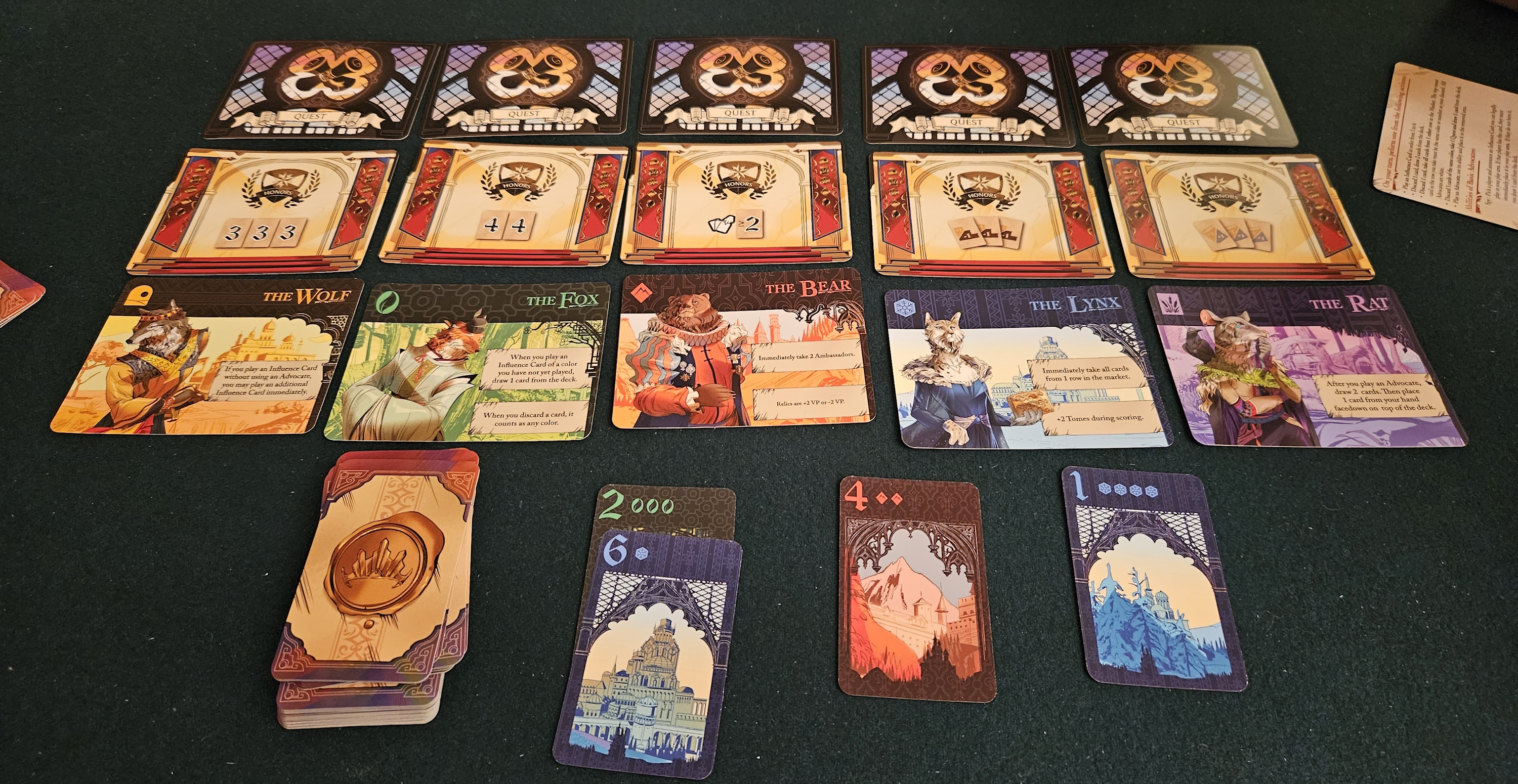
Inheritors smacks you over the head with a big ole market.
In a phrase, Inheritors is reminiscent of Reiner Knizia’s Lost Cities with extra steps. The gist is that everybody at the table is trying to build sets of cards, ranking each suit from 1 to potentially 6. The rub is that there aren’t very many copies of the cards in the upper reaches, prompting everybody to go scrounging for precious high-ranked numbers, whether from an ever-changing card market or even one another’s hands. It’s brisk, it’s dirty, and it’s about as controlled as a free-fall when you’ve got an umbrella, one hundred banana peels, and the leg webbing of a wingsuit with which to direct yourself into a big net with a bull’s eye on it. Also, you’re dueling with one to three other primates for command of the umbrella.
Along the way, there are special cards aplenty, many of them bringing new scoring goals or game-altering perks into the mix. There are tomes, which are tempting to swap out in the market thanks to their wildcard nature, but which also score a tidy heap for whomever is holding the most when the game wraps up. Relics, on the other hand, award a point if you control the highest number in its matching suit, but subtract a point if you don’t. There are advocates, too, special cards that manipulate the location of the ordinary stuff. The spy, for example, can steal a card from an opponent’s hand, provided you guess it correctly, while a conspirator lets you leapfrog over a missing number in one of your suits.
And that’s just the stuff that can be dug out of the regular deck. These are the cards that are always in motion, bouncing from hands to market back to hands, before settling into secure tableaus. There are others to consider, bigger one-off cards that are awarded as you fulfill various schemes. Quest cards are one, earned when you discard three matching cards to the market, and then awarding either one or two points depending on whether you meet the end-game condition hidden on their reverse side. Honors are another, giving out single-point rewards for meeting certain goals, like having three suits at rank 4 or being the first aspirant to hit rank 6.
Finally, clan cards spill out ongoing bonuses. You’re limited to claiming one of these, and only once you hit the third rank in the corresponding suit. These break all sorts of rules, some minor, others more likely to hitch your eyebrows to the ceiling fan. The Wolf lets you play two regular cards at a time, while the Lion awards extra points for honors and unlocks the knight, a special advocate that draws a whole bunch of cards into your hand. There are ten of these clans to select from, five per game, and they should not be considered balanced in the slightest.

Adding cards.
The reason I’m detailing all these card types is because Inheritors is something of a mishmash. Its actions are refreshingly uncomplicated — in most cases you’re playing a single card, which keeps it lively — but there are plenty of bite-sized decisions to consider. For example, grabbing a new card requires you to drop something into the market, creating little pools of cards that grow more tempting as they expand. But the card you drop needs to match the number or suit of the bottom card of the pool you’re acquiring. This tends to force tough trade-offs. When something you need is in the market, say, a card of a favored suit or a spy to steal something choice from another player, you may find yourself dumping something you’d rather hold onto.
It’s a lot to keep straight, is what I’m saying, and that’s before we consider the game’s rapid and chaotic course of play. Spies are useful for stealing cards, but that presupposes you can recall who grabbed which card from the market — and precludes the possibility when they drew the card straight from the deck. For a game that puts so many moving parts into action, some extra options for scoping out information wouldn’t have gone amiss.
Still, that same freneticism makes for a surprisingly quick and exciting grapple for points. It isn’t elegant in the slightest; there’s too much randomness and imbalance for that. But this is still the sort of game I’m drawn to, the kind that tosses you a hand of mismatched cards, piles together some sub-optimal decisions, and asks you to make do. Playing Inheritors is like treading water in blue jeans while fighting over pool noodles. You’re barely staying afloat, but it’s silly and invigorating anyway.

The card market is what you’ll dip into most.
To some degree, Inheritors is a house divided against itself. On the one hand, it’s a frantic and light game about stacking numbers, one that doesn’t take itself too seriously. On the other, it often feels like it wants to inspire schemes and thefts and little races for various goals. These two identities don’t quite cohere, settling somewhere in the flawed middle ground.
But maybe that’s a suitable identity for a game about successors tearing apart a kingdom in their bid to inherit it. Like its fuzzy protagonists, Inheritors doesn’t seem to know what it wants. The result is a game I appreciate in spite of its flaws, one that’s wild and untamed and hard to pin down. What a pleasant surprise.
(If what I’m doing at Space-Biff! is valuable to you in some way, please consider dropping by my Patreon campaign or Ko-fi.)
A complimentary copy was provided.
Posted on August 14, 2023, in Board Game and tagged Board Games, Inheritors, North Star Games. Bookmark the permalink. 2 Comments.

 SPACE-BIFF!
Pingback: Age of Three Civilizations | SPACE-BIFF!
Pingback: Terrace Jerks | SPACE-BIFF!