Prickle Root

Since it’s the law that every slightly asymmetrical game must be compared to Cole Wehrle’s Root, let’s get this out of the way right now: Cactus Town, designed by Raúl Luque Torner, is an eensy-weensy bit like Root. Three or four players — five with expansions — are each given a unique role and then set loose to sneak, shoot, and can-can dance through the Old West. It’s cute. But it could have done with more than good looks.
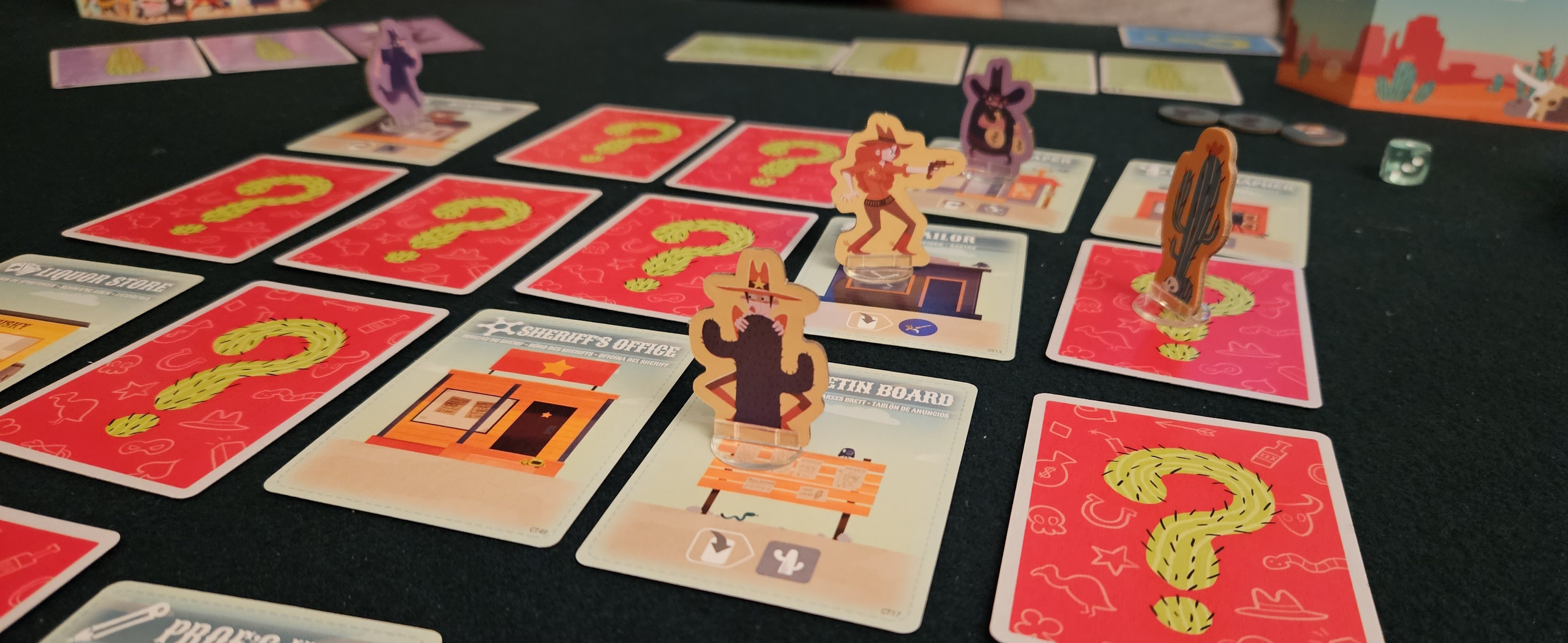
This town ain’t big enough to remember where everything is.
Let’s set the scene. In this town, everybody has a role to fill. There’s the sheriff and her deputies, a hapless trio that needs to keep the streets clean of banditry. Fortunately for their job security, three bandits have recently blown in. If only that were the town’s sole problem. A pair of bounty hunters are hoping to rustle up a victim and some horses to beat a hasty escape, and a can-can dancer has returned to pay off her debts and get justice on those done wronged her.
That’s a clever start, every bit as attention-catching as the baddies and heroes of Vast: The Crystal Caverns and Vast: The Mysterious Manor. In fact, that comparison is probably the stronger one than Root, although it’s still a strained parallel. That’s because Cactus Town isn’t quite as asymmetric as some of its peers. Oh, each role has its own goals, not to mention the occasional unique action. To give just one example, while most characters are content to creep around town by moving card to card, only the can-can dancer is able to move diagonally. (By can-can dancing, as it so happens.) But for the most part, everybody at the table interacts with the board, and by extension with one another, in largely the same way.
The mode for those interactions is card programming. Everybody has four cards, which they’ll arrange at the start of each round. There are different ways to arrange the cards, depending on difficulty mode, but the gist is always the same. When your turn comes around, your programmed card shows which actions you’re allowed to choose from. Crucially, this is a rather permissive form of programming. While there will inevitably be dead turns, these are rare. Rather than getting stranded with a card you can’t use, thanks to unforeseen circumstances or the meddling of your foes, each card offers enough leeway that you’ll generally be able to do something with every turn.

Programming my actions.
Which isn’t to say the programming is devoid of thought. Your most important actions, the ones you’re actually chasing for the sake of victory, tend to only be printed on a single card. The sheriff, for example, needs to capture two bandits, but the arrest action is only available on one card. The same goes for bandits and robbing and the can-can dancer settling old scores. As a result, there’s a nice middle ground between painstakingly planning each movement and being able to recover when something doesn’t quite go your way.
Meanwhile, only three of your four cards are used for actions at all. The last one is reserved in case you get into a shootout, when it can be optionally revealed to add to a die roll. These duels are chancy and often disappointing. Even with the game’s optional tokens that add a bit of gunpowder to your shots, or even cancel a shootout altogether, there isn’t much you can do to mitigate a truly bad roll. Many dice games make up for their capriciousness through volume and the law of averages. Here, a play might see only a half-dozen duels, all of them functioning as hinges and turning points. That isn’t enough to round out a bad roll. Instead, your sole recourse is to roll with those rolls. Cactus Town is short. If it doesn’t happen to be short and sweet, well, it isn’t too long to bellyache over.
Not exactly high praise, that. Unfortunately, that’s about as high a compliment as Cactus Town earns. The whole thing feels more like a concept than a finished game. The rules are there, they work, they’re devoid of ambiguities, but the conclusion barely warrants a shrug, let alone a hip-hip-hooray. While you have some flexibility over your programmed cards, it’s everything else that feels wobbly. The combat is only the first half of the problem. Because the cards that make up the town begin face-down, players are forced to explore the map over the course of the game, hopefully uncovering the destinations of their objectives. But these locales also trigger bonuses in their own right, little perks like shifting the cactus to block somebody’s movement, taking an extra step, that sort of thing. Landing on the right bonuses can be the difference between success and failure, especially in a game where moving two spaces in a round is a sizeable jump.
At the same time, setbacks are often as accidental as they are potent. Losing a duel means getting pushed two spaces, effectively losing out on a whole round of repositioning. Having the cactus plopped in your path means going the long way around. In many cases, opposing players don’t mean to block you. It’s just that over the course of regular play, Cactus Town is full of jostling. So you bump around like you’ve hitched a ride in a crowded wagon, only for someone to eventually announce that they’ve won.
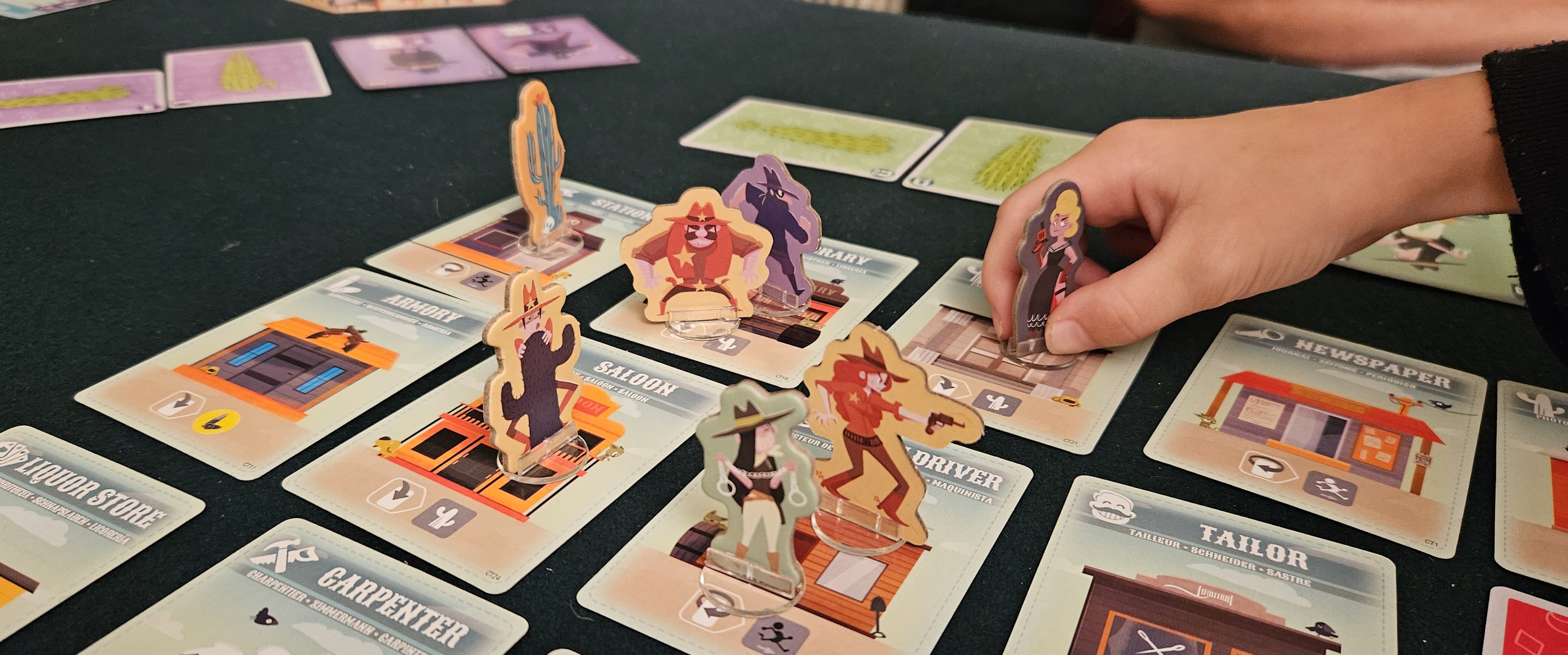
Approaching a showdown.
With a little extra work, Cactus Town might have been sharper. Or it might have put its hijinks front and center, rather than letting them feel aleatory. As it stands, it’s closer to a duel from Buster Scruggs, except without the singing, satire, or sense of place. It’s suitable that the box art shows a cactus with a bullet hole through its center — because wherever that gun was aimed, it didn’t strike meat.
(If what I’m doing at Space-Biff! is valuable to you in some way, please consider dropping by my Patreon campaign or Ko-fi.)
A complimentary copy was provided.
Posted on August 8, 2023, in Board Game and tagged Board Games, Cactus Town, Second Gate Games. Bookmark the permalink. 2 Comments.

 SPACE-BIFF!
Can we make it a law that every time someone compares an asymmetrical game to Root, we have to then compare Root to COIN?
Sorry, but I’m vetoing the motion.