Antiquity in Your Pocket

So we were talking about wallet games. Yesterday we took a look at River Wild, a microgame by Steven Aramini that didn’t quite live up to the (compact) heights of his previous efforts Circle the Wagons and Sprawlopolis. As I wrote way back then, it’s exciting to see how a genre can be pressed into its purest form by the strict limitation of having to fit onto eighteen cards. The only hitch is that the resulting microgame ought to be, you know, good.
Ancient Realm, also by Aramini, is good. Maybe better than good. Maybe even better than Sprawlopolis.

All the stuffs.
If you’ve played Sprawlopolis or its offshoots Agropolis and Naturopolis, you’ll be primed to understand Ancient Realm. This is very much Aramini’s wheelhouse. Across those eighteen cards, the majority of them display staples of the classical world. Namely, the seven wonders. Yes, this is yet another game that bypasses the political, philosophical, scientific endowments of antiquity in favor of the stones they piled together. Oh well. So it goes. Other cards feature some combination of gathering sites and characters, each with their own resources, benefits, and scoring opportunities. How you pile together your cards determines the shape of your kingdom and, ultimately, its final score.
But where Aramini’s -opolis series showed a bird’s-eye view of its geographical spaces, Ancient Realm is more of a side-scroller. Your kingdom is represented horizontally, sometimes stretching surprisingly far from left to right across the table. Apart from that, its central conceit is comfortably familiar, letting you layer cards over one another to emphasize particular strengths.
Here, though, Ancient Realm pulls a fast one. You can place any card into your kingdom, selecting them from a limited market. Wonders are expensive, while ordinary cards are free. In both cases, cards show either two or three boxes, each containing a single wonder, resource site, or worker. Merely placing a card has no lasting effect, apart from the occasional scoring goal. To trigger a card — which you’ll want to do often, since that’s how you gather resources and money — you’re asked to place a card over the top of the foundations you laid previously. In effect, you extract a box’s value by crushing it.
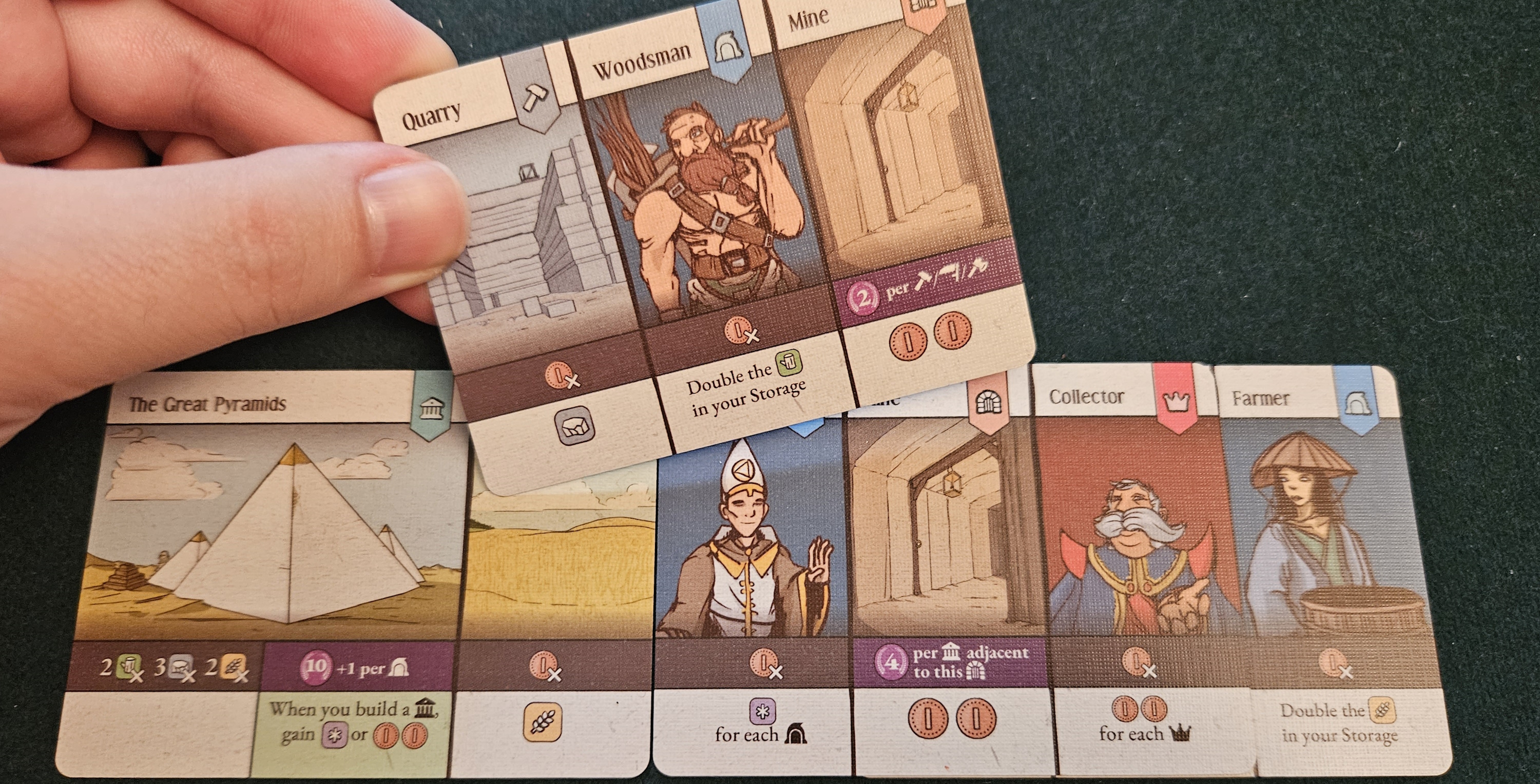
Is this game making a statement?
There’s an extractive assumption nested in there, forests and fields and mines, not to mention people themselves, being ground into the dust of history in order to produce short-term gains for your empire. It’s a spicy nod to the way empires default to valuing edifices over the hands that erected those edifices, and it generates fantastic tension.
The obvious draw is the wonders themselves; they’re big and expensive and drop whopper amounts of points, not to mention little ongoing bonuses. But the better example is the game’s mines. These are both your principal source of cash and worthwhile scoring goals in their own right. The problem is that you’re forced to choose between one and the other. Either a mine stays in your tableau until the end of the game, when it at last bestows its scoring bonus, or you crush it beneath another card to extract its gold. This is rarely an easy choice. Gold, after all, is your empire’s wildcard, able to buy the food, wood, and stone you can’t harvest for yourself. But like many of the best solitaire microgames, including Aramini’s oeuvre, this is a score-chaser first and foremost. Every placement represents not only one decision, but an entire chaos theory ripple-to-tidal-wave of future choices.
And it isn’t only the cards you place. Even the decision of how to refill the market can have lasting implications. You can freely throw away wonders to earn a minor infusion for your kingdom, maybe even netting that one crucial resource that will let you build something grander. But that’s only the half of it. Even ordinary cards are crucial, as their flip-side reveals an ongoing event. Maybe you earn some cash whenever you build a wonder, or you can trade resources freely this turn. But flipping that card into the market removes the event, forcing you to think about your long-term economy.
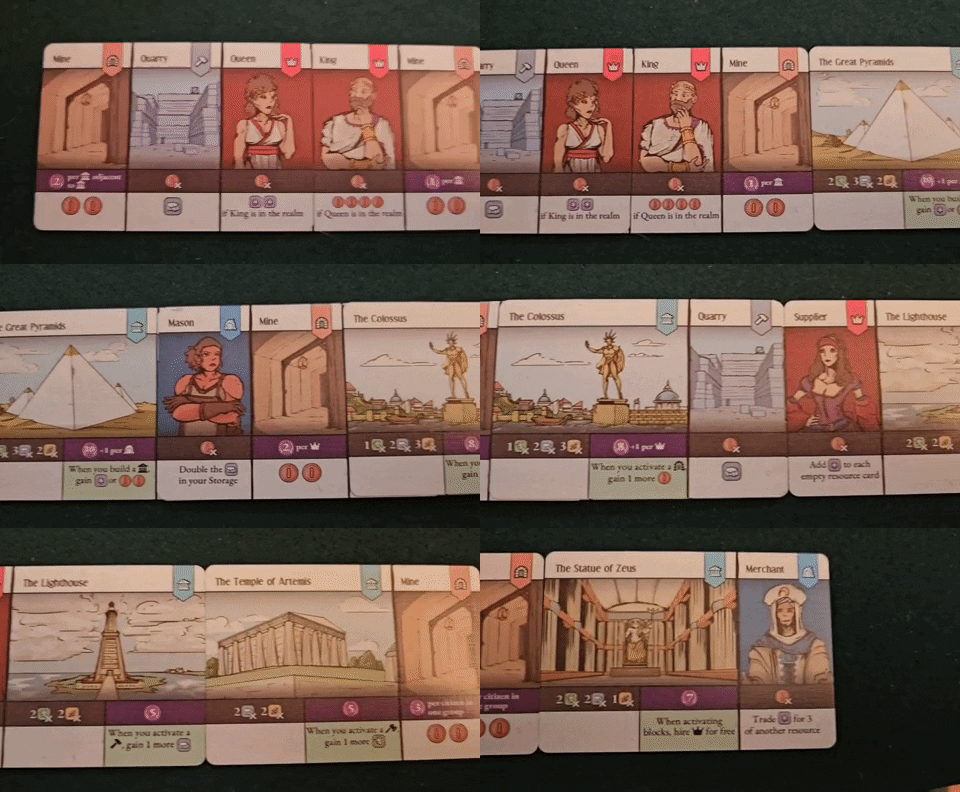
Behold! A very horizontal kingdom.
Longer term, anyway. This is still a ten-minute microgame. But it’s a striking microgame, one that demands repeat plays and even some furtive mulligans and backtracks. When a game that lasts only a fraction of an hour gets me to cheat, even if only by retracting a move to see how much better an alternate outcome could have been, that’s how you know I’m invested. Of Button Shy and Aramini’s recent duo of solitaire offerings, this is by far the stronger — and I hope it warrants further exploration the way Sprawlopolis did.
(If what I’m doing at Space-Biff! is valuable to you in some way, please consider dropping by my Patreon campaign or Ko-fi.)
A complimentary copy was provided.
Posted on August 1, 2023, in Board Game and tagged Alone Time, Ancient Realm, Board Games, Button Shy. Bookmark the permalink. 1 Comment.

 SPACE-BIFF!
Pingback: Flippin’ Heck | SPACE-BIFF!