Worldbreakers: The Gathering

Those of us who lived through the collectible card game boom of the 1990s approach our CCG derivatives with due suspicion.
Consider Worldbreakers: Advent of the Khanate, Elli Emir’s take on the genre. From one perspective, it’s the bastard child of Magic: The Gathering and Android: Netrunner, right down to the compulsive inclusion of a colon in its title. There’s nary a novel bone in the game’s body. Teaching it is as easy as confirming that your pupil also constructed decks in middle school. If anything, its slight differences from Magic — say, in the way attacks are resolved — are a sticking point for no other reason than because they’re so minor that they never wholly escape their daddy’s shadow.
On the other side of the coin, Worldbreakers is appealing for much the same reason. Amir has refined that august parentage into far more approachable offspring. It’s intuitive to teach, riffs on a few familiar chords, and crosses vivid new horizons. The result is that playing Worldbreakers is like exploring a hobby from adolescence for the first time.

Does the Baleful Viper toss vipers at her enemies? I hope so.
Sometimes literally, although that depends on personal experience. I’ve taught Worldbreakers to two people now. One is an old hand at Magic: The Gathering, whose basement countertop is currently cluttered with the draft cube he’s assembling. The other knows Magic only as a punchline, something he’s heard about from friends, but couldn’t tell an aggro deck from a control deck if they were both laid out in front of him for contrast.
And they were. Laid out in front of him, I mean. Rise of the Khanate, the first set for Worldbreakers, features four pre-constructed decks, one for each of its “guilds,” colors not unlike the mana types of Magic, and correspondingly these decks are strictly themed around each color’s dominant approaches to victory. In this case we were playing as Khutulun, heir to the Mongol Empire, and Marco Polo, that pasty European dude who hung out in the Mongol court for a while. In Amir’s parlance, these are the titular “worldbreakers,” magical potentates who can channel their alt-history’s mythical resource — aptly called “mythium,” although I could never stop calling them crystals — to amplify their natural abilities.
Khutulun’s natural abilities apparently revolve around rallying enormous quantities of soldiery to her banner, because that’s exactly how she plays. There are three types of cards in Worldbreakers, but you might spend quite a few rounds drawing from Khutulun’s deck before you see anything other than followers, this game’s version of creatures. Her followers are cheap and plentiful, and when you do get around to drawing an event card, the game’s single-use spell equivalent, these often revolve around bringing out more followers. But just because she’s leading a horde doesn’t mean they’re an unruly mob. Indeed, one of the cleverest things about Khutulun’s deck is that her troops are capable warriors in their own right. This soon becomes a defining characteristic of Worldbreakers, that there are no trash cards, that just because something is affordable doesn’t mean it doesn’t also pack a wallop when deployed at the right time or in the right way. For example, the pace of Khutulun’s game is deeply familiar to anyone who’s played with a mob of Magic’s red cards. She gradually swamps her side of the table with expendable followers only to unleash them over and over again, overwhelming her opponent with sheer quantity.
In sharp contrast to Khutulun’s churning momentum, Marco Polo is all about slowing down the action. His deck is brimming with the third type of card. These are camps, slight analogs of Netrunner’s agendas, which require a stiff cost up-front but gradually offer bonuses and perks with further development. This is usually as easy as spending a turn on the “develop” action, although the game’s action economy is so precisely throttled that doing so often feels like a turn that could have been better spent elsewhere. In the meantime, camps are vulnerable to enemy attack. Hence Marco Polo’s central tension: to win, he needs to build and develop his camps, a sequence of actions that would otherwise be pleasantly isolated, but the threat of rival attacks forces him to surgically disrupt his opponent’s tempo.
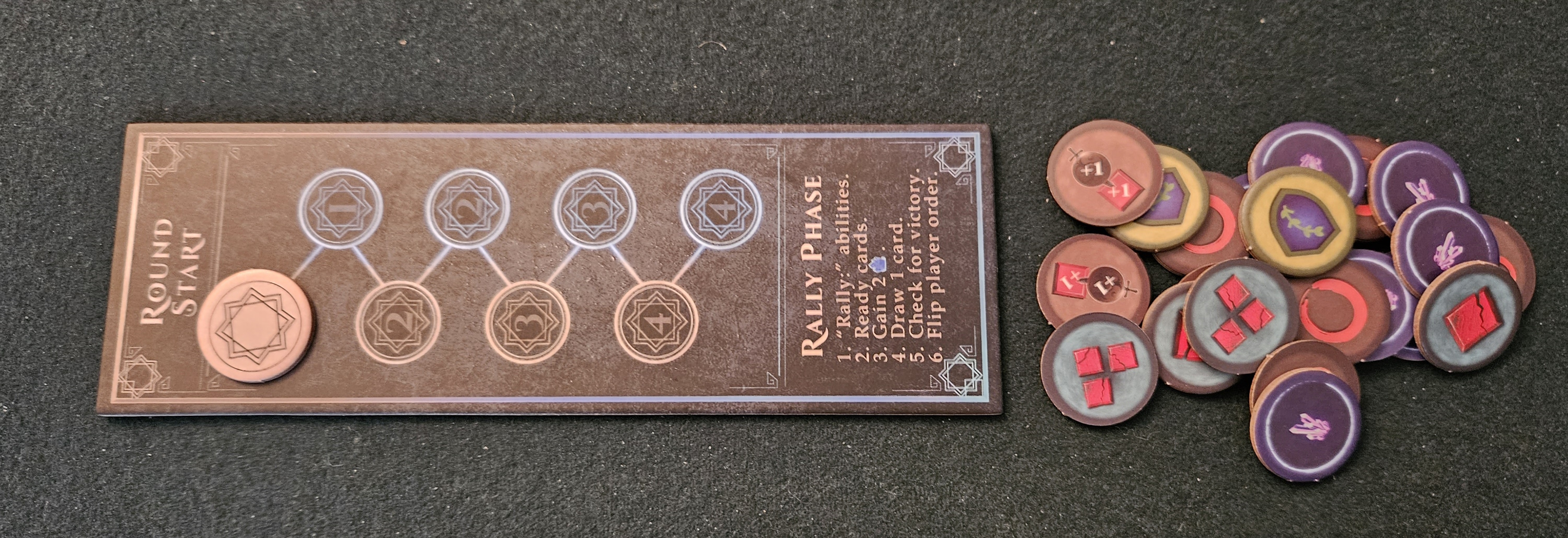
The round track ensures that every action matters.
Like I said, it was aggro versus control. But while my uninitiated friend found the rules breezy enough, he soon floundered when it came to putting theory into practice. He simply couldn’t find the beat. My other pal, the one with the cube draft on his counter, more or less waved off my instructions as too recognizable to bother listening to again, and was soon playing competently.
This maybe makes Worldbreakers sound a whole lot like Magic. And it is. But the distinctions are worthy of note. I mentioned that Worldbreakers exerts strict control over its action economy. Rather than permitting wide-open turns, actions pass rapidly between sides, one at a time. On occasion there are special effects that will bestow a second action, but these are rare and precious things. A single round allows only four actions per side before offering a quick infusion of crystals and an extra card draw — and possibly triggering a special ability or two — and then resetting the table for the next bout. It’s fast and fierce, forcing every single action into the spotlight. It isn’t uncommon to spend an action drawing a card or harvesting a crystal. These always feel like failures of planning despite their inevitability, encouraging players to find better combos or further streamline their play order. Meanwhile, other actions are appropriately climactic, like launching a big attack. Or even a small attack, depending on the faction.
For example, Ruknuddin Khurshah, the worldbreaker leader of the Order of Assassins, loves to deploy single attackers. His deck is full of specialists who only reveal their full potential when fighting solo, dealing unblockable wounds or bringing home crucial resources. The Muhandasat, a council of six genius engineers, would rather never attack at all, instead forming internal combos that resolve at the end of the round to build their power.
Power, by the way, is the game’s win condition. The entire duel is pitched as a race to ten power tokens. There are only a few ways to gain the stuff, but they’re nicely distinguished by guild. Khutulun leans into the whole Golden Horde angle. Everyone earns power when their attacks breach past defenders, but her troops sometimes gain power simply by showing up on the field of battle. Again, momentum is her watchword, and it’s common to see her setting the game timer by earning a trickle of power tokens each round. Marco Polo has the steady income of his camps, the Muhandasat pull their keyword tricks each round, and the Order of Assassins assassinates people. They do so love their branding.
Further, this emphasis on gaining power, rather than, say, wiping out a rival wizard’s pool of hit points, goes a long way toward setting the tone of Worldbreakers. It’s a beautifully drawn world, full of joy and menace alike, and there’s an undercurrent of optimism that suits the idea of building something rather than merely tearing it down. Of course, evaluated as nothing more than a function of raw arithmetic, there’s really no difference between counting to ten or counting backwards from ten. In practice, however, counting upward allows the game to feel constructive. The Muhandasat are a council of women engineers building a technological utopia in the 13th century, for crying out loud. The entire game world is full of little corners like that, details that feel real and lived-in simply because they depict people, however magically gifted, who see themselves as doing something good and fine.
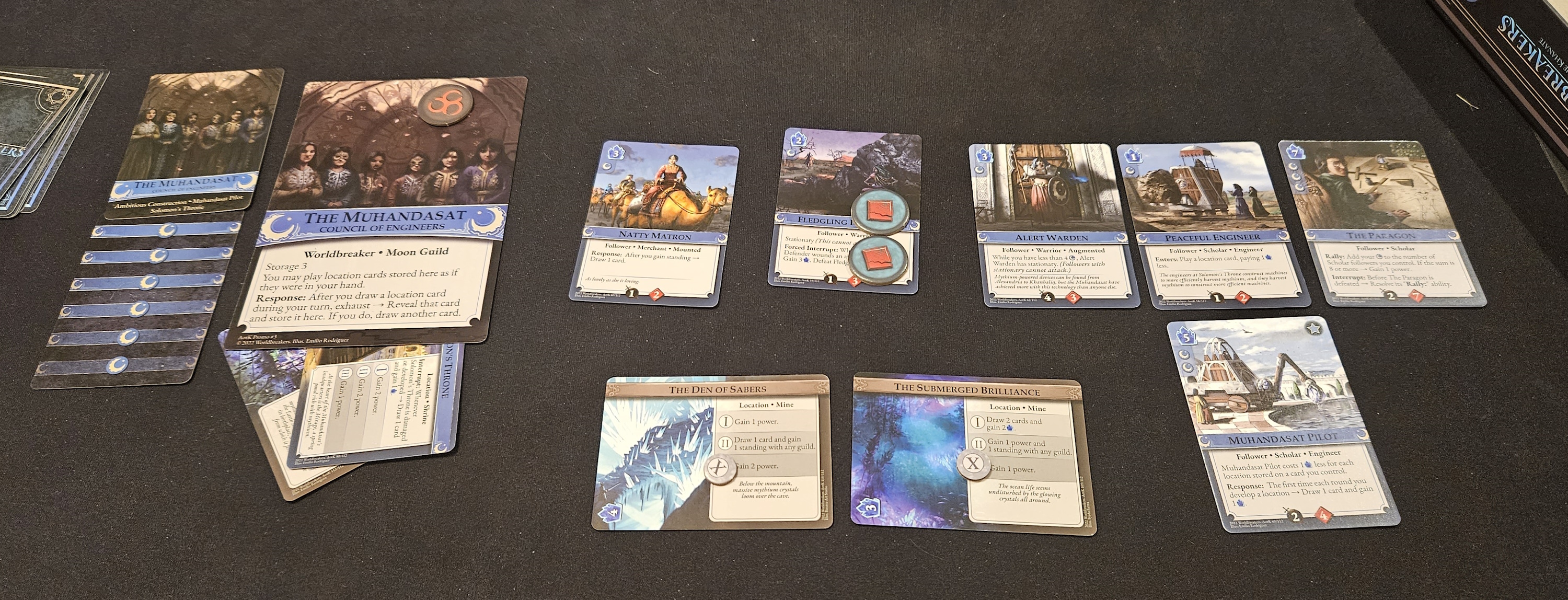
Each of the game’s four worldbreakers is distinct and vibrant.
This isn’t to say that Worldbreakers is perfect. Its proximity to Magic means it imports some of that game’s peccadilloes, including the very real possibility of bum draws — a flaw that’s only exacerbated by the way its decks are constructed. Decks are a slender thirty cards, but no duplicates are permitted. This allows each deck to cover a lot of ground, which I actually prefer to template decks filled with duplicates, but doesn’t do much to ensure that certain cards wind up in your hand.
Construction here is more holistic, leaning toward general strategies rather than revolving around particular cards. Unfortunately, I still feel like I haven’t seen Worldbreakers at its best. The pre-constructed decks are perfectly serviceable, but each one revolves around only a single guild type. The game could open up considerably once two or three guilds are merged, but the drafting rules as they stand are somewhat baggy. Every single unique card is drafted, and we found that we could focus on a color and then more or less reconstitute its deck intact. There would obviously be a few subtractions, but Marco Polo was still pitching tents while Khutulun swarmed her rival. After drafting, we were fielding the same general decks, but with a few errant cards and more actions spent drawing or leveling up our guild standings.
To some degree, this might reflect a difference of drafting philosophy more than a flaw in the game. When it comes to drafts, my preference is for working with difficult choices and emergent combinations. By putting up every card in the set during the draft, there’s little need to improvise. More often, we defaulted to grabbing cards based on color over every other consideration — and avoiding those guilds, like the blue guild with its high need for keywords, that are more particular. There’s currently an expansion on the way, The Indigo Sisterhood, and I’m curious whether it will simply jumble its 40 additional cards into the mix. As it stands, our drafts took longer than the ensuing matches by about double, so I hope Amir has a more elegant solution in mind.
I hope so. Worldbreakers also supports custom decks, but my tastes (and free time) have transitioned since middle school. My schedule no longer accommodates lazy afternoons for poring over binders of cards. The more compact format and card pool would certainly be easier to work with than the heaps I once popped out of blister boosters, but the main ways I play these CCG descendants is through pre-constructed decks and drafts. While the former are well done in Worldbreakers, at least enough to warrant a couple dozen matches, the latter needs to feel perfect to keep my attention. As it stands, Worldbreakers isn’t there yet.
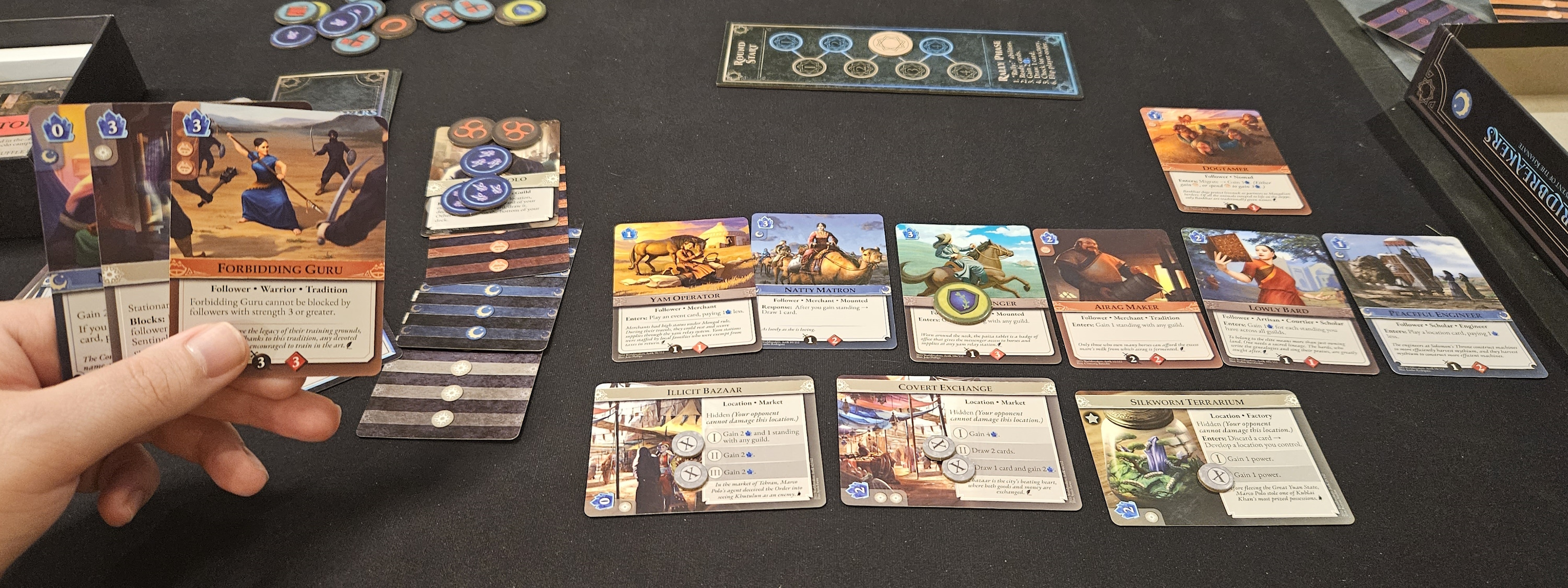
The draft allows wilder builds, but is too baggy for my tastes.
Like I mentioned at the outset of this review, the quality of Worldbreakers is at least partially a matter of perspective. Personally, I appreciate its low-key improvements to the Magic formula. This is a game that I haven’t had to learn so much as been allowed to experience. It’s lovely to sit down at the table and already know the gist of what’s coming, and then to be surprised at the kinks it puts in the genre, the vibrancy of its world, the way it plays with my expectations. It isn’t wholly the game I want it to be — it leans more toward Magic than Netrunner, for one thing, and some sharper drafting rules wouldn’t go amiss — but it’s close. Darned close.
The game’s first expansion, Worldbreakers: The Indigo Sisterhood, is currently on Kickstarter.
(If what I’m doing at Space-Biff! is valuable to you in some way, please consider dropping by my Patreon campaign or Ko-fi.)
A complimentary copy was provided.
Posted on June 19, 2023, in Board Game and tagged Board Games, The Fruits of Kickstarter, Worldbreakers: Advent of the Khanate. Bookmark the permalink. 7 Comments.

 SPACE-BIFF!
I feel like there has been a resurgence of CCGs and CCG-likes lately. What is curious to me is that it is not just games by big companies (Lorcana, One Piece), but even indie ones like Grand Archive and Worldbreakers that are finding a lot of support.
Hey, that’s great! I’m not plugged in enough to notice that trend, but if that’s the case, more power to the indies.
I backed Worldbreakers on Kickstarter, and I am glad I did. I’m happy it exists, and that I helped a bit with that. My experience with it has been good so far, and/but I think that Dan’s article is very fair and considered (as always), and that it captures a lot of how I feel about the game at this stage.
Dan, you’re the best reviewer in the hobby by miles. You review a lot of niche games that I will likely never play, and I feel like reading your reviews gives me an amazing sense of what it would be like to play those games.
Reinforcing that sense is the fact that your reviews of games I HAVE played match my experience pretty closely. If we were friends, I don’t think we’d have much trouble agreeing on what to play.
So this review is interesting, because I just played Worldbreakers the other day and you didn’t touch at all on the thing that jumped out the most to me about the game: its pacing.
The game felt glacial. Yes, it’s a race to 10 points, but it’s not one where anything interesting or surprising ever happens. Everything is so throttled, it can only ever proceed one or two power at a time. Like a slo-mo finish that starts far too soon. It just becomes a grind.
To me, this is the new quintessential example of a game where the mechanics are pretty much perfect but the game is uninspired.
Judging by your past reviews I expected you to mention something along those lines, so I was surprised you didn’t.
What do you think? Just a difference in taste?
Hm, I suspect our experiences haven’t lined up. The pace of Worldbreakers is indeed deliberate, but I haven’t ever felt like it’s too pokey. If anything, some of my matches were over earlier than I wanted them to be! But I’m happy to defer to somebody else’s experience. It sounds like the game doesn’t always move at the speed that it ought to.
Wow, I also have always thought that “baleful” meant something along the lines of “hangdog”, sad, a little melancholy maybe. How did we both come to the same erroneous conclusion?
It just sounds that way! I don’t know why!