Fighters in Spaaaaace

There are so many things in Jordan Nichols and Michael Dunsmore’s Star Fighters: Rapid Fire that ought to be my jam. This is a real-time game (check) about chucking dice (check) and assigning them to a starship’s dashboard (check) in order to blast your opponent out of the sky (check check check). That’s a lot of checks. An entire preflight checklist’s worth of checks.
Upon takeoff, however, the flight was turbulent. Or perhaps it wasn’t turbulent enough. There’s no turbulence in outer space. What I’m saying is that it didn’t go as I’d hoped. After giving it some thought, there are two reasons for Star Fighter’s failure to launch. Now there’s the right metaphor! One, this game doesn’t seem to know what to do with its dice. And two, it’s been done before with far greater panache.
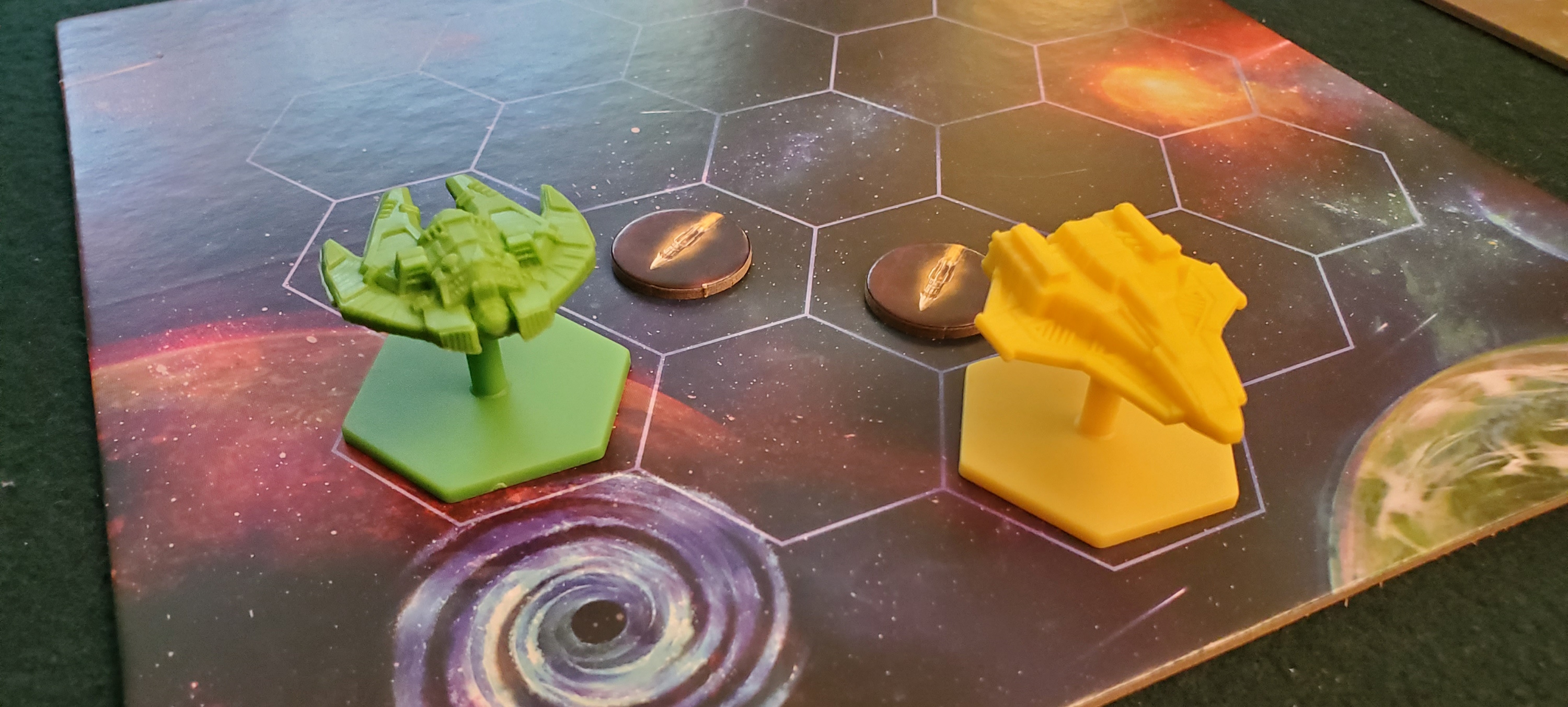
Dodging torpedoes.
Let’s begin with the basics.
In Star Fighters, you are, as expected, the ace crotch-jockey of a star fighter. Your goal is to fly fast, fire on target, and squat out the occasional torpedo. To simulate the high-wire thrills of piloting such a vehicle, most of the game is played simultaneously and in real-time. Both players — with options for three or four players if you’re willing to settle for some jankiness — roll their dice at the same time. And then reroll. And then reroll some more. When the right results pop up, you slap them onto your ship’s dashboard. Eventually, when the proper moves have been programmed in, you give a shout to pause the action. At this point, the game slows to a more sedate pace, with everybody taking turns to resolve their dice.
Almost right away, Star Fighters outs itself as a particular sort of real-time game. For simplicity’s sake, there are two broad types. The first type is all about making decisions under pressure. You have multiple options, but the constant ticking of a timer — in this case, the presence of a rival fighter rather than the countdown of a mechanical timer — forces you to make those decisions as quickly as possible, often resulting in suboptimal moves. In the second type, the decisions are more muted. You aren’t faced with tough decisions so much as the need to get something done right now. These two types of real-time game might seem superficially similar. Sure enough, they both prioritize speed. But the first type is about making decisions. The second type is about reflexes.
Star Fighters sits in the second category. There are precious few decisions to be made at any given moment. As evidence, consider the dice. These are simple little things. Most of their sides are blank. Blanks can’t be assigned at all. The other sides dictate whether they can be placed. Along with their color, dice either slot into a system or they don’t. If you have a blue die, it can be used to move your ship forward or rotate your ship. That’s almost the entirety of it. A red die can be used to fire lasers or torpedoes. On rare occasions, a mix of blues and reds can be used to recharge your shields. This isn’t often a good move for no other reason than because it requires more bandwidth. More often, an attack can be avoided by darting away from it.
In other words, Star Fighters is about rerolling dice. Whenever you roll the dice, most of them inevitably come up blank. There’s no decision to be made. So you reroll them, assign the marked faces that come up, and then roll them yet again. It’s all speed and very little forethought. Which is fine, I suppose, but it makes an evasive maneuver on the principal reason I play real-time games, or even board games. I like making decisions, including under time pressure. Here, I’m being tasked with automating random inputs. My own inputs, decisions, are barely there.
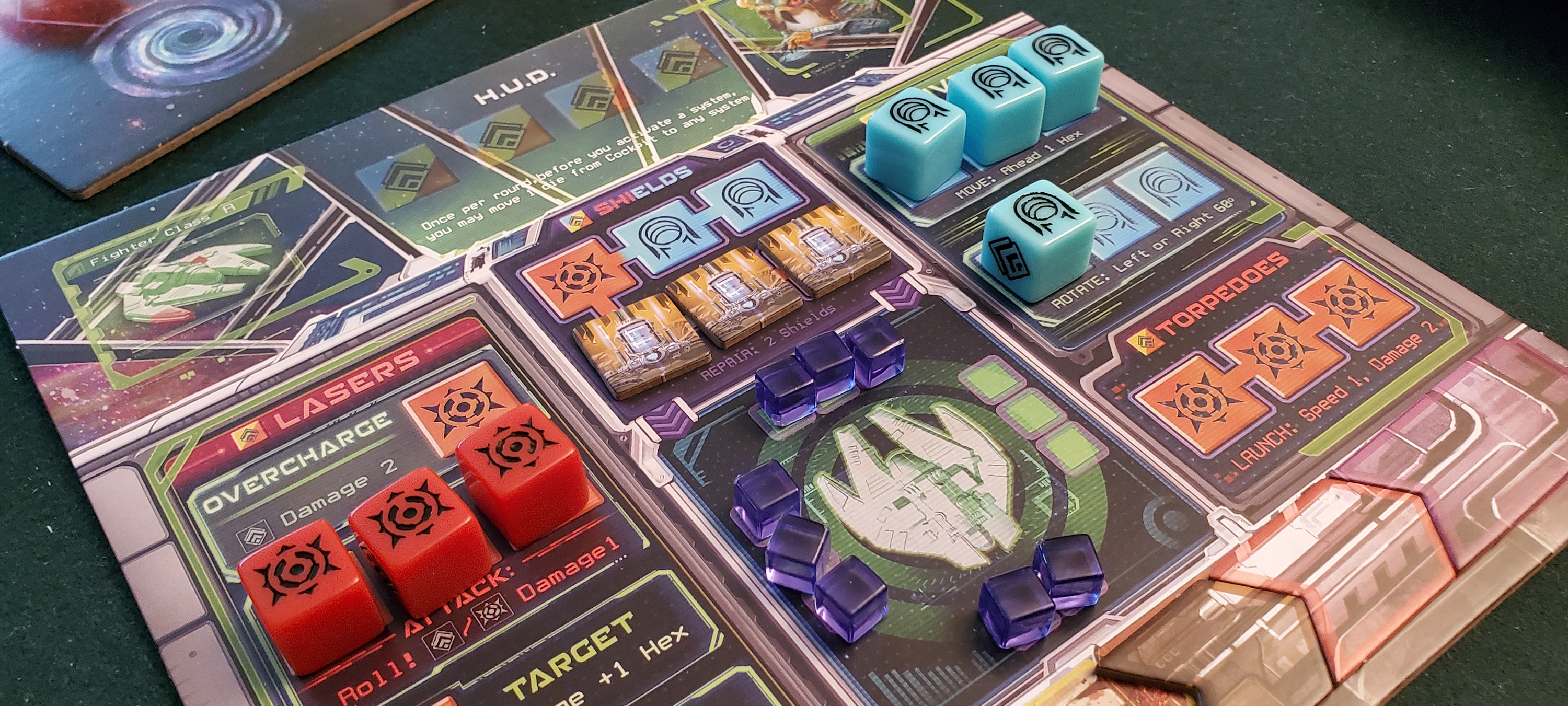
The dice placement options are rather limited.
Okay, so Star Fighters isn’t my kind of game. That might say more about me, a fuddy-duddy of thirty-six with crumbling reflexes, than about the game itself. Fair enough.
Except everything about Star Fighters keeps reminding me of a superior game from a while back. A full decade ago, dammit. I’m talking, of course, about Space Cadets: Dice Duel by Geoff and Sydney Engelstein. On the surface, an observer might mistake them for the same game. They’re both simultaneous real-time games. They’re both about chucking dice and assigning them to dashboards. They’re both about star fighters trying to blast each other to smithereens.
In practice, however, their dissimilarities are greater than their parallels. For one thing, Dice Duel was a team game. Rather than seating you in the cockpit of an X-Wing, its point of reference was the bridge of the Enterprise. Maybe more accurately the Defiant, a faster and deadlier vessel that still required a dedicated team to function. Everybody manned their own unique station, sometimes two or three, sometimes even swapping roles mid-battle. In that regard, it was the Captain Sonar of its day. Managing the helm was its own minigame. So was the sensor suite, and the torpedo tubes, and shields, and jamming, and everything else. It was, at times, a bit extra. Targeting the enemy ship required some math. Basic math, but math all the same. It was all about making decisions under pressure, not merely on your own, but as a cog in a greater war machine.
I don’t mean for this to become a review of Dice Duel. Nor, really, to slam Star Fighters by comparison. But the parallel is an apt one. Dice Duel was a wholly rounded experience. Its expanse of space was treacherous, forcing players to avoid asteroids and nebulae or take advantage of wormholes. The stellar cartography in Star Fighters is limited to the width of a football field and sports a single wormhole pair. You’ll use it often, warping from one side of its tiny map to the other to avoid the torpedo that’s on your tail. But it’s otherwise textureless, empty, small. The same goes for everything else in Star Fighters. The decisions are muted, almost automatic. The dice are bland. The experience is brisk and unsatisfying. I guess it’s quick. That’s one thing it has over on Dice Duel, which could drag on. But it feels like a side quest to that game’s broader confrontation, like a minigame you might play, a fighter darting out between capital ships. Wouldn’t that be something? On its own, it’s too meager even for a snack.

I don’t think the dice bowls are included.
I wanted to like Star Fighters. Even as a game that prioritizes reflexes over decisions, it could have done more to give an impression of the speed of its vessels, their velocity, their killing sharpness. Instead, it hones its lasers on a weak dice system. There’s space for a game like this, a faster and leaner compression of Dice Duel. Star Fighters isn’t it.
(If what I’m doing at Space-Biff! is valuable to you in some way, please consider dropping by my Patreon campaign or Ko-fi.)
A complimentary copy was provided.
Posted on June 1, 2023, in Board Game and tagged Alley Cat Games, Board Games, Star Fighters: Rapid Fire. Bookmark the permalink. 2 Comments.

 SPACE-BIFF!
Shame. I have Space Cadets Dice Duel, but I wonder if I’ll ever have enough interested players to give it a go.
Pingback: Skimping on Parchment | SPACE-BIFF!